
Most Digital Asset Management maturity models in active use today were built in a different era - before MCP and the Model Context Protocol, before agentic workflows became operational reality, before CSRD obligations made carbon reporting non-optional, before C2PA shifted content provenance from concept to checkpoint. They date themselves the moment they are published. Today, in collaboration with DAM News, we are releasing AMM-26 - the Activo DAM Maturity Model 2026.
1. Why a 2026 maturity model
Four shifts in the DAM landscape made the existing models structurally insufficient. AMM-26 is built around all four.
1.1 AI moves from feature to substrate
Auto-tagging is no longer a checkbox; it is the floor. Above it sits a stack that today's models barely acknowledge: agent-driven search, MCP-mediated tool use, agentic workflows orchestrating multiple systems, embedding-based retrieval, generative variants, and AI-attributed analytics. AMM-26 introduces an explicit AI-amplified marker on seven dimensions where AI does not merely speed up the work but changes the maturity criteria themselves.
1.2 Composability is the new default
MACH, headless, event-driven, iPaaS - the DAM is no longer a destination but a participant in a content fabric. AMM-26 elevates Composability & Integration (D9) as a first-class dimension and links it to the technical floor (D8) and the agentic layer (D10) to capture how well the DAM plays with the rest of the stack.
1.3 Provenance and regulation become operational
C2PA is no longer a research project. The EU AI Act, RGPD/GDPR, ISO 42001 and CSRD have moved AI training data, content provenance, and rights management out of legal-and-compliance and into the daily operating model of every DAM team. D6 Rights, Compliance & Provenance captures the full provenance posture, not just the rights metadata fields.
1.4 Sustainability stops being optional
CSRD reporting obligations and the runaway compute cost of AI inference are reshaping how mature DAM organizations think about storage, renditions, retention, delivery, and AI model selection. AMM-26 newly elevates SUSTAINABILITY as a sixth capability domain - three dimensions (D15, D16, D17) covering carbon visibility, lifecycle efficiency, and compute-and-infrastructure footprint.
2. What AMM-26 is, at a glance
AMM-26 is a vendor-agnostic, AI-aware maturity model for Digital Asset Management. It describes a maturity trajectory, not a product roadmap, and is usable with any DAM platform on the market. The structure is:
→ 6 capability domains · ORGANIZATION, INFORMATION, SYSTEMS, PROCESSES, ACTIVATION, SUSTAINABILITY.
→ 17 dimensions · each independently positioned on the maturity scale.
→ 5 maturity stages · Initial → Foundational → Structured → Connected → Adaptive.
Vendor-agnostic. AI-aware. Outcome-anchored.
Each of the 17 dimensions is positioned independently against the 5-stage scale. The resulting profile is a fingerprint, not a single score - a maturity radar that reveals exactly which capabilities are ahead of the pack, which are gating progress, and where the next quarter's investment should land.
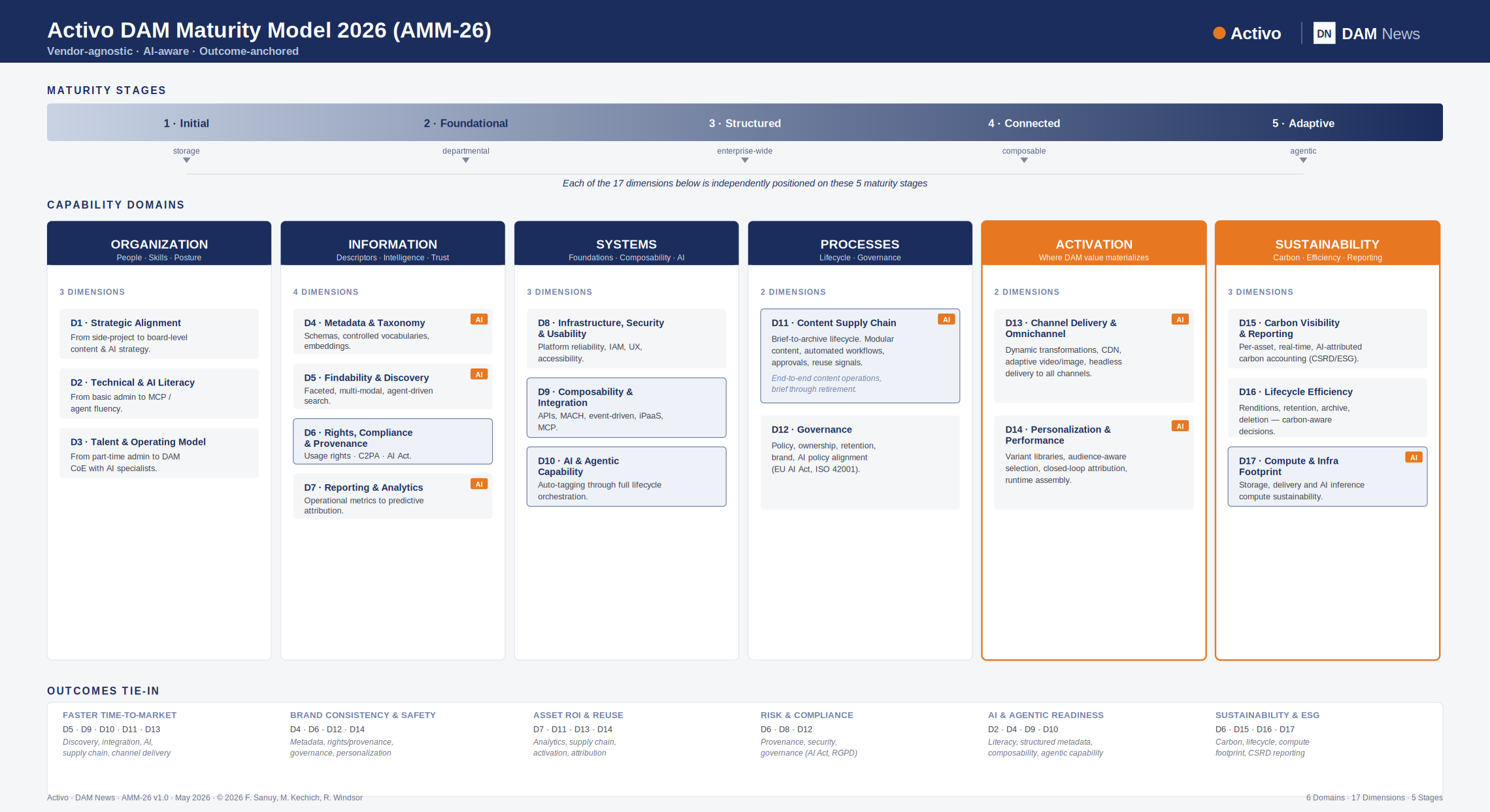
Figure 1 · AMM-26 framework at a glance - 6 domains, 17 dimensions, 5 maturity stages, anchored to six business outcomes.
3. The six capability domains
Together, the six domains describe a complete DAM practice. ACTIVATION and SUSTAINABILITY are newly elevated in AMM-26 as first-class domains, recognizing that the value of a DAM materializes downstream - in channels, audiences and outcomes - and that its environmental footprint is now a board-level concern.
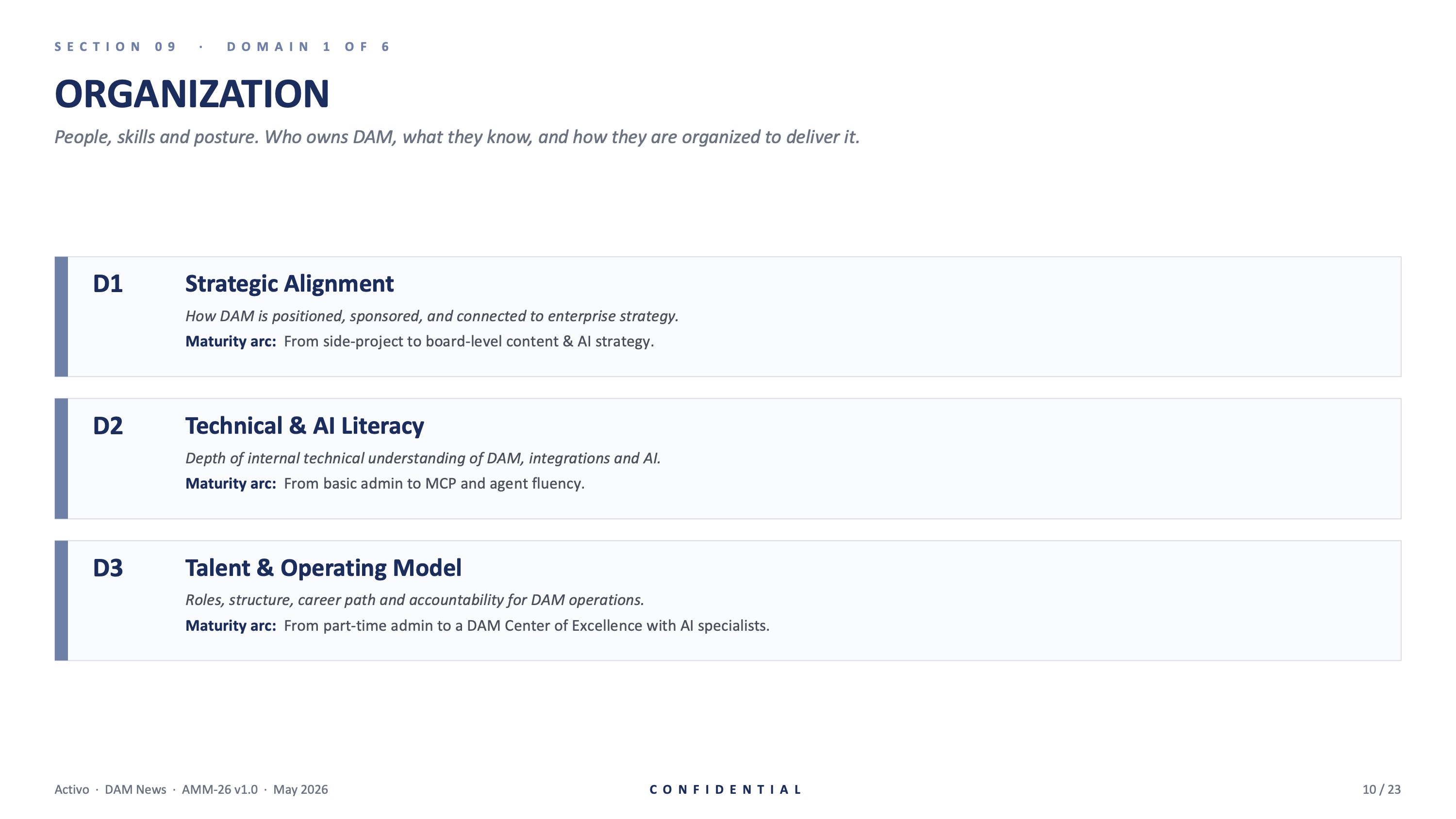
→ ORGANIZATION (D1–D3) covers people, skills and posture. Strategic alignment, technical and AI literacy, talent and operating model. Manual entry only - these dimensions are not feature-bound.
→ INFORMATION (D4–D7) covers descriptors and trust attributes. Metadata and taxonomy, findability and discovery, rights and provenance, reporting and analytics.
→ SYSTEMS (D8–D10) covers the technical foundation. Infrastructure and security, composability and integration, AI and agentic capability.
→ PROCESSES (D11–D12) covers the content lifecycle end-to-end. Content supply chain and governance.
→ ACTIVATION (D13–D14) covers where DAM value materializes. Channel delivery and omnichannel, personalization and performance.
→ SUSTAINABILITY (D15–D17) covers the environmental footprint. Carbon visibility, lifecycle efficiency, compute and infrastructure footprint.
4. The 17 dimensions


5. The five maturity stages
6. Relationship to the DAM News Open Specification
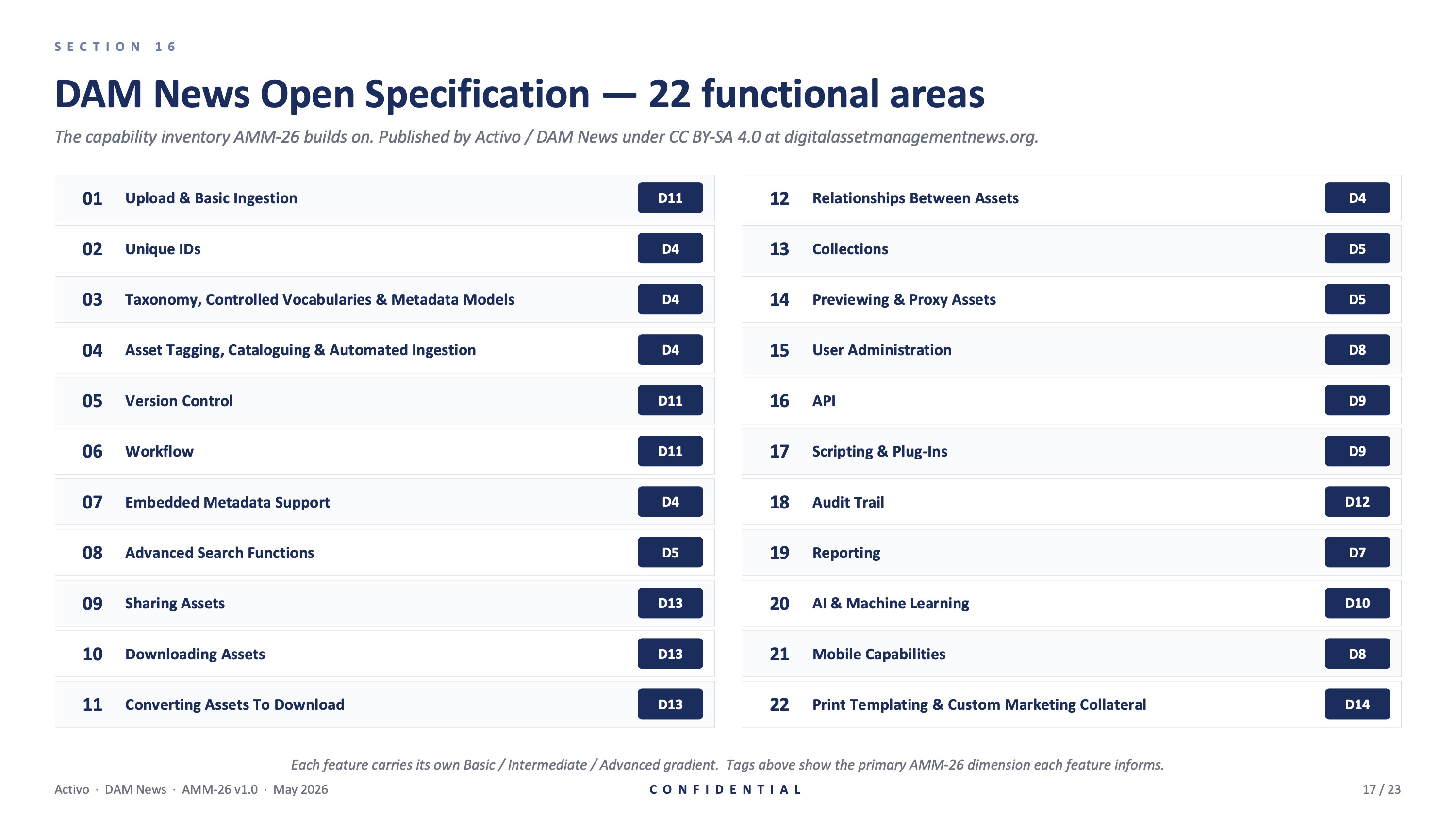
AMM-26 is built on top of the DAM News Open Specification (CC BY-SA 4.0), the vendor-agnostic capability inventory for DAM functionality published and continuously edited at digitalassetmanagementnews.org.
The Open Specification covers 22 functional areas - from Asset Tagging and Cataloguing through Advanced Search Functions, Embedded Metadata Support, Audit Trail, AI & Machine Learning, and more. AMM-26 maps each of these areas to one or more dimensions, and uses the Basic / Intermediate / Advanced gradient inside each area as the source signal for auto-computing dimension scores.
Beyond the Open Specification, AMM-26 adds the layers the Open Spec deliberately leaves out: people, AI, activation and sustainability. D1–D3 (Organization), D6 (Provenance), and D15–D17 (Sustainability) are not feature-bound. They are assessed manually - because no feature inventory can capture board sponsorship, AI literacy, C2PA posture or carbon reporting maturity.
7. What you get with AMM-26 v1.0
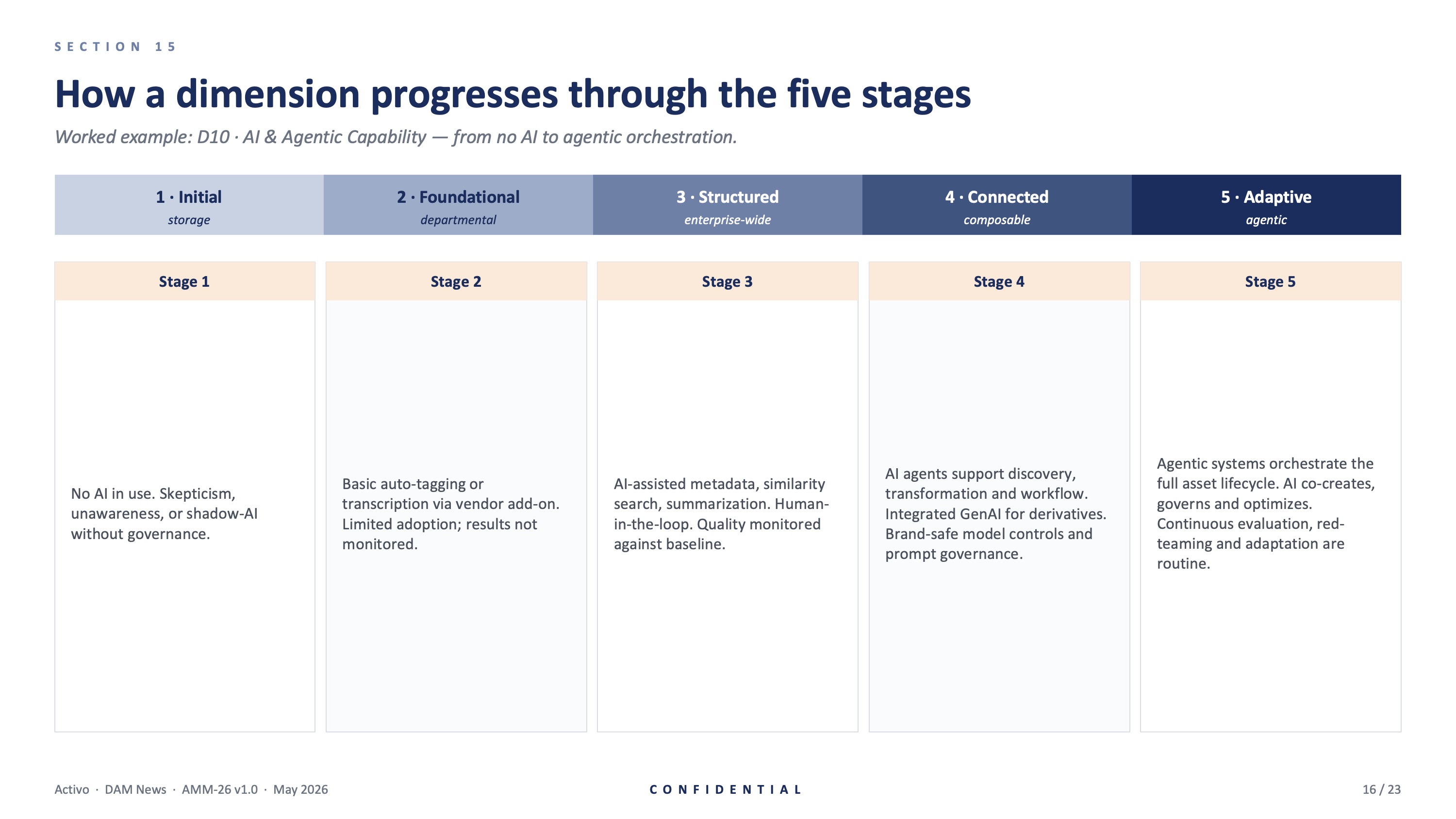
→ A 23-slide initiation deck - covers the four shifts, the framework architecture, the six domains, the dimension catalogue, a worked stage progression on D10 (AI & Agentic Capability), the cross-walk with the Open Specification, and a sample maturity profile.
→ A self-assessment Excel workbook - six sheets covering the Open Spec rating, the per-dimension fingerprint with auto-computed and manually-overridable scores, the per-domain rollup, a live maturity radar that auto-updates as scores populate, and a reference sheet with stage criteria.
→ A maturity radar visualization - the 17 dimensions plotted on the 1–5 scale, with a Stage 4 target ring, navy current-stage polygon, and orange-highlighted Stage 1 gap dimensions. Available both as the live Excel chart and as a standalone illustration.
→ A reference framework - for vendor evaluation (vendor-by-vendor scoring against AMM-26 dimensions), target-state planning (where you want to be in 12 / 24 / 36 months), and onboarding journey design (how to move from one stage to the next on a given dimension).
8. How to use AMM-26
The assessment workflow is deliberately compact. A first pass takes one to two working days for a single business unit; a full enterprise assessment with stakeholder interviews typically takes two to three weeks.
→ Step 1. On the Open Spec assessment sheet, rate the organization's capability against each of the 22 functional areas - None, Basic, Intermediate, Advanced, or N/A. Add evidence or notes per feature in the rightmost column where available.
→ Step 2. Open the Dimension fingerprint sheet. The AMM-26 dimension-level scores compute automatically from the Open Spec ratings, mapped through the dimension-to-feature cross-walk. Each dimension shows an auto score, a manual override field, an effective score, and a derived AMM-26 stage.
→ Step 3. Override manually where the auto score does not reflect reality - especially for Organization (D1–D3), Provenance (D6) and Sustainability (D15–D17), which are not derivable from feature ratings alone.
→ Step 4. Review the Domain summary for the six-domain rollup and the Maturity profile sheet for the visual fingerprint. The radar redraws automatically as values populate.
→ Step 5. Use the Reference sheet for full definitions of each dimension and each maturity stage. Use the profile to prioritize the next phase of work.
9. Outcomes: what AMM-26 delivers
Every dimension is tied to one or more business outcomes. The fingerprint and the outcome ambitions drive the prioritization sequence:
→ Faster time-to-market - D5 Findability, D9 Composability, D10 AI, D11 Content Supply Chain, D13 Channel Delivery.
→ Brand consistency and safety - D4 Metadata, D6 Rights and Provenance, D12 Governance, D14 Personalization.
→ Asset ROI and reuse - D7 Analytics, D11 Supply Chain, D13 Channel Delivery, D14 Performance.
→ Risk and compliance - D6 Provenance, D8 Security, D12 Governance (EU AI Act, RGPD, ISO 42001).
→ AI and agentic readiness - D2 AI Literacy, D4 Structured Metadata, D9 Composability, D10 Agentic Capability.
→ Sustainability and ESG - D6 Provenance, D15 Carbon, D16 Lifecycle, D17 Compute Footprint (CSRD-aligned).
10. Roadmap to v1.1
AMM-26 v1.0 is the foundation. Six items are on the table for v1.1, contingent on practitioner feedback:
→ 01 Feature-level cross-walk. Map each Basic / Intermediate / Advanced criterion in the Open Specification onto the AMM-26 maturity stages, so practitioners can assess at feature level and roll up.
→ 02 Accessibility (WCAG). Visual contrast, keyboard navigation, screen reader support for the DAM UI and the delivered assets. Increasingly mandatory under the EU EAA (2025).
→ 03 MAM/PAM-adjacent capabilities. Broadcast workflows, video transcoding pipelines, 3D and AR assets - referenced today by D11 and D13 but not first-class.
→ 04 AI dimension granularity. Whether to split D10 into Generative / Discriminative / Agentic, or keep it aggregated as a single trajectory.
→ 05 Industry overlays. Regulated industries (pharmaceuticals, finance, automotive), retail, media. Likely appendices rather than core changes.
→ 06 Licensing. Recommendation to publish AMM-26 under Creative Commons CC BY-SA 4.0, consistent with the Open Specification.
11. Open draft · comments welcome
This is v1.0. We are releasing it as an open draft for practitioner review, not a finished standard. Comments, push-back, and contributions are explicitly welcome via:
→ DAM News fireside chats, which will run dedicated sessions on the framework and the assessment workbook.
→ Activo's professional network - direct feedback to the authors below.
AMM-26 is intended to be a community asset, not a vendor pitch. The recommended licence is Creative Commons CC BY-SA 4.0, consistent with the DAM News Open Specification.
About the authors
Frédéric Sanuy - CEO and Co-Founder, Activo. Twenty-five years in enterprise creative production and digital asset management, with a long focus on the intersection of DAM, PIM, AI and content supply chain operations across LVMH, automotive, FMCG and retail clients.
Malika Kechich - Executive Director and Co-Founder, Activo. Senior consulting leader specializing in DAM, PIM, and content operations transformations. Drives Activo's delivery and methodology.
Ralph Windsor - Director and Chief Editor, DAM News. Founder and editor of digitalassetmanagementnews.org and author of the DAM News Open Specification. Twenty-five years covering the DAM market as an independent analyst.
AMM-26 v1.0 · May 2026 · © 2026 Activo / DAM News. All rights reserved. Recommended licence: Creative Commons CC BY-SA 4.0.


