Fotoware’s “Reimagining DAM” user conference took place on 19 March 2026 in Munich, Germany. The event brought together DAM professionals, technology partners, industry analysts, and thought leaders to explore how Digital Asset Management is being fundamentally reshaped by AI, content authenticity standards, and the ever-growing demands of modern media workflows.
This comprehensive recap captures the keynote sessions, product announcements, strategic insights, panel discussions, customer use cases, and awards from the conference - from Fotoware’s product vision to the critical role of IPTC, C2PA, and Content Credentials in building trust in the age of AI-generated media.

“Driving pioneering innovation to make a difference in users’ lives.”
- Fotoware Vision
“Enable people and organizations to do more with their content.”
- Fotoware Mission
Fotoware positions itself as more than a DAM vendor - it is a content lifecycle partner. Every piece of content has a purpose: a story to tell, knowledge to share, or a memory to preserve. From newspapers like the Financial Times and L’Equipe, to police forces like the London Metropolitan Police and Hamburg Polizei, to cultural institutions like the Rijksmuseum and the Munch Museum, and to major sports organizations like UEFA - Fotoware powers content journeys across diverse sectors.
Founded in 1997 as an early pioneer in the DAM space, Fotoware has grown from a founder-owned startup into a mature SaaS platform. Key figures today:
850+ customers
40 countries
80+ employees
98% customer satisfaction
15 years average customer tenure
24 partners
Key milestones span from the launch of FotoStation and FotoWeb in the early years, through the SaaS transition, acquisition of Picturepark, consent management pioneering, to today’s platform for the future with modernized FotoStation and expanded service teams.
The conference opened with a compelling look at the forces reshaping the DAM landscape. The rapid expansion of digital assets and formats across sectors is redefining the scale and complexity of DAM, demanding new ways of working that can handle high-volume, multi-format content operations.
221 zettabytes of global data creation in 2026, projected to nearly double by 2028 driven by digital images, videos, and rich media.
34 million AI-generated images created daily across 2,000+ tools, reflecting a fundamental shift in visual content creation.
46% of marketers citing a move toward video as a key driver of rising content demand.
By 2027, 50% of large organizations will have failed to unify engagement channels, resulting in disjointed digital experiences.
By 2030, AI regulation will cover 75% of global economies and increase compliance spend.
By 2030, 25% of IT work will be done by AI alone.
Sources: Gartner, BusinessWire, Adobe, Forbes, Forrester, IDC
A major theme was the growing tension between the power of AI-generated content and the need for trust, traceability, and governance. Content trust and traceability challenges intensify with the rise of AI-generated media. Simultaneously, governments and regulatory bodies are introducing new rules, increasing governance requirements placed on organizations managing digital assets.
Fotoware presented its innovation strategy organized around six market-aligned themes:
AI: AI-powered insights, advanced tagging, customer-specific AI tagging, agentic AI, asset intelligence. Harnessing AI while addressing governance, authenticity, and control.
Content Authenticity: Content Authenticity workflows for authenticity and transparency of any asset, leveraging the C2PA standard.
Governance, Compliance & Control: Privacy, AI, copyright require stricter control over digital assets, with robust support for compliance and rights management.
Security: Doubling down on security, redundancy, anti-hacking automation. Data sovereignty as a growing concern.
Enterprise-wide Orchestration Hub: DAM as an integrated ecosystem connected throughout the organization, with granular data retrieval and permissions APIs.
Software as a Service: Faster time to market, continuous updates, zero-downtime deployment, secure, scalable, multi-tenant cloud solution.
Fotoware Veloz: The cloud-based content hub — central platform for storing, searching, and managing digital assets.
FotoStation: Advanced photography and metadata management — desktop application for professional-grade asset handling.
During the media wokshop, Stéphane Dayras demonstrated the whole worklow from Fotostation supported c2pa to the delivery in Fotoweb and Imatag integration.
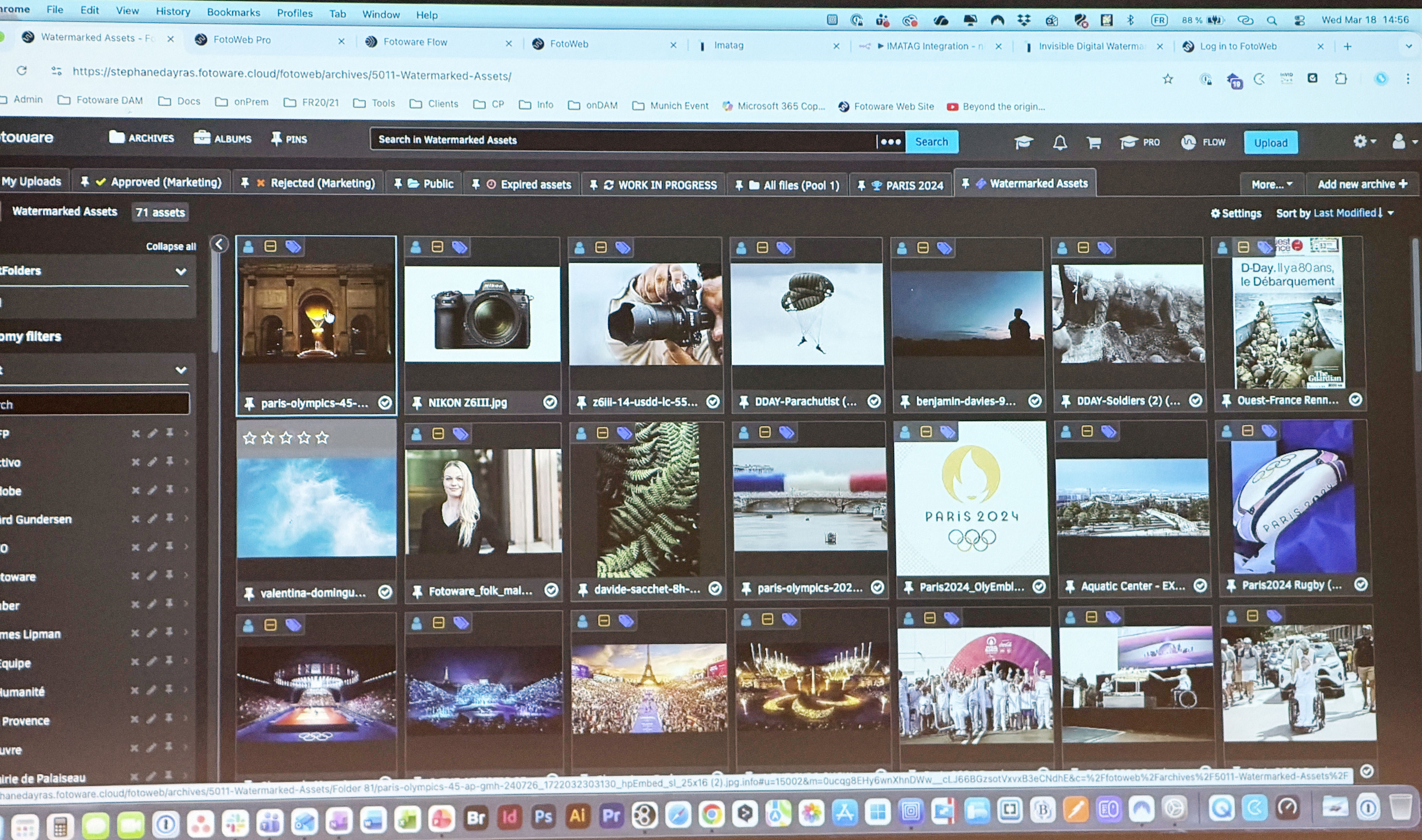
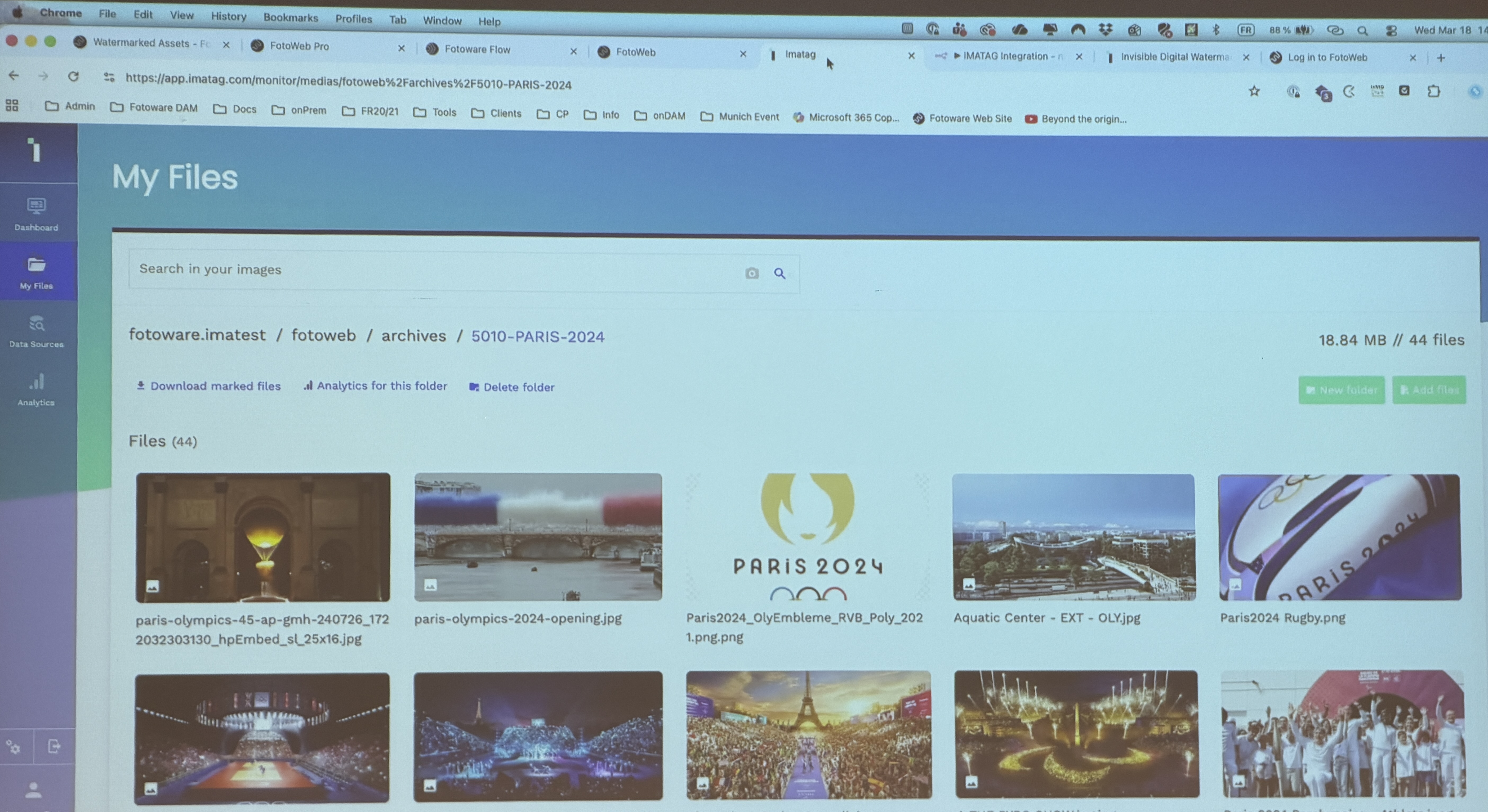
Flow: Flexible automation tool — cloud orchestration module built around triggers, conditions, and actions.
Alongside these items Fotoware committed new bigthings coming especially on Videos, UX and distributions all driven by customers feedback.
Sample workflow demos presented at the conference included ingestion from sFTP server, metadata update, automated auto-tagging, cold archiving to sFTP server, and purging.
Fotoware introduced the concept of the “Connectable DAM” with three tiers of integration:
Plug-and-play: Turn on an integration using pre-built connectors and API standards.
Configurable Automation: Define workflow steps using the Workflow Automation Toolkit.
Custom Development: Write code using SDKs and widgets for fully bespoke integrations.
Plug-ins and Connectors: Expanding pre-built integrations.
Configurable Automation: Making workflow automation accessible to non-technical users.
UI Extension: Customization of the user interface for specific organizational needs.
Toolkits & SDKs: Robust developer tools for custom integrations.
Fotoware’s human-centric, four-step approach to workflow automation:
1. Person: Understand who is involved and what outcome they need to achieve.
2. Process: Design the workflow steps that deliver the desired outcome.
3. Technology: Apply automation and AI where they meaningfully enhance the workflow.
4. Validate: Test the workflow to ensure it works in practice before scaling.
Rich Media Workflows: Automated workflows for all visual content images to video with translation, tagging, analysis, streaming, and editing, all within the DAM.
Content Modification: AI-powered colour enhancement, face blurring, background replacement for flexible asset reuse.
Duplicate Management: Smart detection and reconciliation of duplicates to maintain a clean asset collection.
Asset Findability: AI-powered natural-language search for faster, smarter asset discovery.

Speaker: Kristina Huddart, Content Operations & DAM Consultant, Huddart Consulting
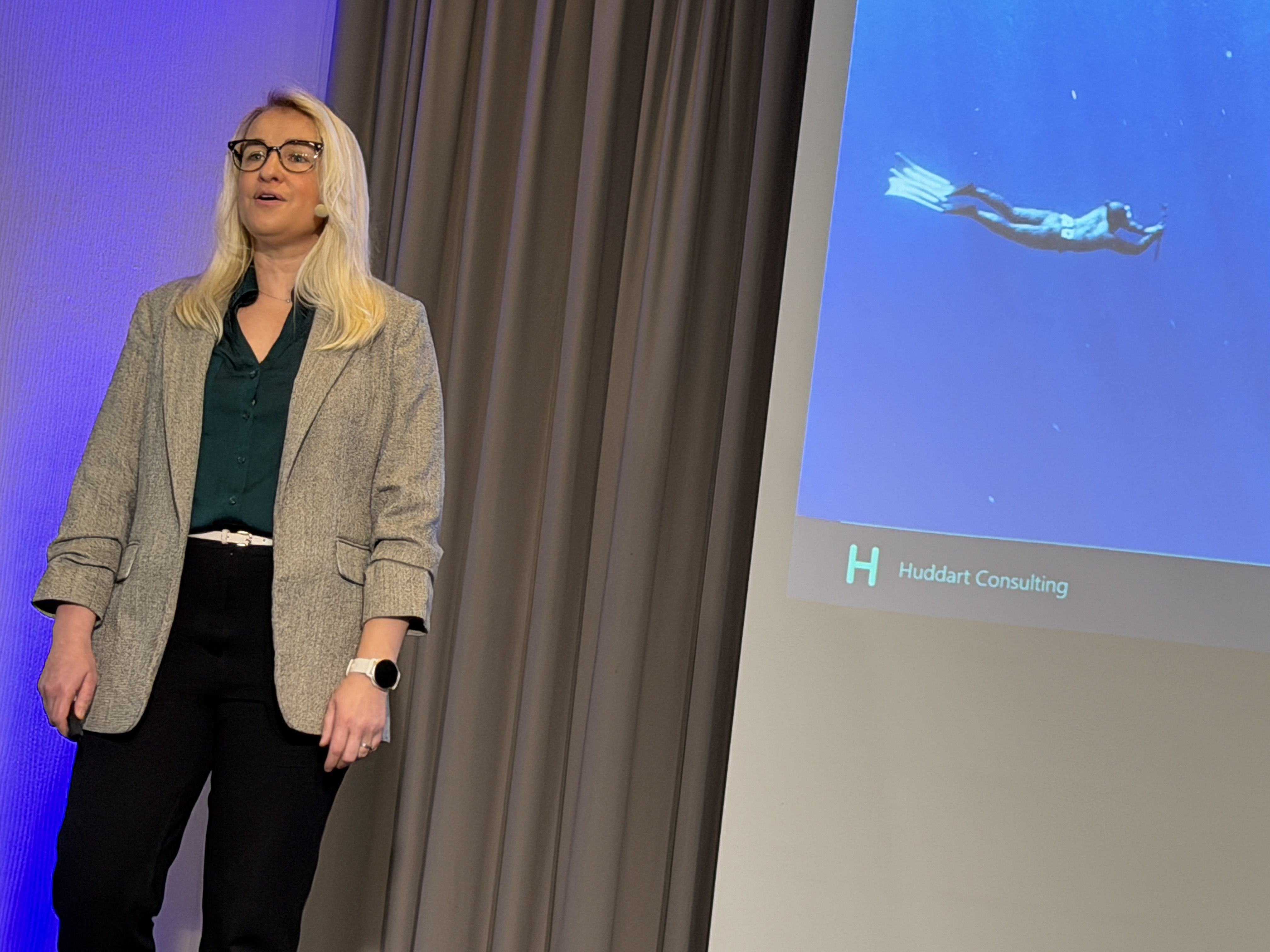
Kristina Huddart delivered a thought-provoking keynote titled “Reimagining DAM: Why Trust Will Define the Future of Content Operations.” Her presentation explored the fundamental role of trust in the evolving content landscape, particularly as AI adoption accelerates across organizations.
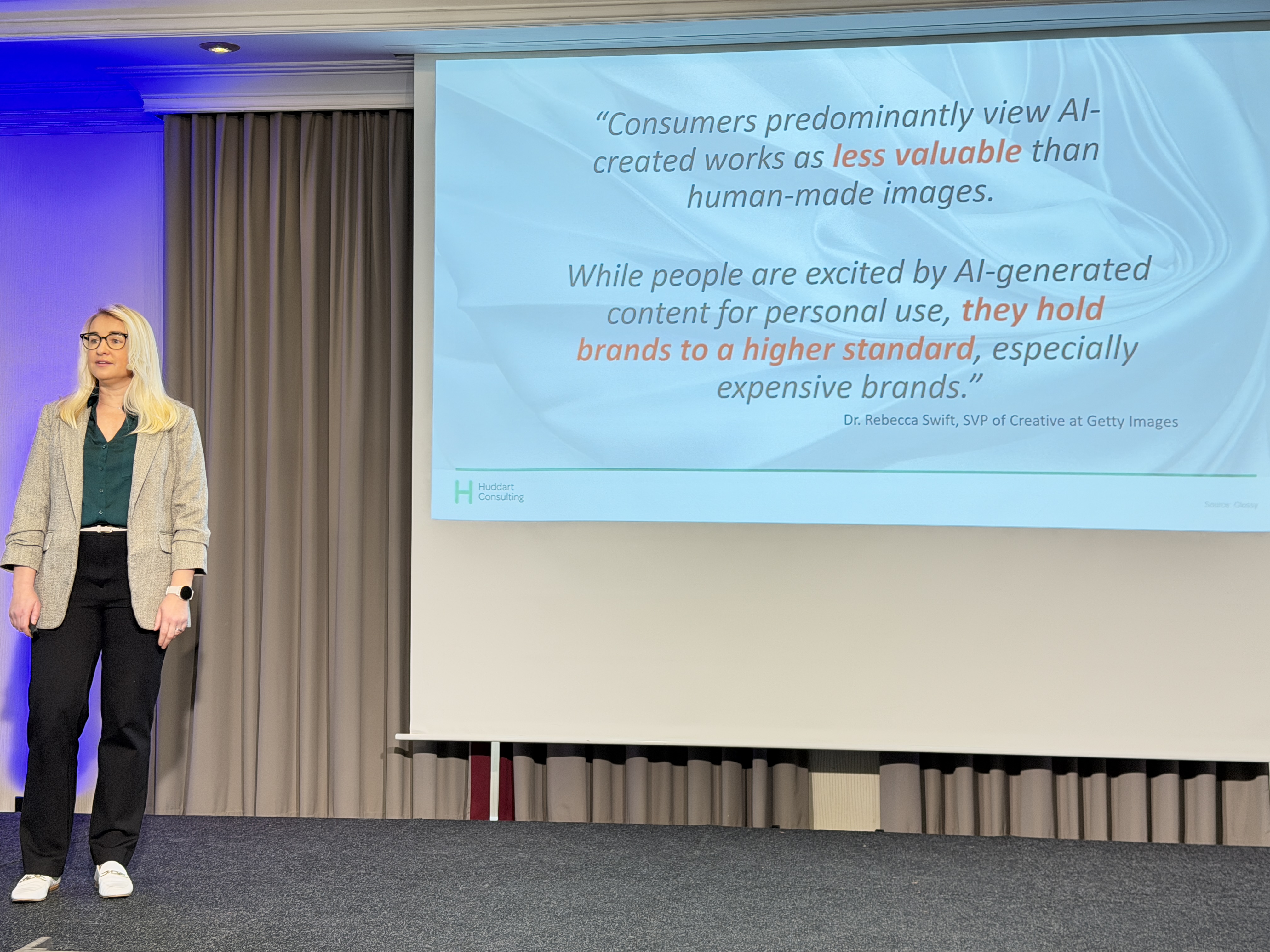
78% of organisations use AI (Source: McKinsey, Stanford AI Index, Medium, CAIO Newsletter)
71% of organisations already use generative AI
These figures underscore the ubiquity of AI in modern enterprises, making trust in AI-generated and AI-processed content a strategic imperative rather than a theoretical concern.
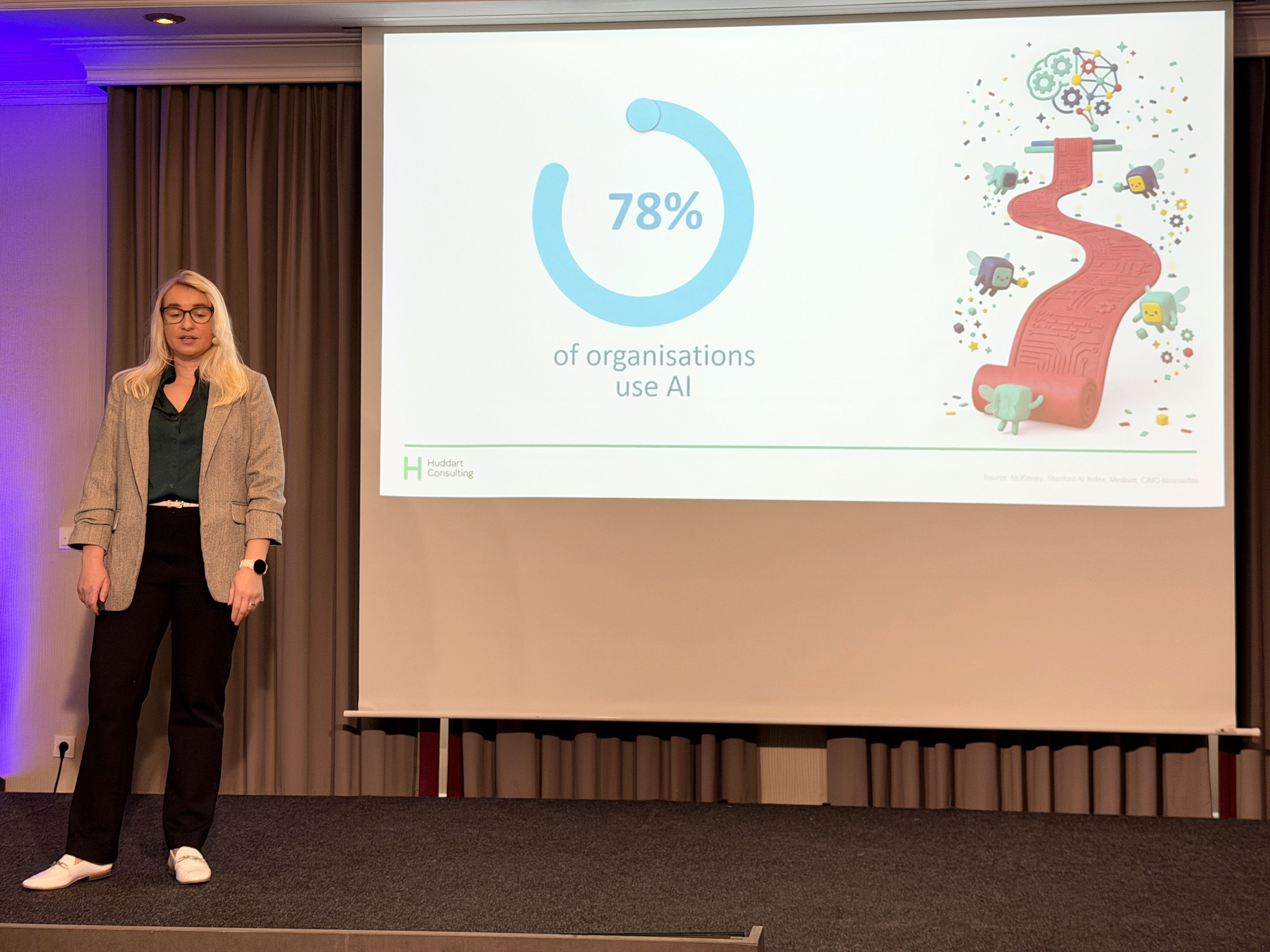
“Consumers predominantly view AI-created works as less valuable than human-made images. While people are excited by AI-generated content for personal use, they hold brands to a higher standard, especially expensive brands.”
— Dr. Rebecca Swift, SVP of Creative at Getty Images
This insight highlights a critical gap: while AI content is proliferating, consumer expectations around authenticity and quality remain high — particularly for brand-associated content. Organizations must navigate this tension carefully.
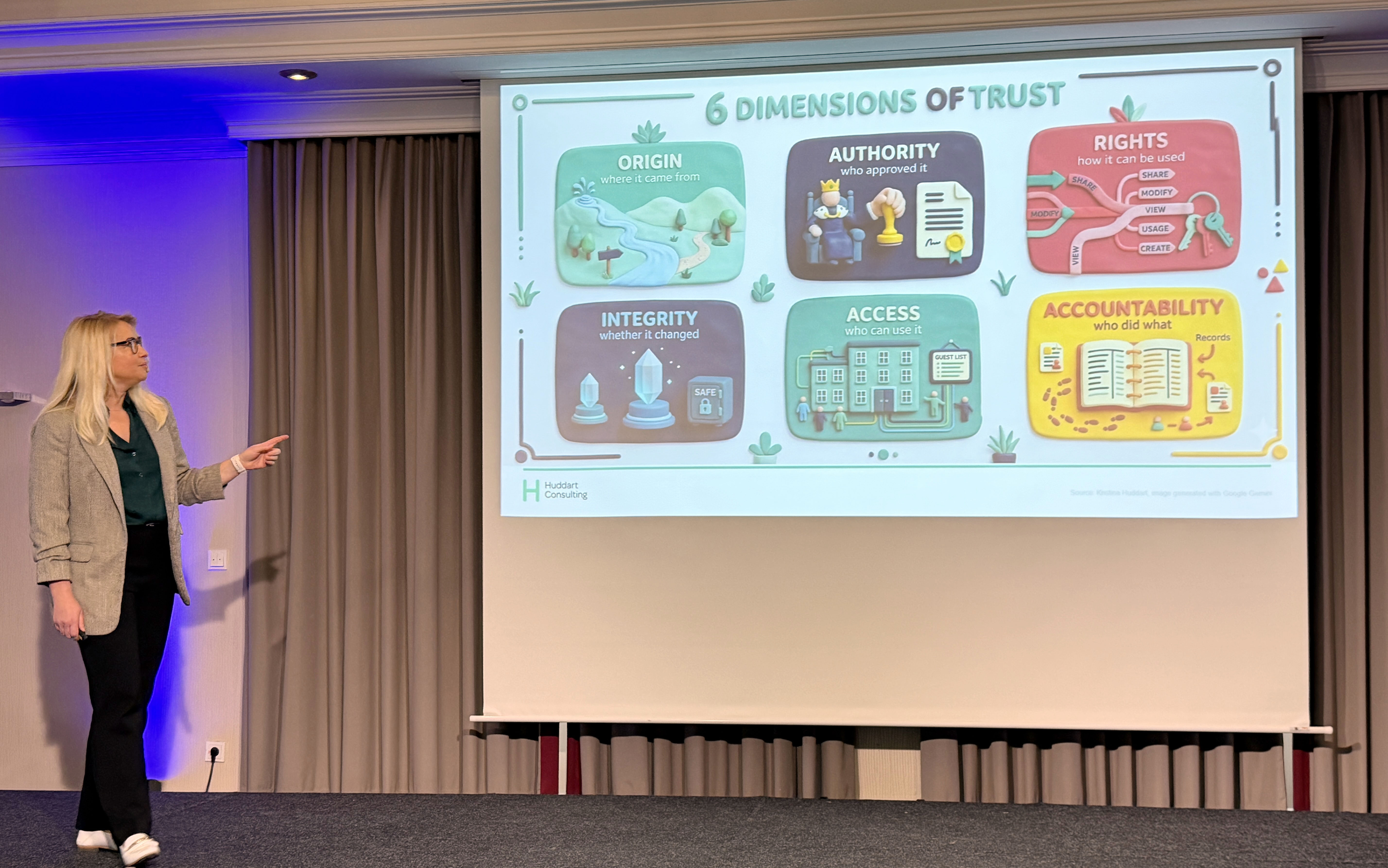
Kristina presented a compelling framework for understanding trust in content operations, organized around six dimensions:
Origin: Where did the content come from? Understanding provenance and source.
Authority: Who approved it? Establishing clear approval chains and editorial governance.
Rights: How can it be used? Managing share, modify, view, usage, and create permissions.
Integrity: Has it changed? Detecting and tracking any modifications to the original asset.
Access: Who can use it? Controlling who has access to content and under what conditions.
Accountability: Who did what? Maintaining complete audit trails and records of all actions.
This framework provides a practical lens through which organizations can evaluate and strengthen their content operations making trust a measurable, actionable objective rather than an abstract concept.
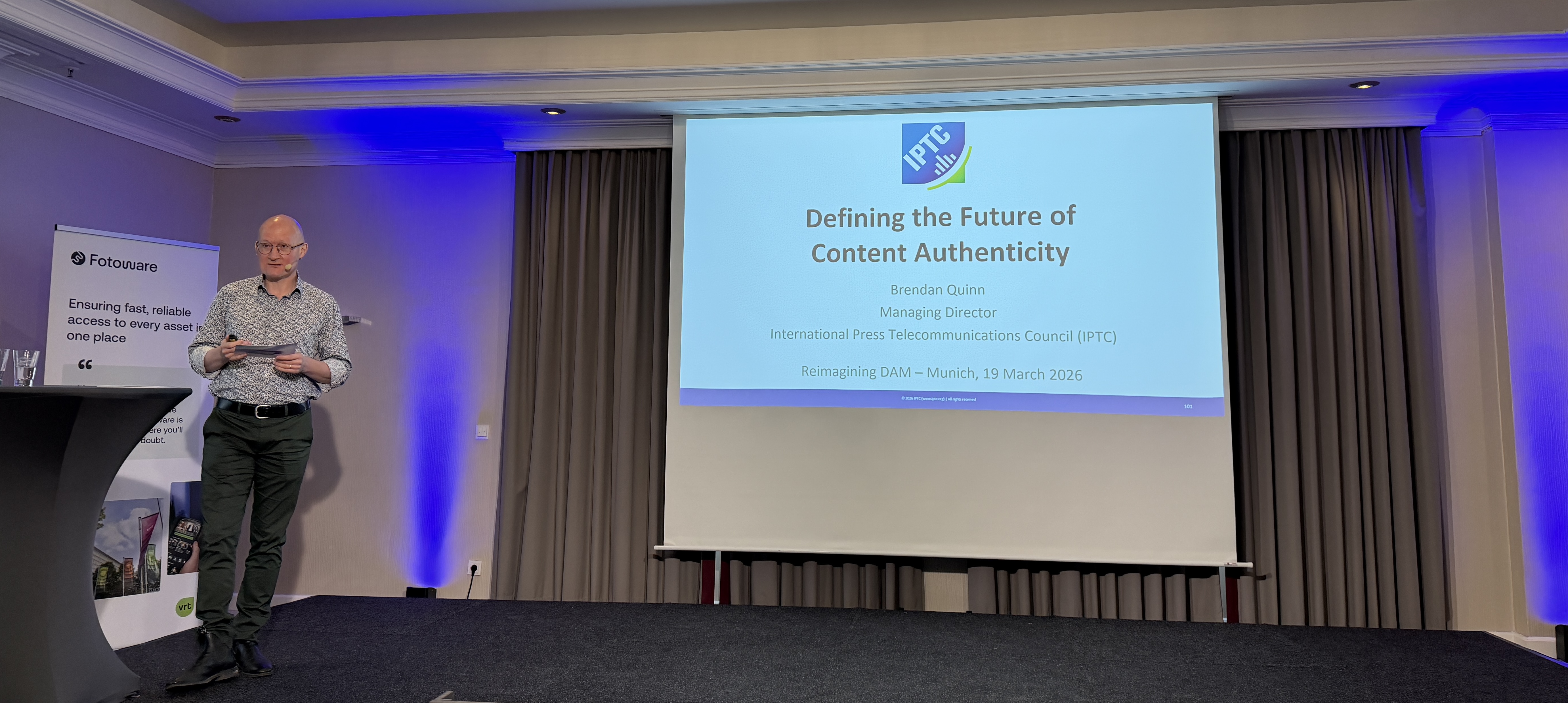
Speaker: Brendan Quinn, Managing Director, International Press Telecommunications Council (IPTC)
Reimagining DAM – Munich, 19 March 2026
Brendan Quinn delivered one of the most technically rich sessions of the conference, providing a comprehensive deep-dive into the current state and future of content authenticity standards. His presentation covered the crisis of trust, the C2PA ecosystem, real-world implementations, and the evolving trust models for 2026 and beyond.
Quinn opened by highlighting the crisis of trust facing the media industry. Publishers are constantly fighting against being misrepresented, with examples including fabricated news content and the emergence of tools like OpenAI’s Sora that are fundamentally changing how we understand and trust visual truth. The window to save visual truth is closing.
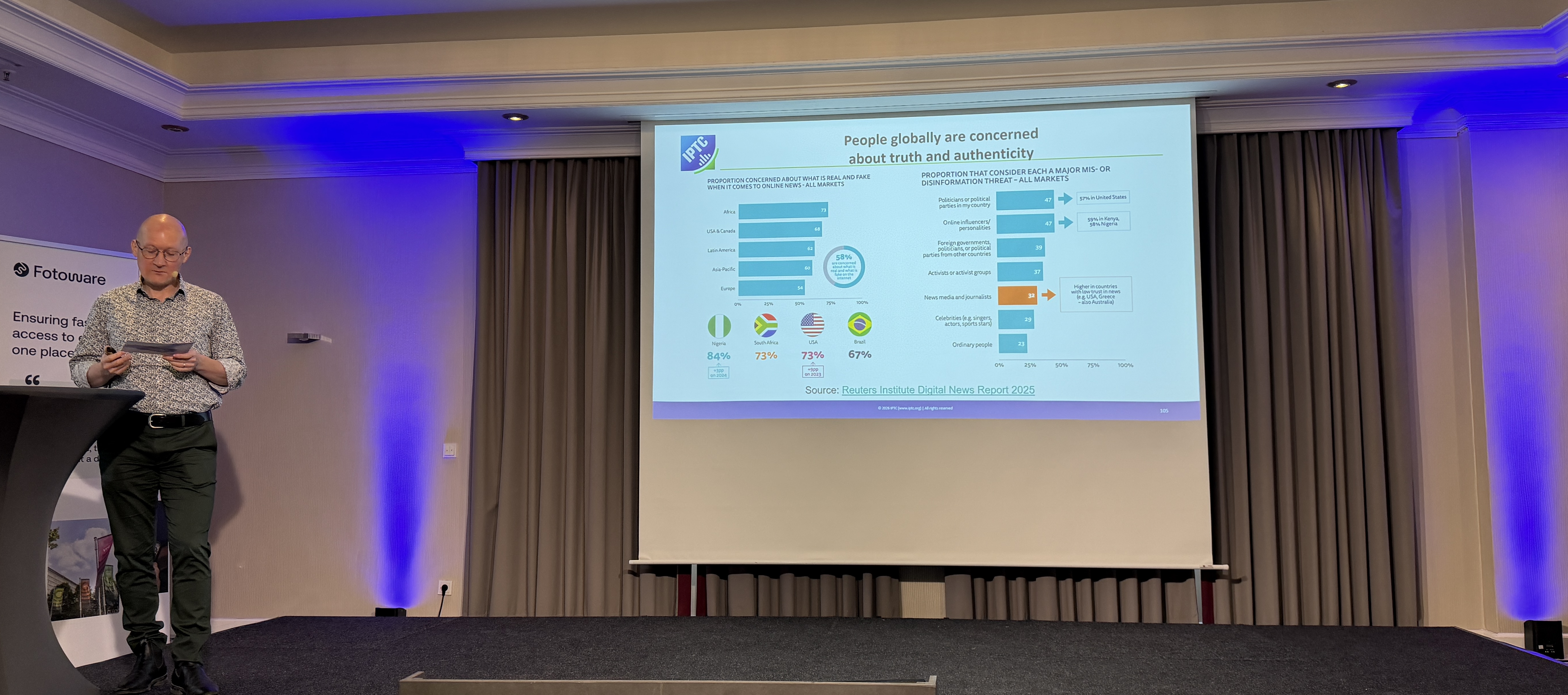
Citing the Reuters Institute Digital News Report 2025, Quinn presented striking data on global concern:
58% of people globally are concerned about what is real and fake on the internet.
Africa: 73% concerned — the highest by region.
USA & Canada: 68% concerned.
Europe: 54% concerned.
Nigeria: 84% concerned — highest individual country, up significantly from 2024.
USA: 73% concerned, up from 2023.
The top perceived sources of misinformation include politicians/political parties (47%), online influencers (47%), foreign governments (39%), activist groups (37%), and news media and journalists (32%).
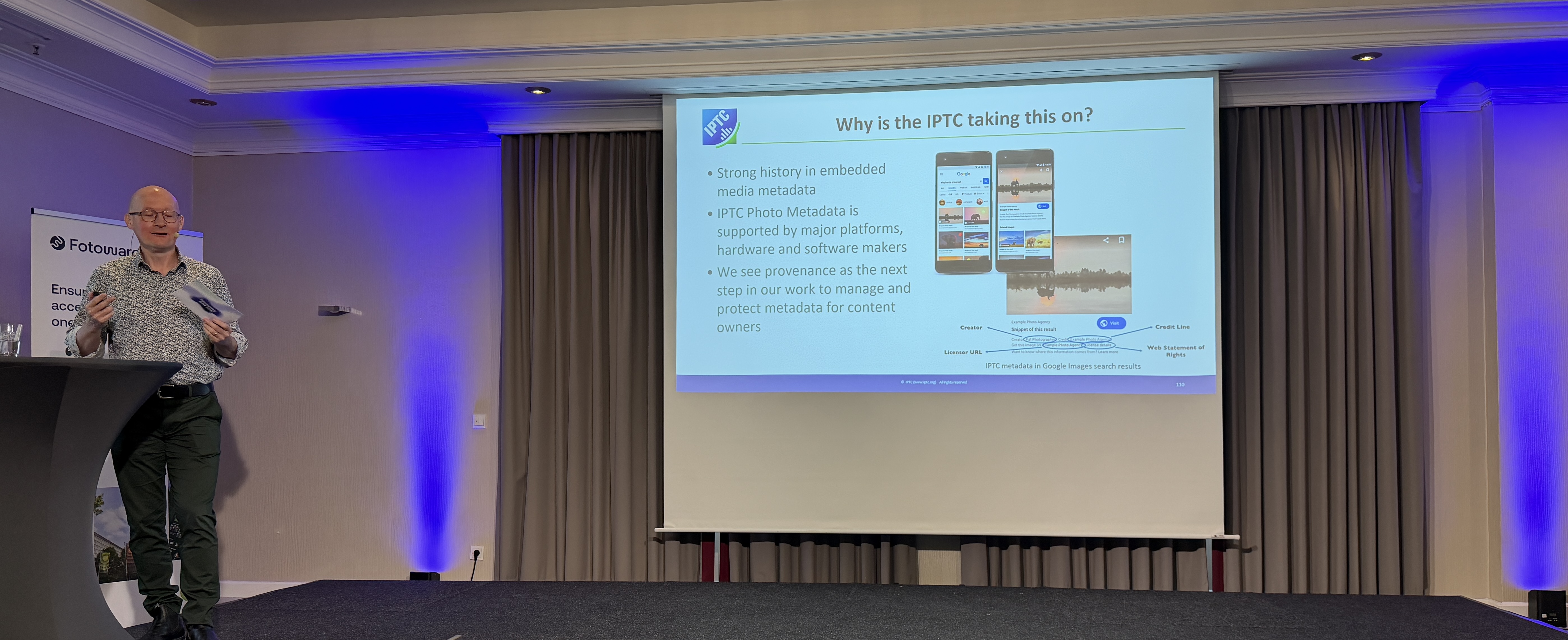
IPTC has a strong history in embedded media metadata. IPTC Photo Metadata is supported by major platforms, hardware, and software makers. IPTC sees provenance as the next step in its work to manage and protect metadata for content owners. IPTC metadata is already visible in Google Images search results, showing Creator, Credit Line, Licensor URL, and Web Statement of Rights.
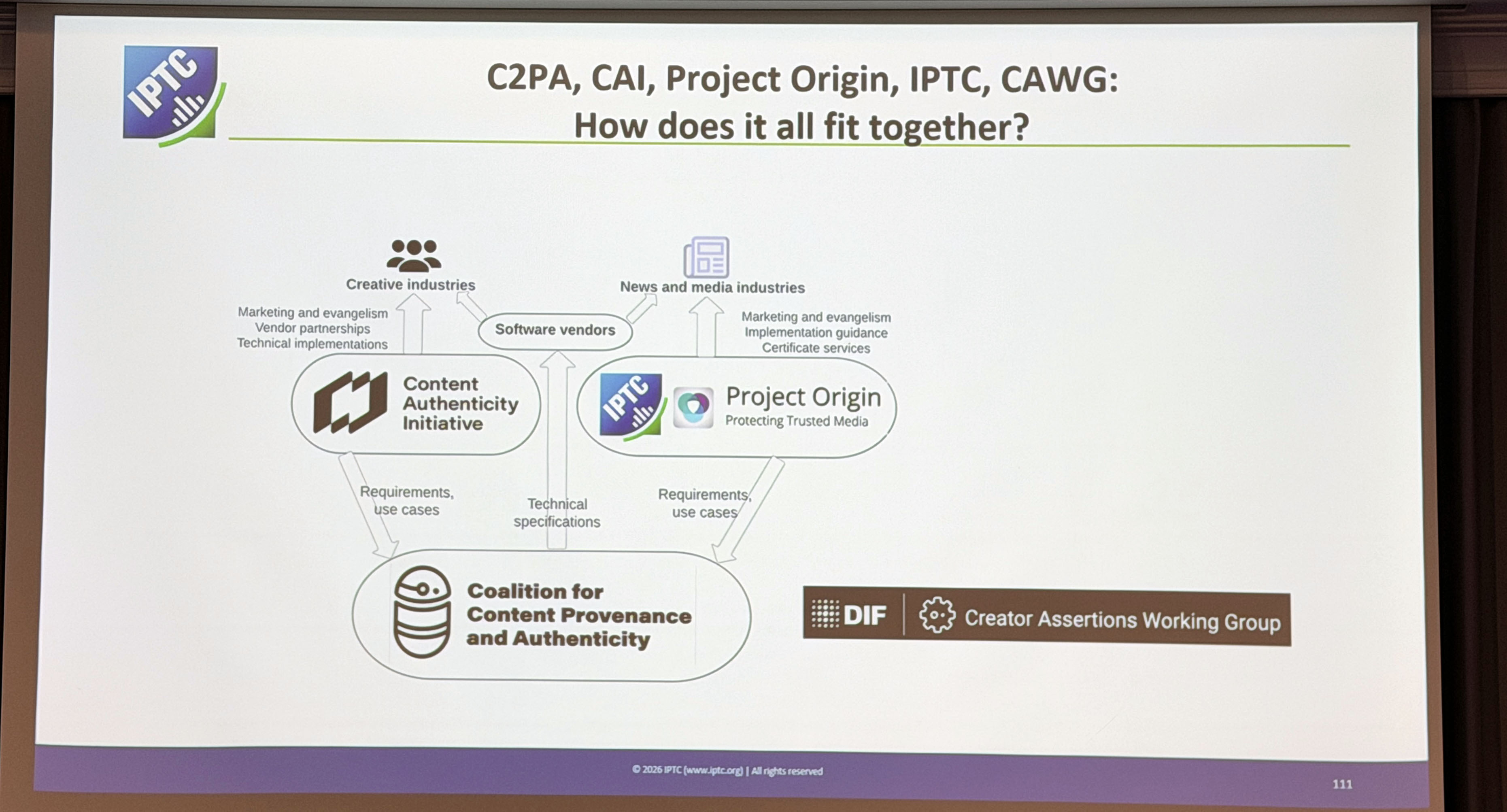
Quinn explained how the various organizations and initiatives fit together in the content authenticity ecosystem:
Content Authenticity Initiative (CAI): Serving creative industries with marketing, evangelism, vendor partnerships, and technical implementations. Provides requirements and use cases to C2PA.
Project Origin: Serving news and media industries with marketing, evangelism, implementation guidance, and certificate services. Also feeds requirements into C2PA.
IPTC: Sits at the center, working with software vendors and providing technical specifications to C2PA.
C2PA (Coalition for Content Provenance and Authenticity): Receives inputs from all parties and produces the technical standard.
DIF Creator Assertions Working Group (CAWG): Works on identity assertions within the C2PA framework.
C2PA establishes a “chain of custody” for content, with content credentials (cr) applied at each stage: from reality, through capture, edit, and delivery to the end user. Each step in the chain preserves and extends the provenance information.
Quinn demonstrated that Content Credentials are already being implemented across the industry:
· Google Pixel smartphones embedding content credentials at capture
· Sony PXW-Z300 professional cameras supporting C2PA
· LinkedIn displaying content credentials on posted images
· France Télévisions using “Certificat du contenu” for broadcast content
· Generative AI engines from Google, OpenAI, Adobe, and Microsoft marking AI-generated content
IPTC identified three distinct workflows for implementing Content Credentials, starting with the “Publisher Stamping” workflow — where content credentials are applied at the delivery stage by the publisher, even if they were not present at capture or edit. This is the most accessible entry point for news organizations.
The Content Authenticity Initiative has defined three complementary pillars:
1. Signed Metadata: The “Content Credential” that travels with the file, documenting who, when, and how.
2. Fingerprinting: Identifying the unique “DNA” of an asset to re-attach metadata if it’s stripped.
3. Watermarking: Placing imperceptible patterns in pixel data that act as a persistent link to the asset’s history.
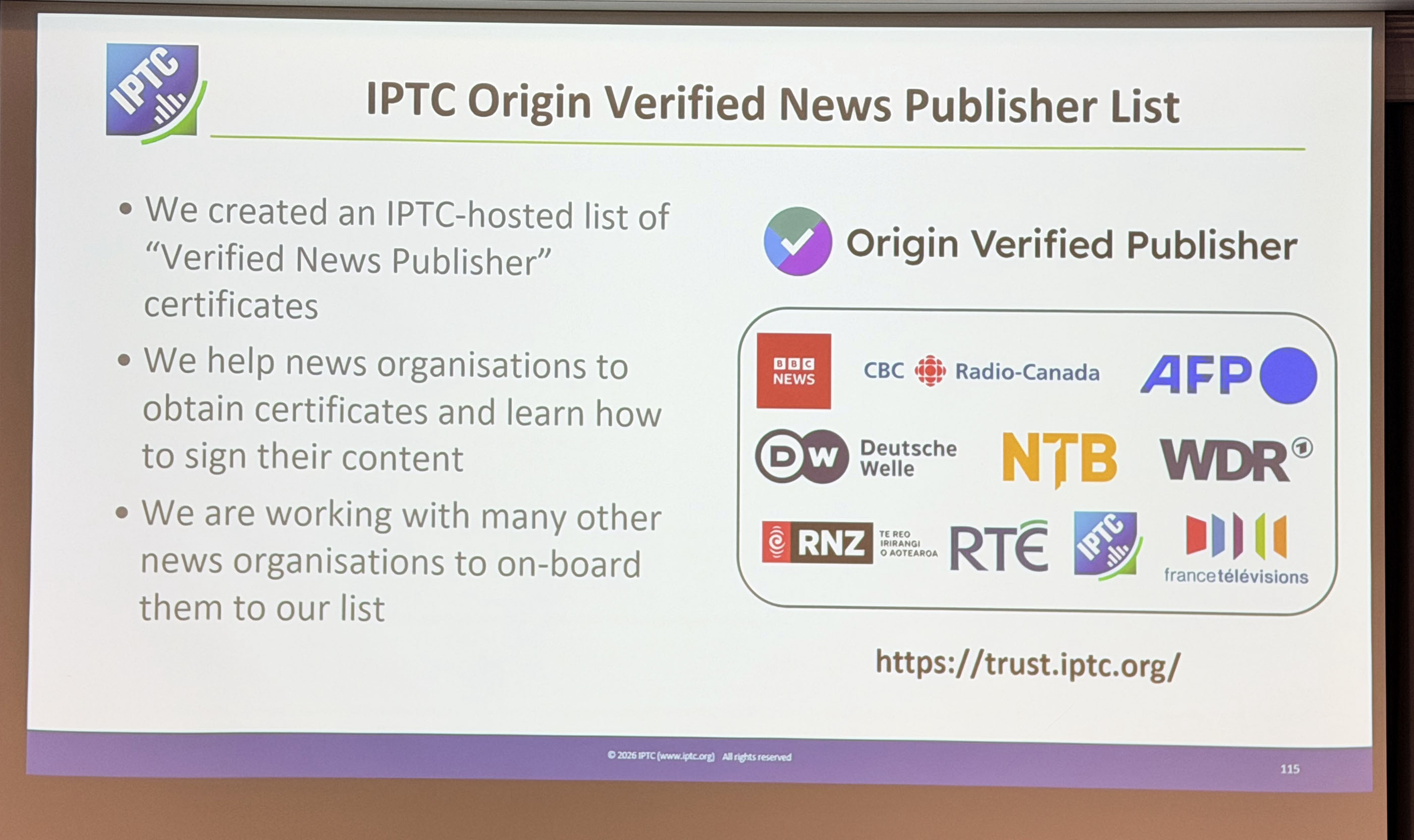
IPTC has created a hosted list of “Verified News Publisher” certificates and is helping news organizations obtain certificates and learn how to sign their content. Current verified publishers include: BBC News, CBC Radio-Canada, AFP, Deutsche Welle, NTB, WDR, RNZ, RTÉ, IPTC, and France Télévisions. The list is available at trust.iptc.org.
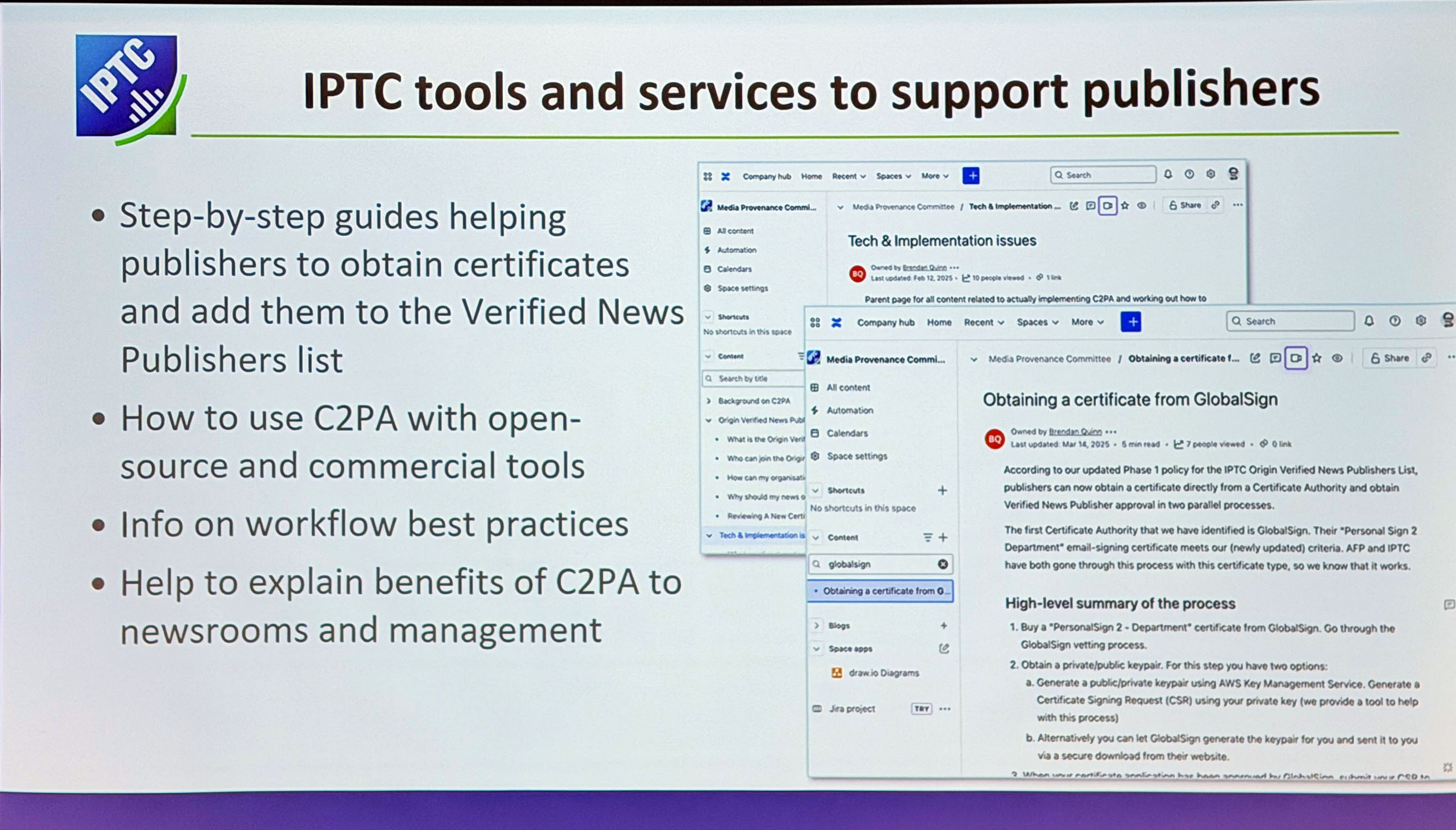
· Origin Verify Validator (originverify.iptc.org) checks whether content has been tampered since being signed, shows publisher, publish time, caption, and alt text. Works with JPEG, PNG, and MP4.
· IPTC WordPress plugin a C2PA Signer plugin that automatically signs images attached to WordPress posts with Content Credentials.
· Step-by-step guides for obtaining certificates and joining the Verified News Publishers list.
· Guides on using C2PA with open-source and commercial tools.
· Workflow best practices documentation.
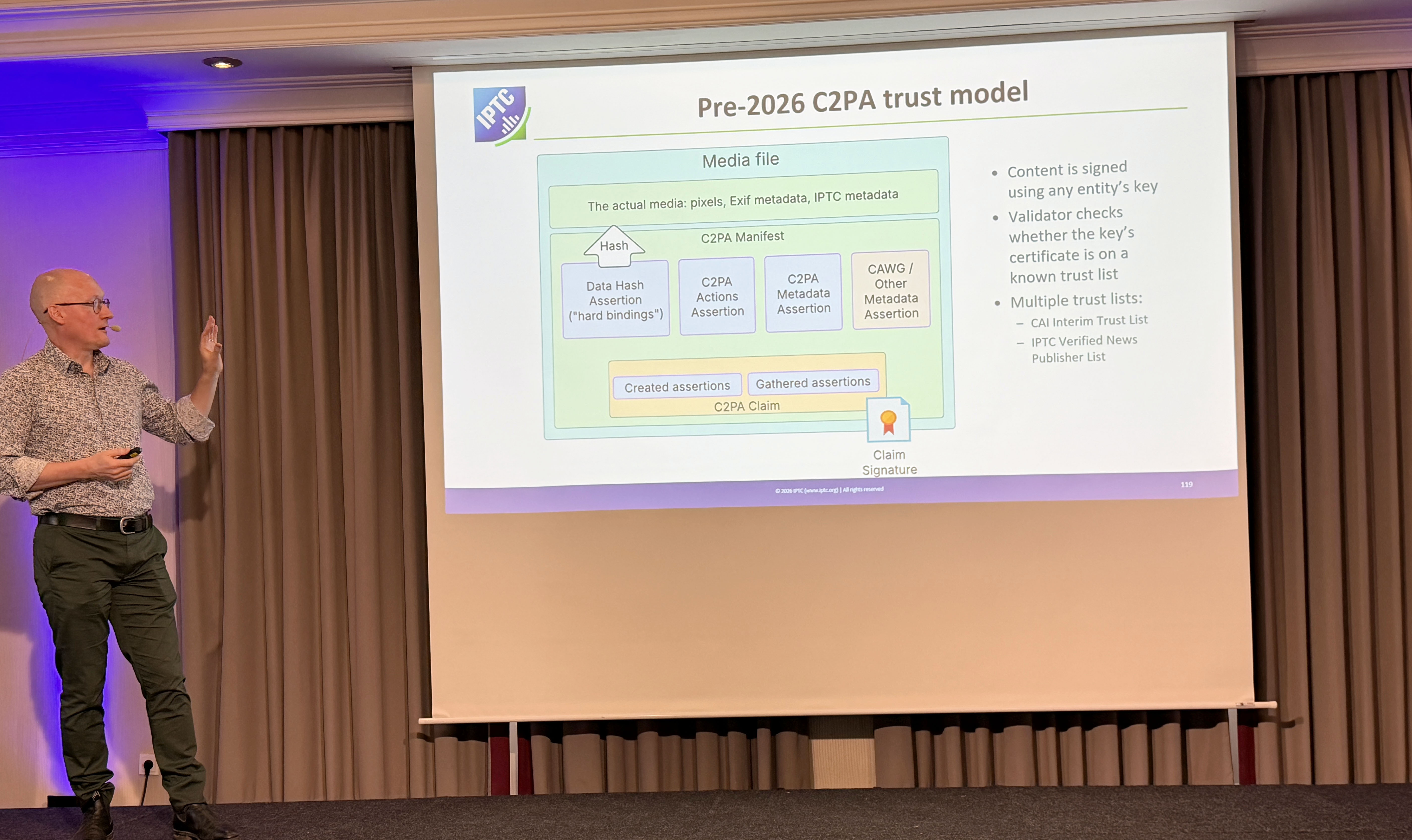
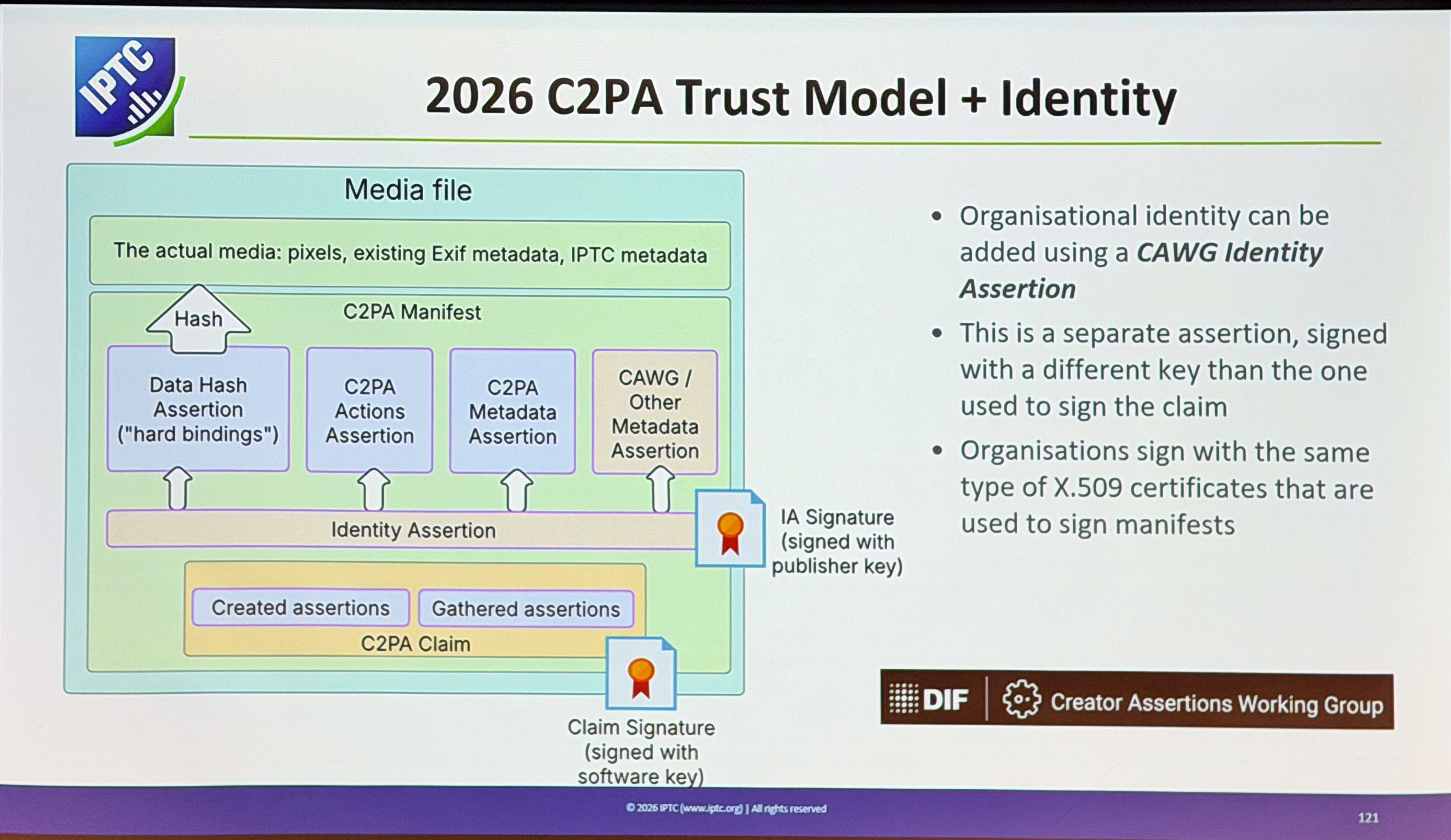
In the pre-2026 model, a media file contains pixels, Exif metadata, and IPTC metadata, plus a C2PA Manifest with a Data Hash Assertion (“hard bindings”), C2PA Actions Assertion, C2PA Metadata Assertion, and CAWG/Other Metadata Assertions. The manifest contains created and gathered assertions within a C2PA Claim, secured by a Claim Signature. Content is signed using any entity’s key, and the validator checks whether the key’s certificate is on a known trust list (CAI Interim Trust List or IPTC Verified News Publisher List).
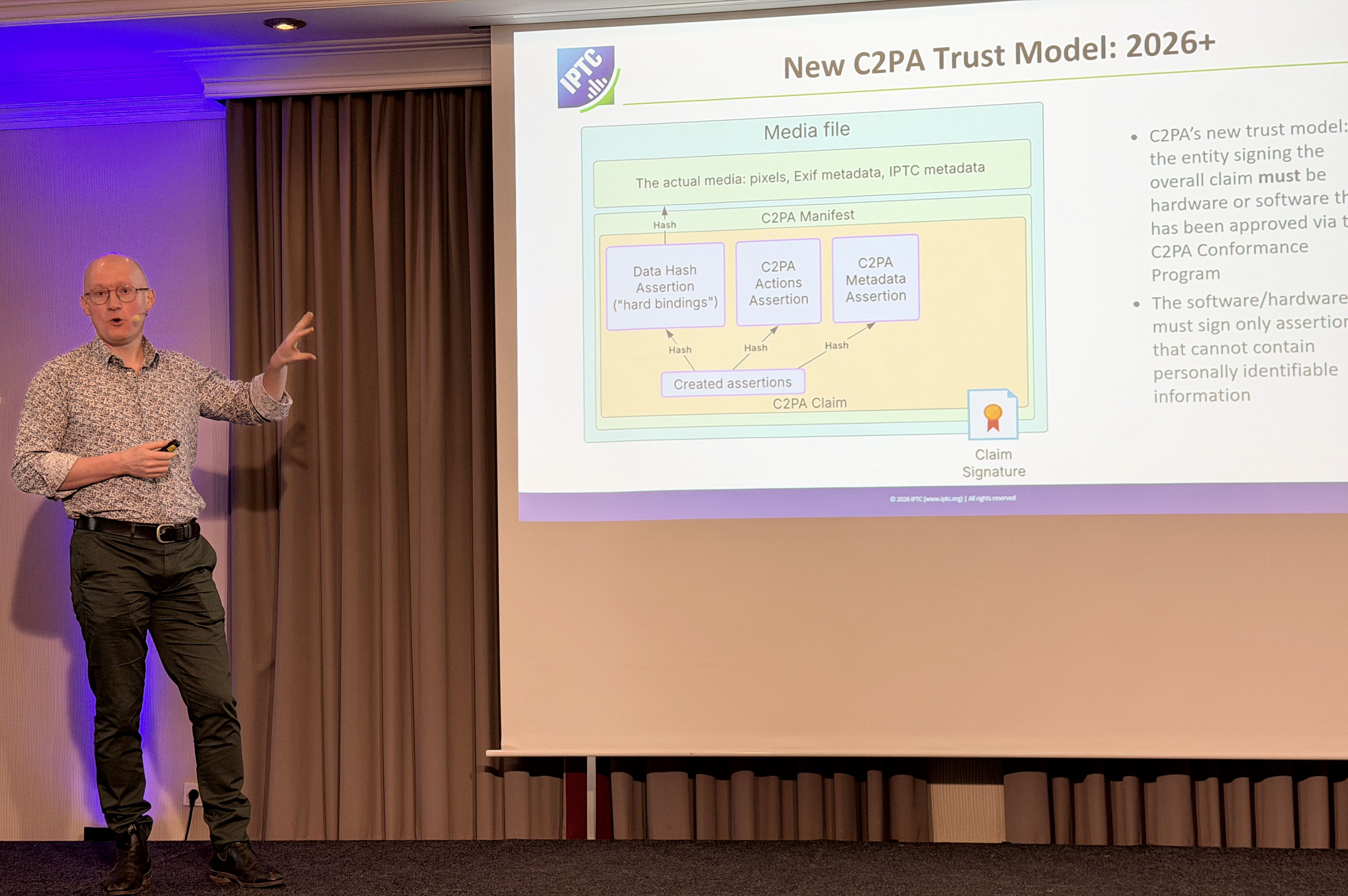
The 2026+ model introduces a critical change: the entity signing the overall claim must be hardware or software that has been approved via the C2PA Conformance Program. The software/hardware must sign only assertions that cannot contain personally identifiable information a significant privacy safeguard.
The latest evolution adds the CAWG Identity Assertion a separate assertion signed with the publisher’s key (different from the software key used for the claim signature). This allows organisational identity to be added using the same type of X.509 certificates used to sign manifests, creating a clear separation between “what software processed this” and “who published this.”
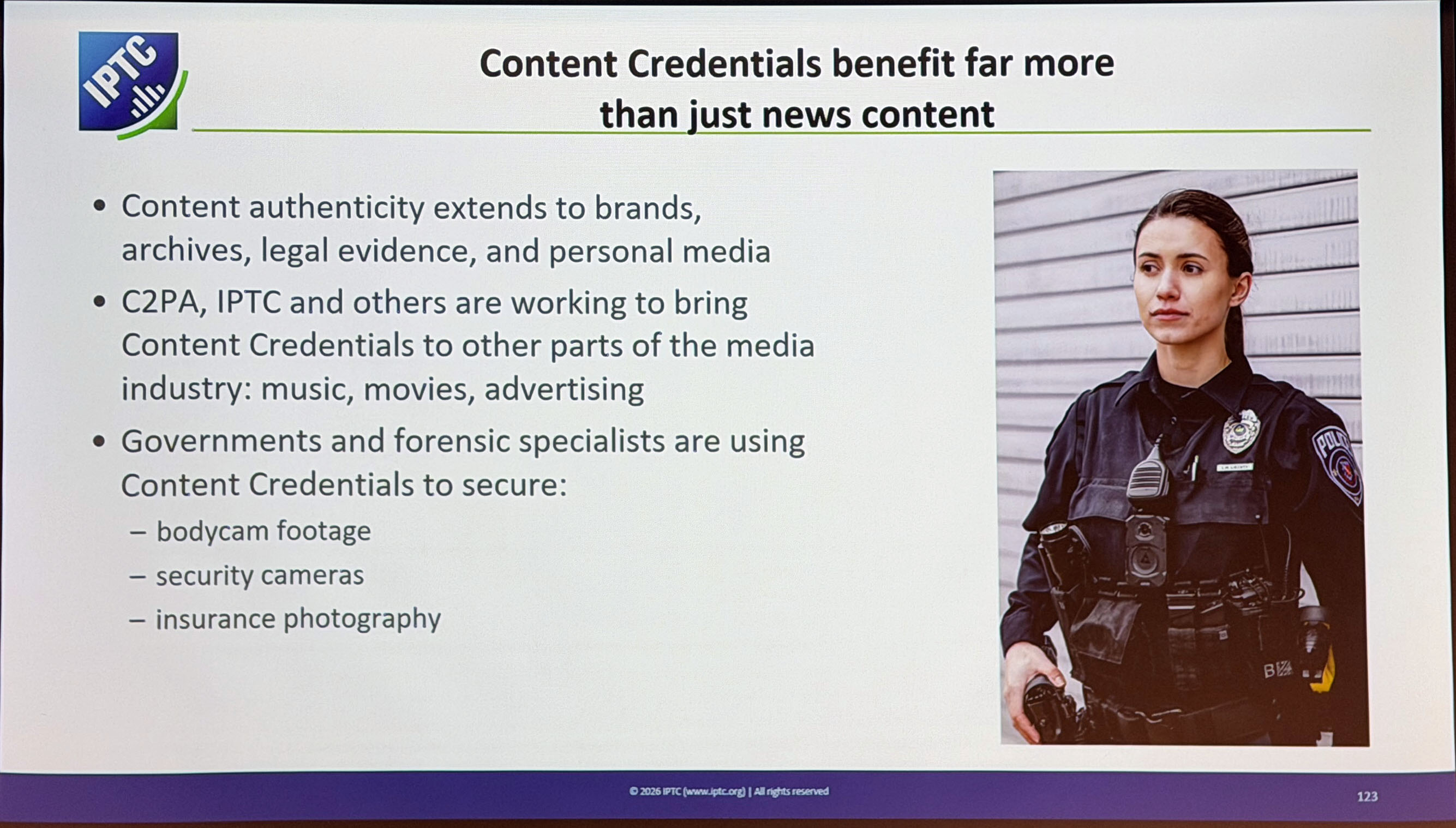
Quinn emphasized that Content Credentials benefit far more than just news content. Content authenticity extends to brands, archives, legal evidence, and personal media. C2PA, IPTC, and others are working to bring Content Credentials to music, movies, and advertising. Critically, governments and forensic specialists are already using Content Credentials to secure bodycam footage, security cameras, and insurance photography.
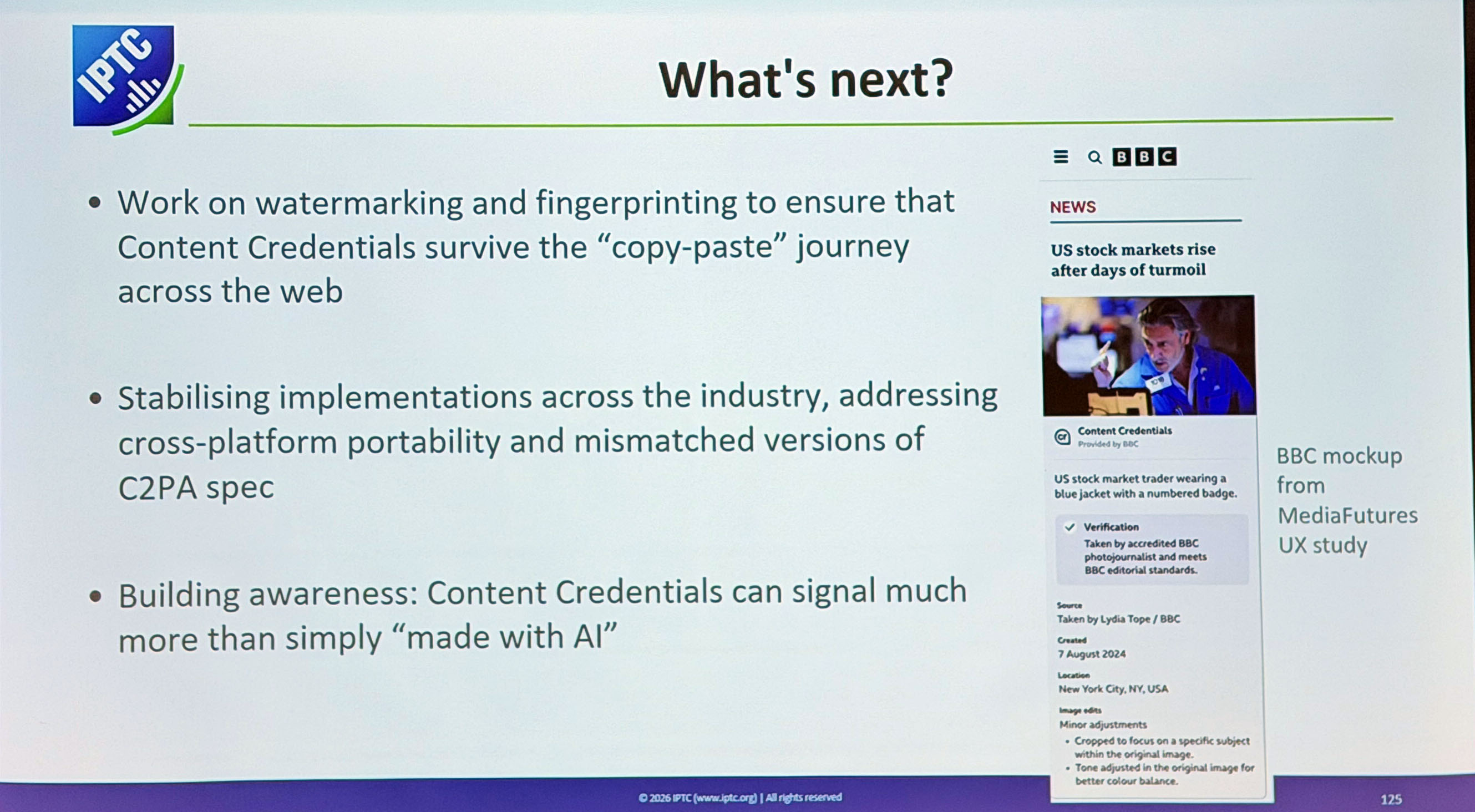
· Work on watermarking and fingerprinting to ensure that Content Credentials survive the “copy-paste” journey across the web.
· Stabilising implementations across the industry, addressing cross-platform portability and mismatched versions of the C2PA spec.
· Building awareness: Content Credentials can signal much more than simply “made with AI.”
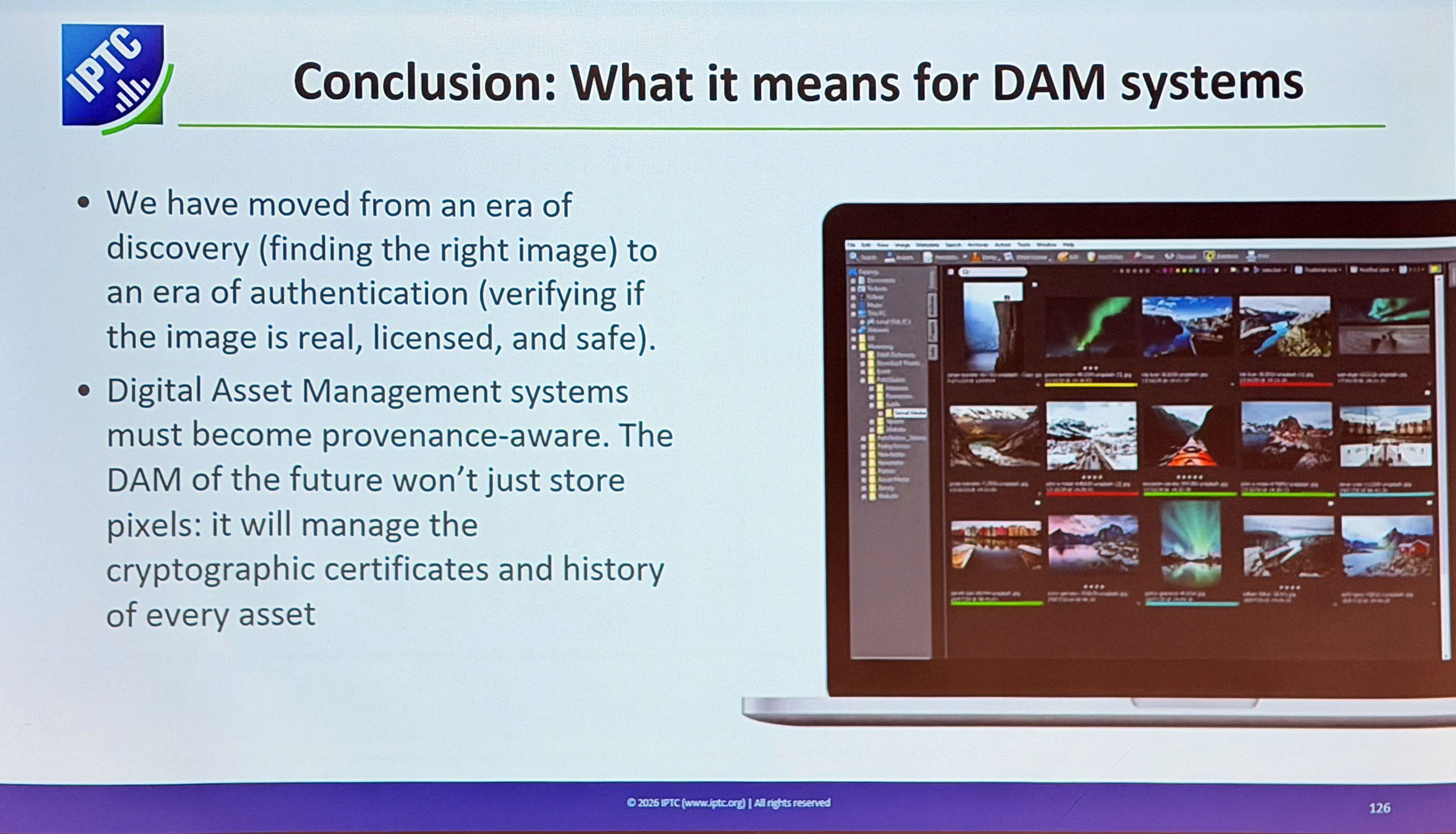
“We have moved from an era of discovery (finding the right image) to an era of authentication (verifying if the image is real, licensed, and safe). Digital Asset Management systems must become provenance-aware. The DAM of the future won’t just store pixels: it will manage the cryptographic certificates and history of every asset.”
— Brendan Quinn, IPTC
The full agenda and speaker list for the IPTC Media Provenance Summit has now been announced, including the world’s foremost experts on C2PA and content provenance in the media industry.In collaboration with CBC/Radio-Canada, the International Press Telecommunications Council (IPTC) is hosting the next Media Provenance Summit, which takes place at the Reuters building in Toronto, Canada on Thursday 16 April, 2026
You can find al the info : https://iptc.org/news/agenda-for-iptc-media-provenance-summit-toronto-now-announced/
Fotoware presented its commitment to content authenticity through three pillars: its membership in the Content Authenticity Initiative (CAI), launched by Adobe in 2019; its adoption of the C2PA standard that creates open standards for media provenance; and its active implementation of C2PA to support Content Credentials within its platform.
Fotoware envisions the DAM as the central provenance hub, fulfilling three key roles:
· Preserve credentials maintaining content credentials embedded at capture throughout the lifecycle.
· Extend provenance adding new provenance data through editing, metadata changes, and distribution.
· Not break signatures ensuring DAM operations do not invalidate cryptographic signatures.
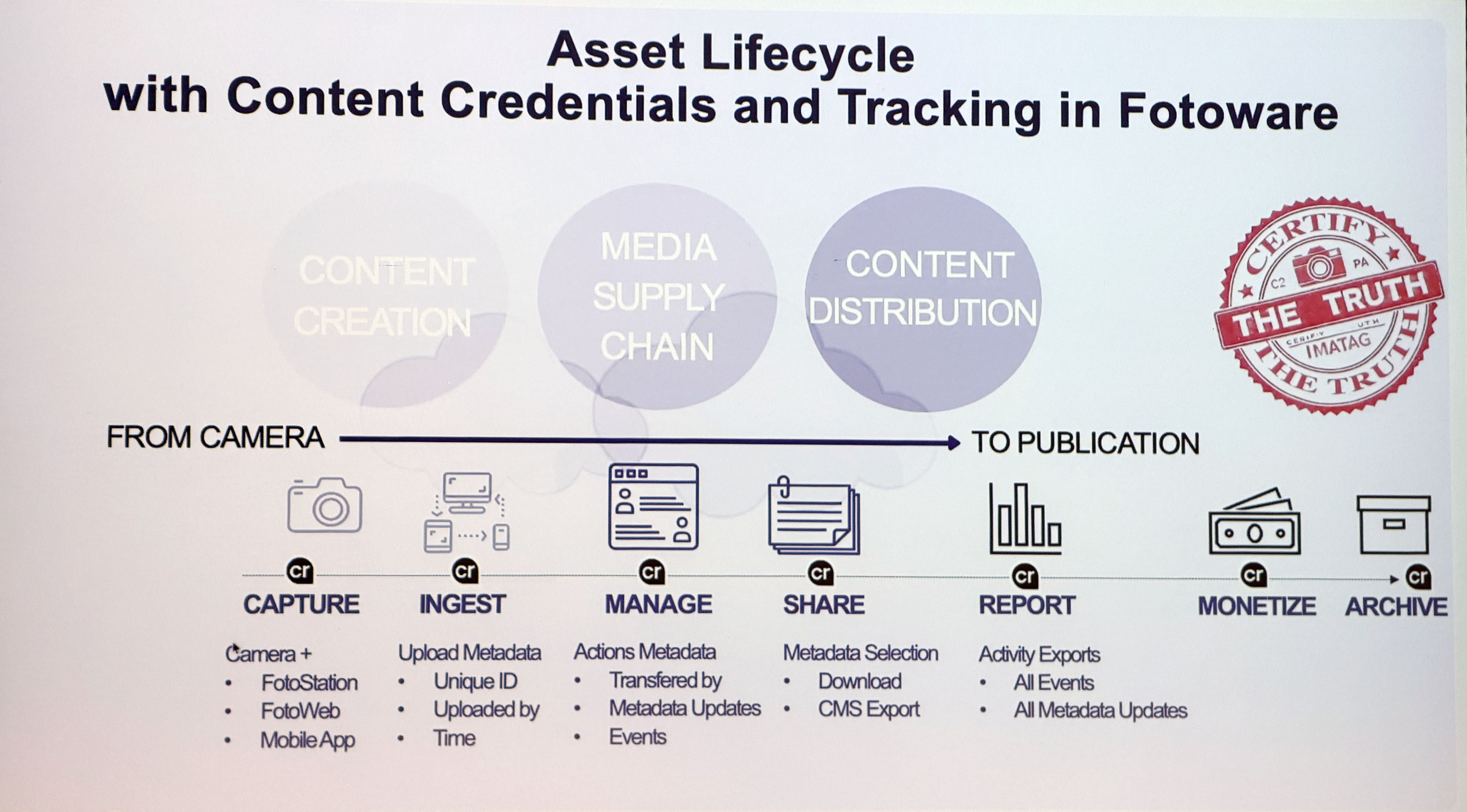
Fotoware is building a tamper-free workflow maintaining content credentials through every stage: editing, DAM ingestion, metadata changes, renditions, and verification. The message: “We’re building a tamper-free workflow — so you are in control.”
Content credentials are applied at every step from camera to publication: Capture (Camera + FotoStation, FotoWeb, Mobile App), Ingest (unique ID, uploaded by, time), Manage (transferred by, metadata updates, events), Share (download, CMS export), Report (activity exports, all events), Monetize, and Archive.
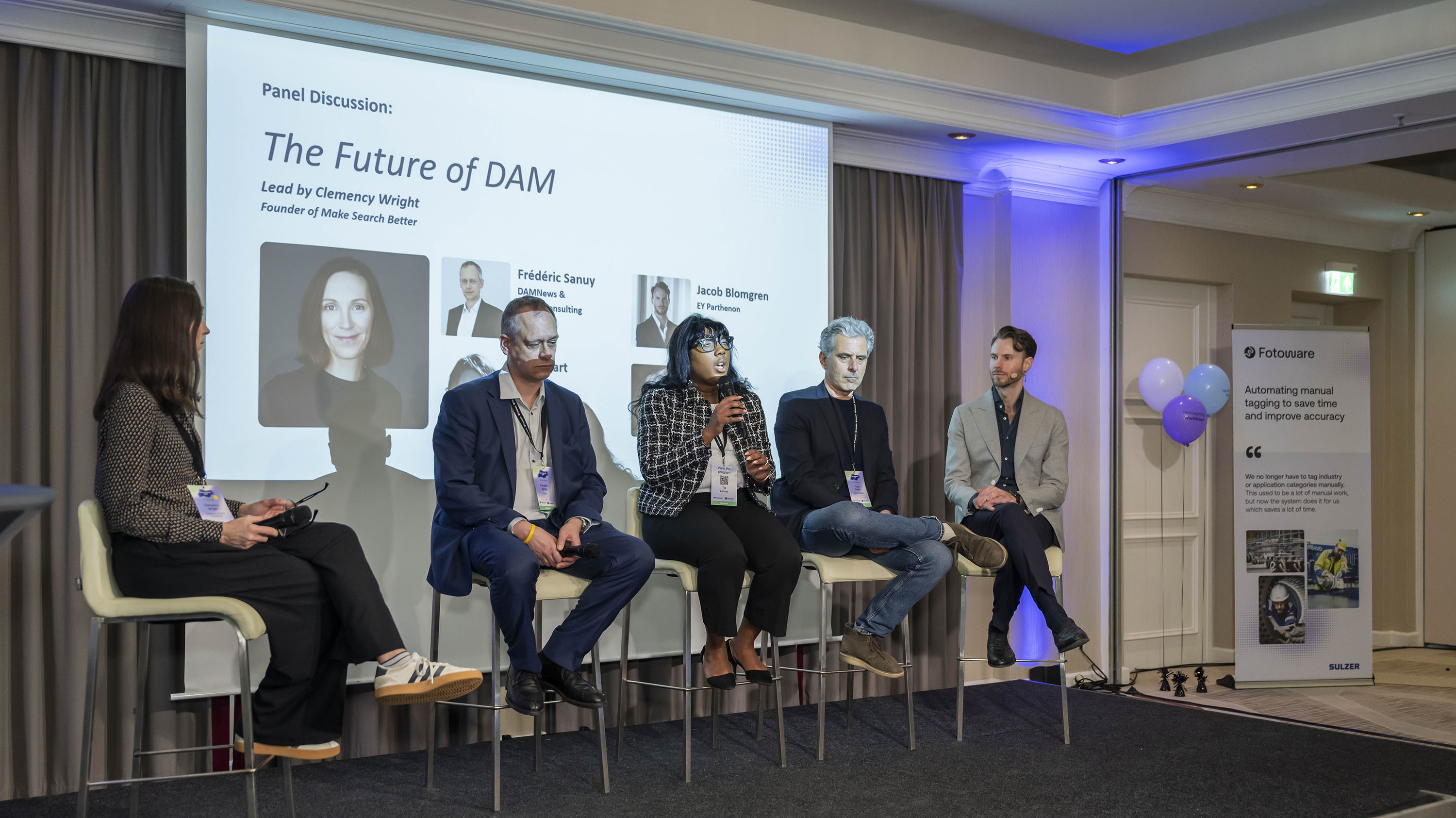
Panelists: Frédéric Sanuy (Activo & DAM News), Tia Zervas Gartner, EY, Timo Faber — Moderated by Clemency Wright (Search Consultant)
One of the conference highlights was the panel discussion on the future of Digital Asset Management, moderated by Clemency Wright (Search Consultant) and featuring Frédéric Sanuy (CEO, Activo & DAM News), Tia Zervas, and Timo Faber. The panel tackled five major questions about where DAM is headed, producing a rich, candid exchange of perspectives on the evolution, AI readiness, responsibility, and future landscape of DAM.
The panel explored how the role of DAM has shifted from a simple digital repository to a business-critical content orchestration hub. Timo Faber traced the evolution: “DAM has gone from a file server on steroids targeted at creative teams to a much broader and more important entity in the martech stack.
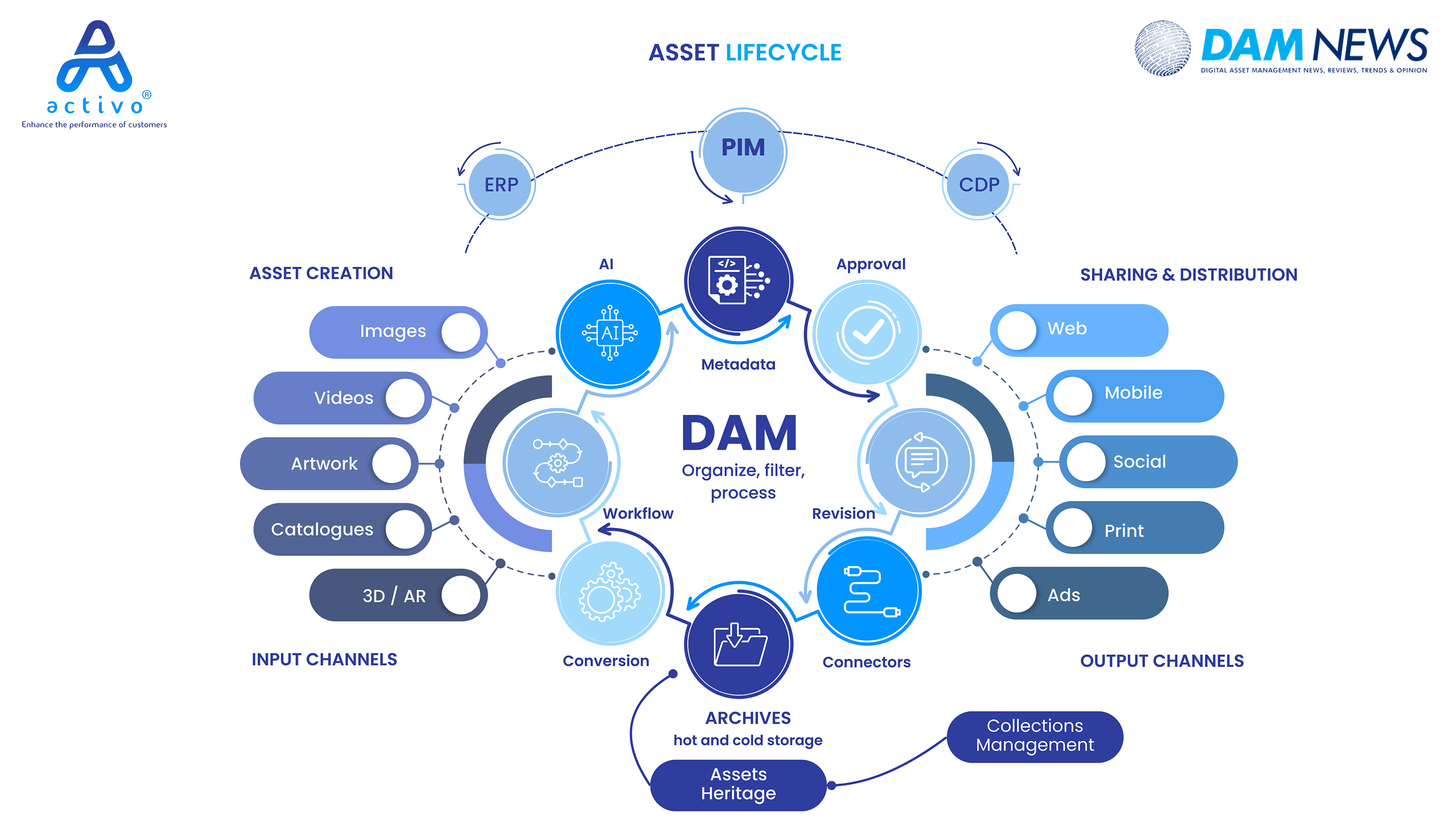
The focus has shifted from upstream (creative ingests) to downstream distribution with a growing number of output channels.” He described the progression from isolated on-prem, to integrated on-prem, to cloud, to cloud native (MACH), to a DAM engine (API-focused) and potentially toward a Governance-Enforcement Engine or Content Intelligence Engine.
Tia Zervas highlighted that genAI is expanding DAM’s relevance beyond marketing: use cases that benefit non-marketers are emerging, such as brand centers powered by the DAM that other functions don’t immediately recognize. DAM is increasingly bridging into document management territory, though there is room for both due to different organizational needs.

Frédéric Sanuy explained also the foundation of a DAM system as an engine for assets and metadata with is something we observe less and less performance wise by the new vendors. Reason why by DAM News we are performing deep div test DAM systems with the Open specifications you can find here :

A candid assessment revealed a significant gap between what DAM vendors offer and what organizations can actually absorb. Tia noted that “agents and agentic capabilities are emerging, but most brands aren’t ready. DAMs already need a dedicated role, and many organizations fail to provide one. Agentic only works if your data and taxonomy are sound.” She recommended organizations first assess their foundation: is your DAM currently sound? Are integrations set? Is foundational AI (smart tagging) working?
Timo observed a “fairly big gap between the latest new features and the DAM majority of customers,” noting that many DAM vendors started experimenting with AI features that “didn’t make any sense” not customer-driven, but triggering “fake demand” and FOMO. He argued for a healthy mix of customer-driven development and vendor vision, with a strong focus on specific use cases.
Timo stated firmly: “We are past the experimental phase. We are starting to see very interesting, useful implementations that make use of AI technology.” Computer vision and NLP for transcription and translation work well today. Looking ahead, he envisions DAM’s role in agentic e-commerce as a “Trust Reinforcement Engine” managing provenance and authenticity for distributed assets. His practical advice: “Start with requirements rather than vendor features. AI isn’t free consider token costs.”
Tia emphasized starting with search functionality and understanding different user groups: “Focus on the longevity and what will enable your organization to grow and scale.”
The panel agreed that DAM is uniquely positioned to enforce responsibility. Timo argued that DAM needs to answer critical questions: “Can this content be used here? Under what conditions? By whom? For which intent? With what risk?” pointing to DRM and C2PA as key enabling standards.
Tia positioned DAMs as the asset source of truth, noting that brand assistants and eventually fully autonomous agents will become important. As content volumes grow, ensuring compliance and keeping integrations sound and adaptable becomes crucial.
Tia predicted that DAMs will continue to encroach on adjacent markets (MAMs, CMPs, PIMs) and that consolidation pressures will drive organizations to expand their DAM’s utility. Her advice: “Even if it’s limited settings at first, if your provider allows you to test their AI, do it or you’ll fall behind. Set time limits, including abandoning ideas altogether.”
Timo offered a provocative vision: “Vendors will add MCP servers on top of their APIs to make DAMs connectable to LLMs. If tools like Perplexity or Claude become the new command center of how humans interact with machines, DAMs as we know them today may start to disappear consumers will search and find assets using a prompt.” He noted that agentic transactions are expected to hit $385 billion by 2030, and when agents shop, “pixels will be less important content must be machine-readable, with fast API responses and well-structured data in a way agents like it. DAM’s role will change.”
Panelists: Kevin Coombs, Richard Shepherd, Mathieu Desoubeaux, Brendan Quinn, Stéphane Dayras
A dedicated panel on the future of trust brought together leading voices from across the content authenticity ecosystem. Kevin Coombs, Richard Shepherd, Mathieu Desoubeaux (imatag), Brendan Quinn (IPTC), and Stéphane Dayras (Fotoware) discussed the practical challenges and opportunities of implementing content authenticity at scale.
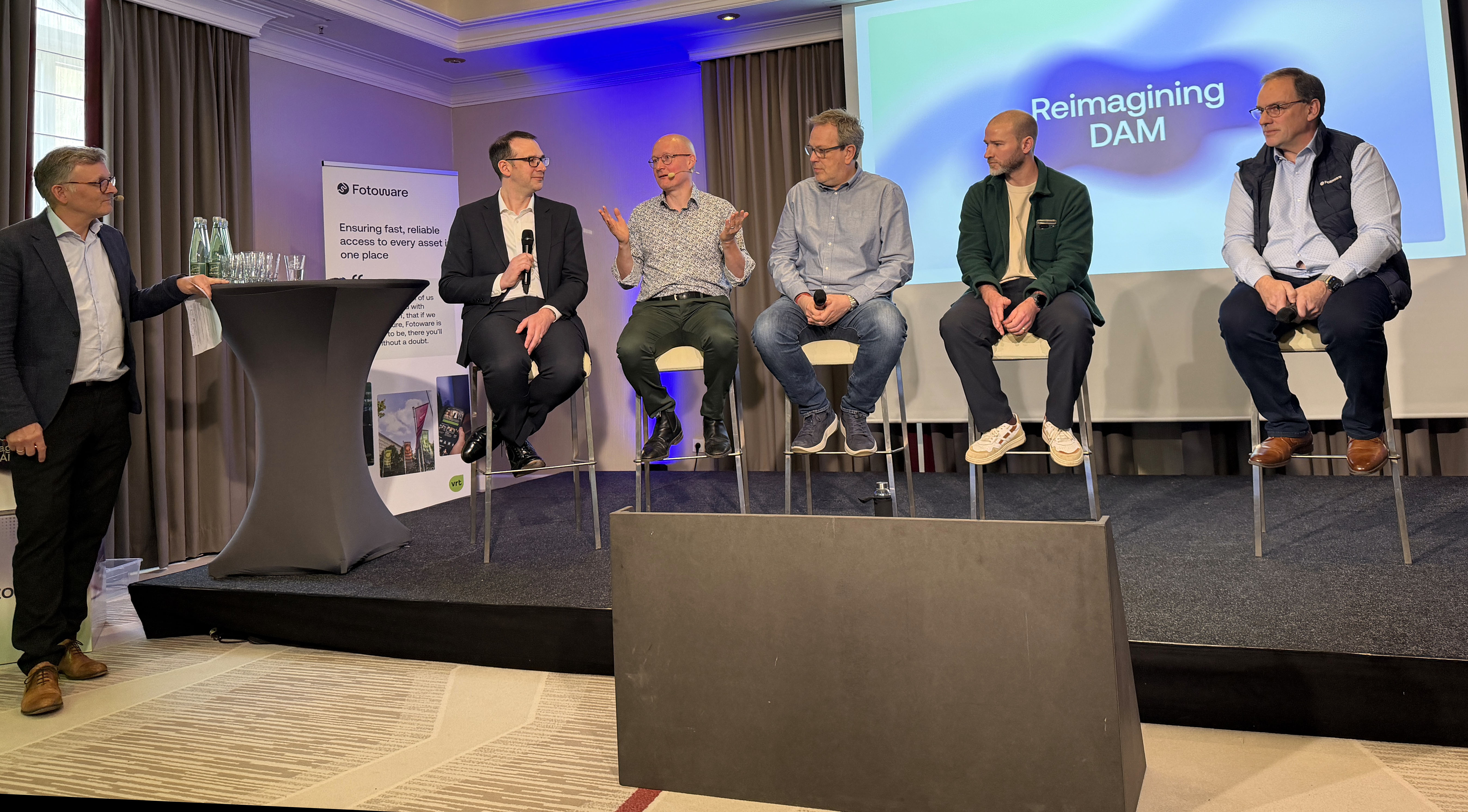
The panel explored the convergence of invisible watermarking technology (imatag), metadata standards (IPTC), camera-level C2PA implementation, and DAM processing. Under the “Certify the Truth” banner, the panelists discussed how the industry is building a comprehensive trust infrastructure from capture devices embedding content credentials, through DAM systems preserving provenance, to publishers and platforms verifying authenticity for end users.
Key themes included the urgency of the misinformation crisis, the need for cross-platform interoperability of content credentials, the role of invisible watermarking as a resilience layer when metadata is stripped, and the practical steps organizations can take today to begin their content authenticity journey.
Presenters: Flo Froidevaux, Line Falk, Angélica Cordova, Craig Rodger
The workflow presentations brought the conference themes to life with practical demonstrations. Flo Froidevaux, Line Falk, Angélica Cordova, and Craig Rodger each showcased real-world workflows that illustrate how Fotoware’s platform is being used to solve concrete content operations challenges.
These sessions demonstrated the breadth of Fotoware’s workflow capabilities from automated ingestion and metadata enrichment, to AI-powered tagging and content distribution, to the orchestration of complex multi-step processes across teams and systems. The presentations reinforced Fotoware’s human-centric approach: starting with people and processes before applying technology, then validating the results.
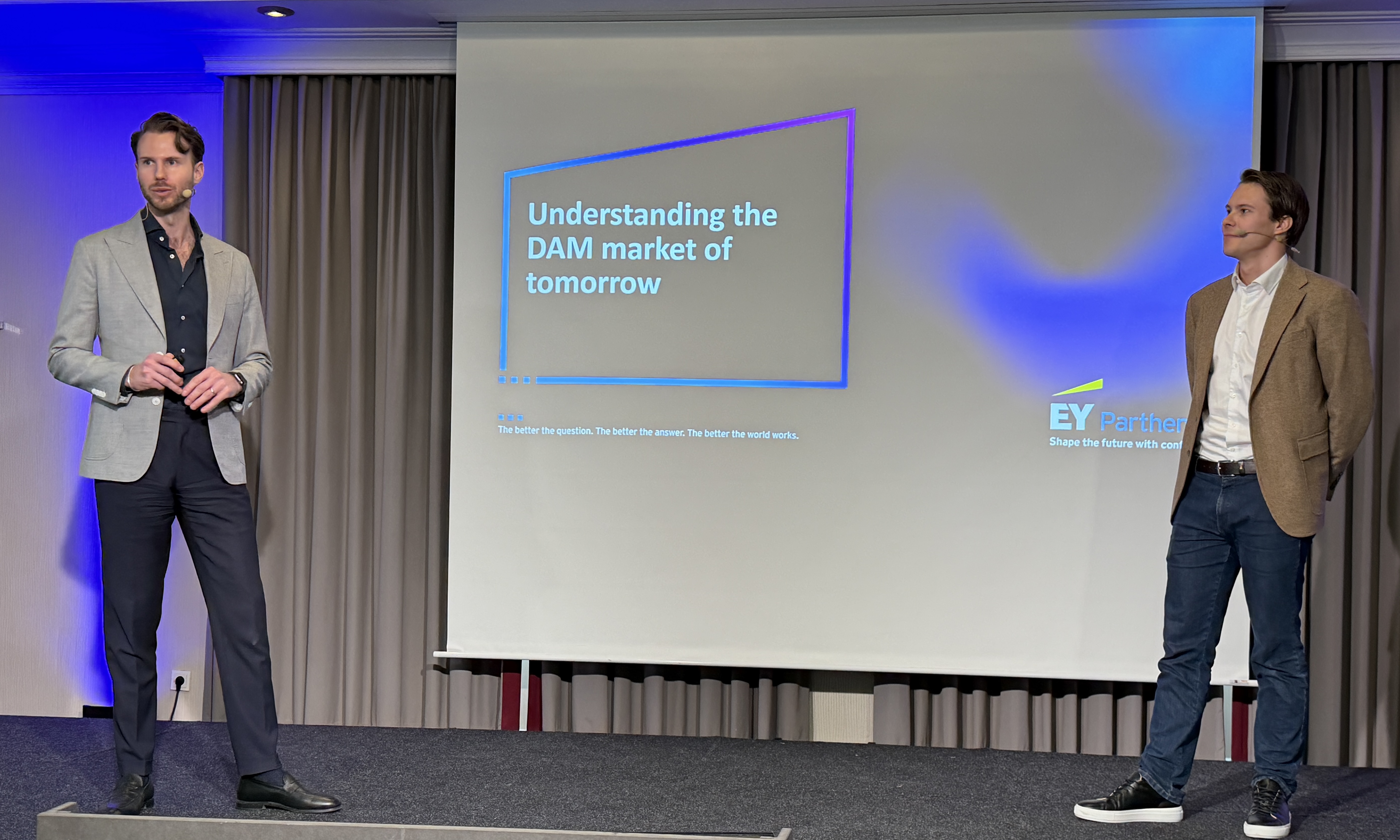
Speakers: Jacob Blomgren and Aksel Skaar, EY-Parthenon
Jacob Blomgren and Aksel Skaar from EY-Parthenon brought an external, market-facing perspective to the conference. Their session provided strategic context on the broader technology and media landscape, complementing the product-focused and practitioner-led sessions with analytical insights from one of the world’s leading strategy consultancies.
The EY-Parthenon perspective reinforced the market trends highlighted throughout the conference: the explosion of digital content, the rising importance of governance and compliance, the transformative potential of AI, and the strategic role that DAM systems play as enterprise content orchestration hubs.
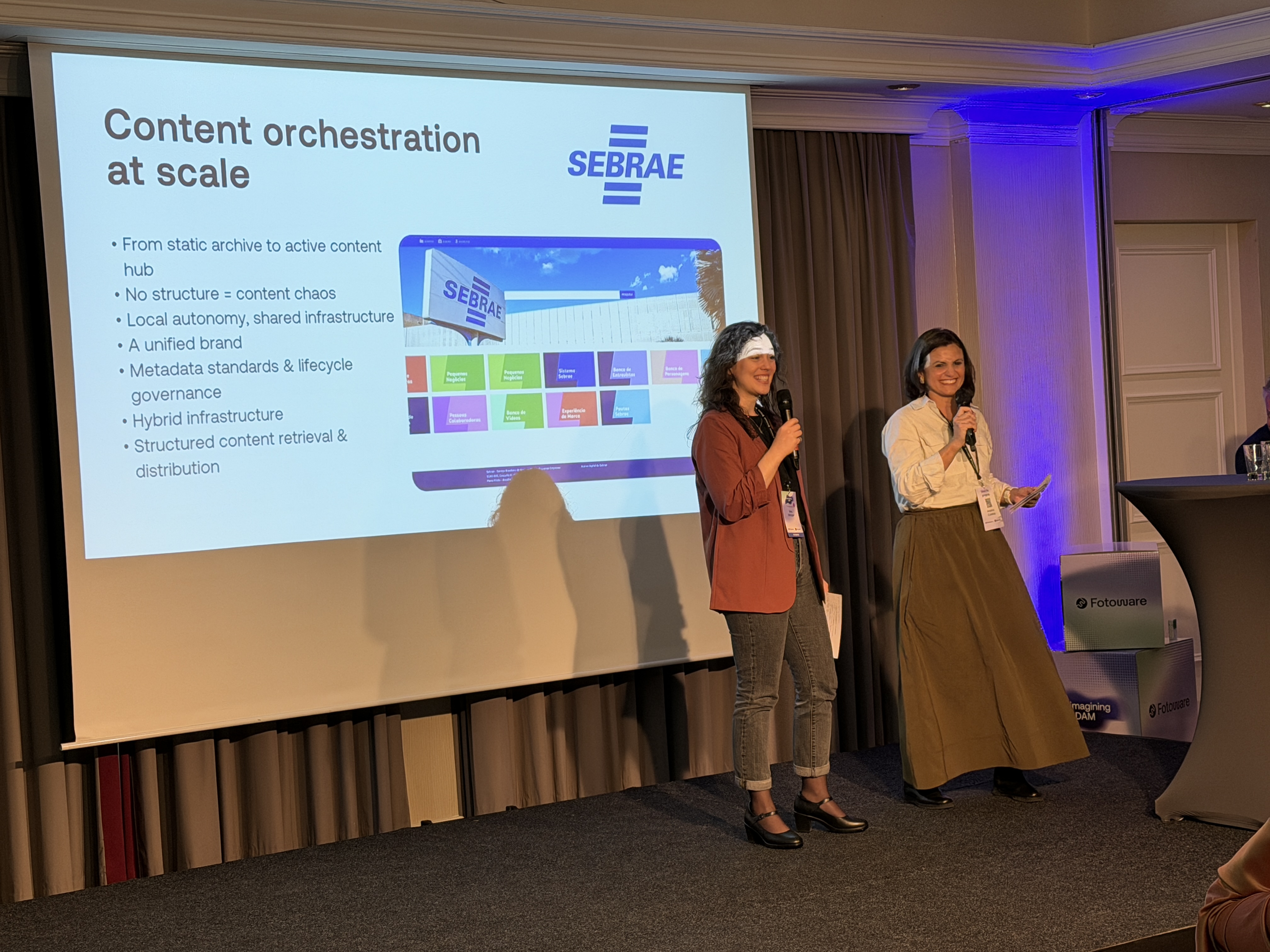
SEBRAE, the Brazilian Micro and Small Business Support Service, presented a compelling case for content orchestration at scale. Their journey illustrates the transformation from a static archive to an active content hub, addressing the reality that “no structure = content chaos.”
Key elements of their approach include:
· Local autonomy with shared infrastructure balancing regional needs with organizational consistency.
· A unified brand across all touchpoints.
· Metadata standards and lifecycle governance.
· Hybrid infrastructure supporting diverse content needs.
· Structured content retrieval and distribution.
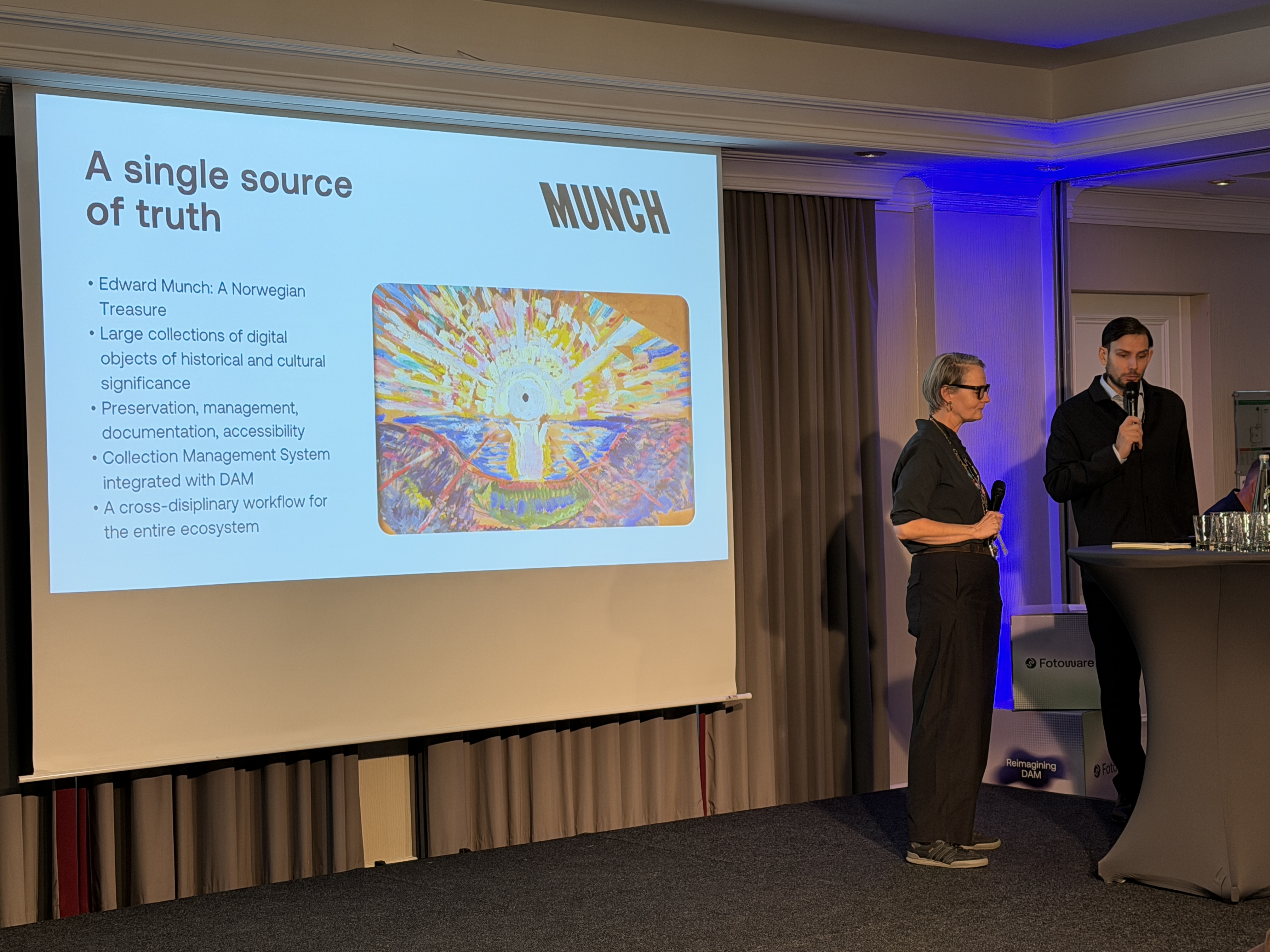
The Munch Museum in Oslo presented its use of Fotoware as a single source of truth for managing the legacy of Edvard Munch a Norwegian national treasure. The museum manages large collections of digital objects of historical and cultural significance, with priorities around preservation, management, documentation, and accessibility.
Their Collection Management System is integrated with the DAM, creating a cross-disciplinary workflow for the entire museum ecosystem — from curators and conservators to public-facing digital experiences.
Equinor, the Norwegian energy company operating globally, presented their use of Fotoware for corporate brand compliance. As a global organization with a global DAM, they manage thousands of press inquiries and extensive historical documentation.
Their approach is built on several principles:
· Daily operations based on a trust-first model.
· Clear roles that make governance sustainable.
· Continuous training that fosters adoption.
· Compliance embedded directly in workflows.
The conference included an awards ceremony celebrating outstanding contributions to the Fotoware community and beyond:
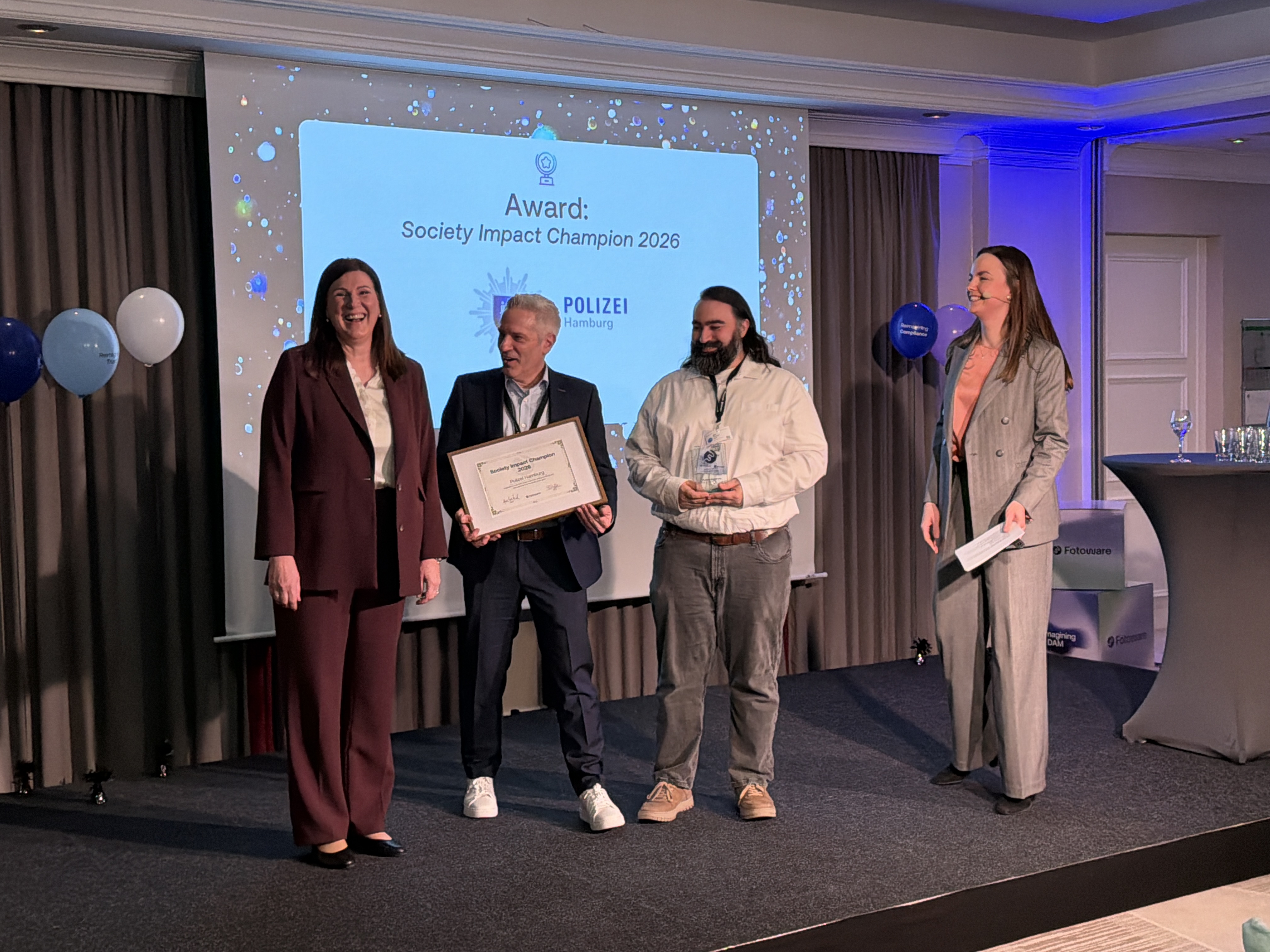
The Hamburg Police received the Society Impact Champion 2026 award in recognition of their pioneering use of Fotoware for digital evidence management. Their work demonstrates how DAM technology can have a direct, positive impact on public safety and the justice system.
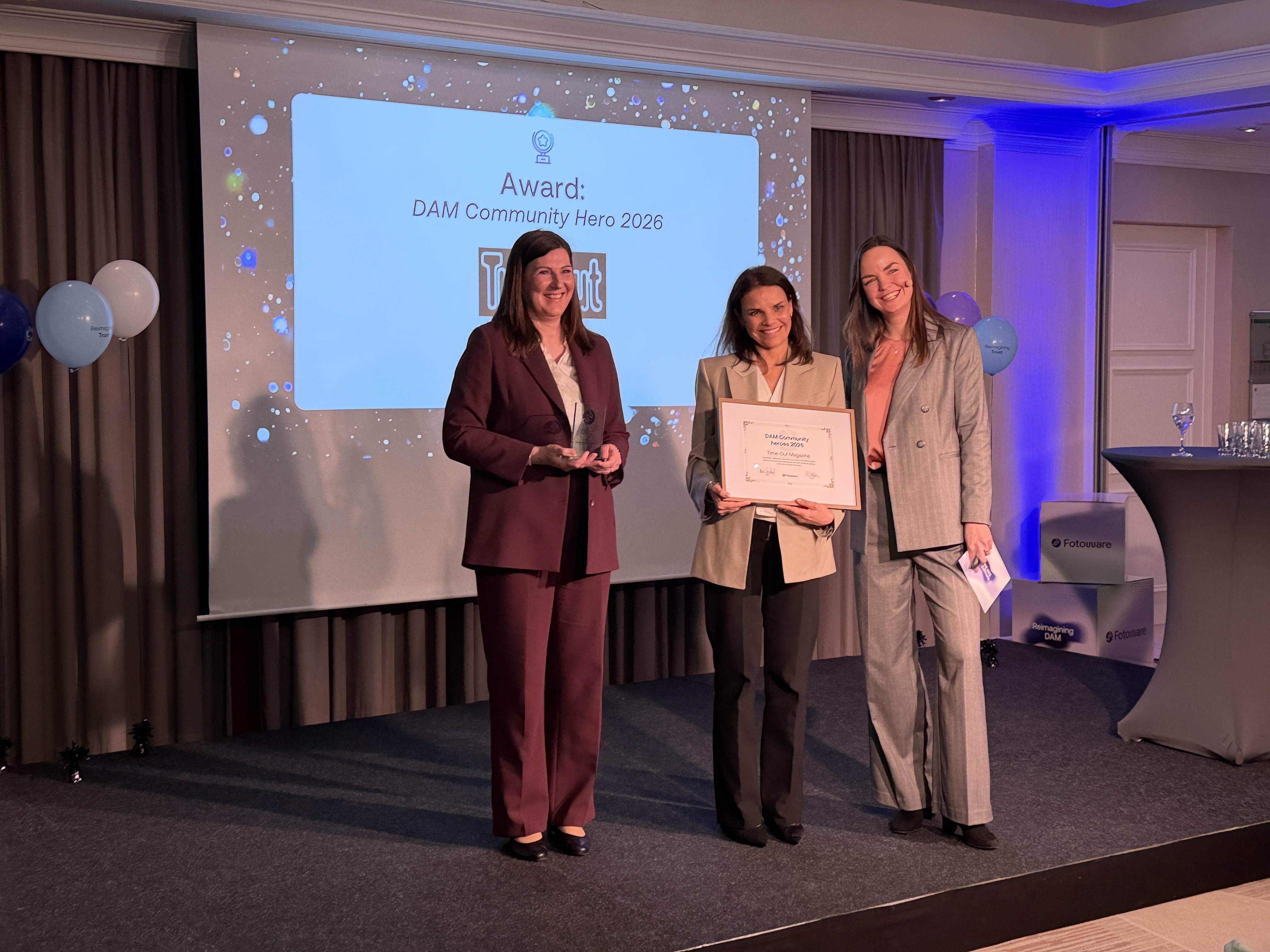
TimeOut magazine received the DAM Community Hero 2026 award, recognizing their exemplary use of Fotoware and their contribution to the DAM community. As a global media brand, TimeOut’s content operations showcase the power of well-implemented digital asset management.
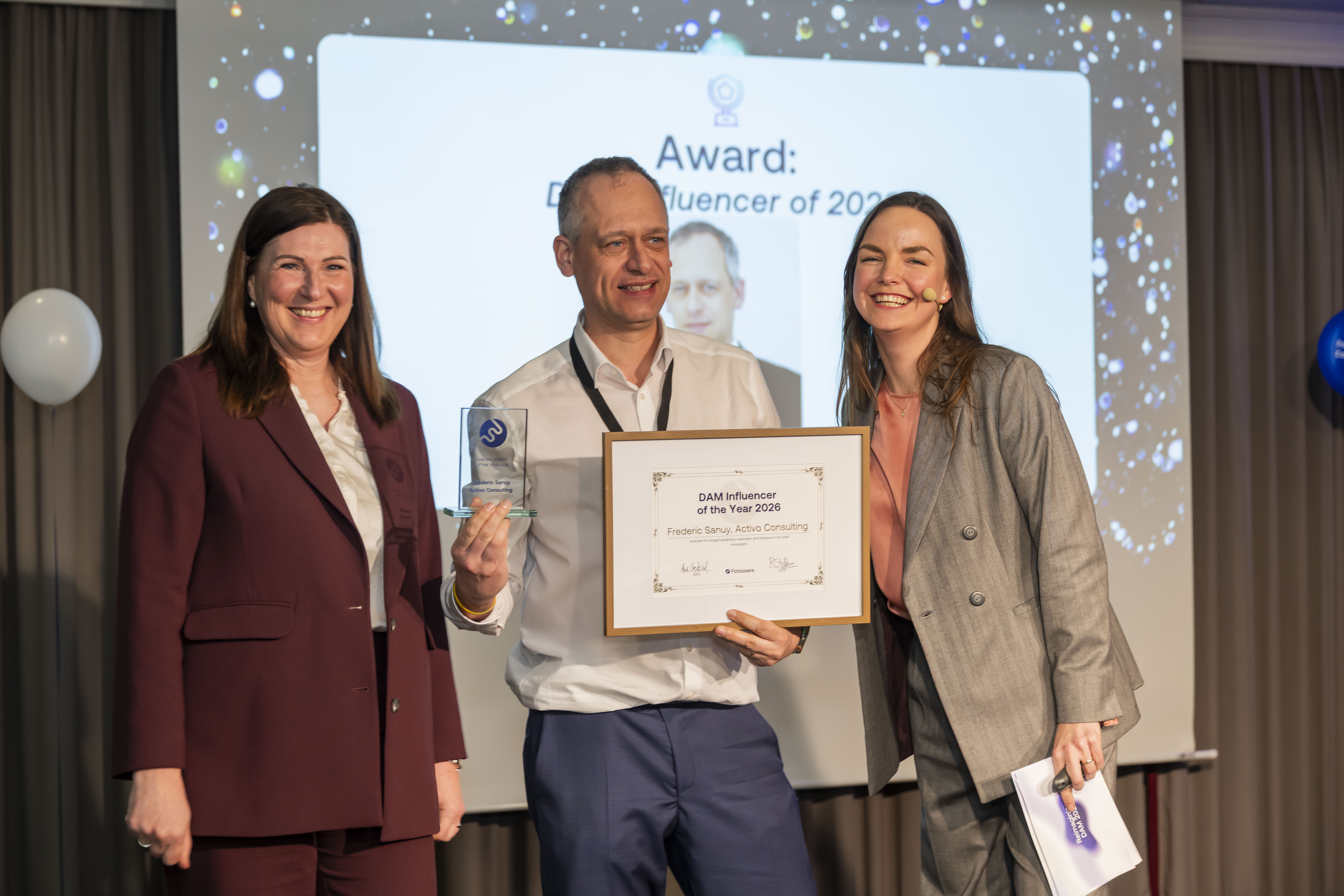
Frédéric Sanuy, CEO and co-founder of Activo and DAM News, was recognized as the DAM Influencer of the Year 2026. This award acknowledges Frédéric’s significant contributions to advancing the DAM industry through thought leadership, market analysis, community building, and his work with DAM News in sharing insights on open DAM specifications, market dynamics, and the impact of AI on digital asset management and 25 years of Fotostation.

1. DAM is no longer just about storage it’s becoming the enterprise content orchestration hub, the provenance hub, and the trust layer for every digital asset.
2. We have moved from an era of discovery to an era of authentication. The DAM of the future won’t just store pixels; it will manage cryptographic certificates and the history of every asset.
3. Content authenticity (C2PA / Content Credentials) is the next frontier. The ecosystem is maturing rapidly, with IPTC’s Verified Publisher List, Origin Verify tools, and the new 2026+ trust model with identity assertions.
4. AI is both the opportunity and the challenge. 78% of organizations use AI, 71% use generative AI but consumers hold brands to a higher standard. Trust frameworks like the 6 Dimensions of Trust provide practical guidance.
5. The human-centric approach matters. Fotoware’s Person → Process → Technology → Validate framework ensures technology serves people, not the other way around.
6. Real-world use cases from SEBRAE, Munch Museum, Equinor, UEFA, and Hamburg Police demonstrate DAM’s breadth of impact from cultural heritage preservation to law enforcement evidence management.
7. Open DAM specifications and market dynamics are shifting. The industry is moving toward greater interoperability while AI-first entrants reshape the competitive landscape.
8. Content Credentials go far beyond news they are being used for bodycam footage, security cameras, insurance photography, brands, archives, and more.
9. Fotoware’s investments in plug-ins, automation, UI extensions, and SDKs signal a platform strategy that invites ecosystem participation.
10. The three pillars of provenancesigned metadata, fingerprinting, and watermarking work together to ensure content credentials survive even when assets are copied and shared across the web.
The Reimagining DAM 2026 conference in Munich made one thing unmistakably clear: we are at an inflection point in how organizations create, manage, and distribute digital content. The convergence of AI, content authenticity standards, and modern cloud architecture is fundamentally transforming what a DAM system can and should be.
Fotoware is positioning itself at the center of this transformation not just as a technology provider, but as a partner in the content journey. With 850+ customers, 98% satisfaction, and a 15-year average customer tenure, the trust is clearly there. The question now is how quickly the broader industry will adopt the content authenticity frameworks that Fotoware, IPTC, and the wider ecosystem are building.
For anyone working in digital asset management, media operations, content governance, or any field where the provenance and integrity of digital content matters, the message from Munich is clear: the future of DAM is connected, intelligent, and authentic.
Frédéric Sanuy • CEO, Activo • DAM News
March 2026


