
Your marketing team just launched a campaign using outdated brand assets. Again. Despite investing $150,000 in a DAM system last year, they're still emailing PSDs and hunting through shared drives for the "final final" logo version.
You're not alone. 73% of organizations struggle with DAM adoption after 18 months, according to recent enterprise software studies. The technology works perfectly. The problem? Missing digital asset governance frameworks that define who does what, when, and how.
Here's what typically happens: IT deploys the DAM system. Marketing gets a 30-minute demo. Everyone assumes adoption will happen naturally. Six months later, your creative team bypasses the system entirely because "it's faster to just Slack the files."
This breakdown costs more than efficiency. Brand inconsistency damages customer trust. Compliance risks multiply when regulated assets live in personal folders. Storage costs balloon across multiple platforms.
DAM operating models require the same structured approach as ERP or CRM implementations. You need clear decision rights: Who approves asset uploads? Which team owns taxonomy updates? How do you handle version conflicts between regional offices?
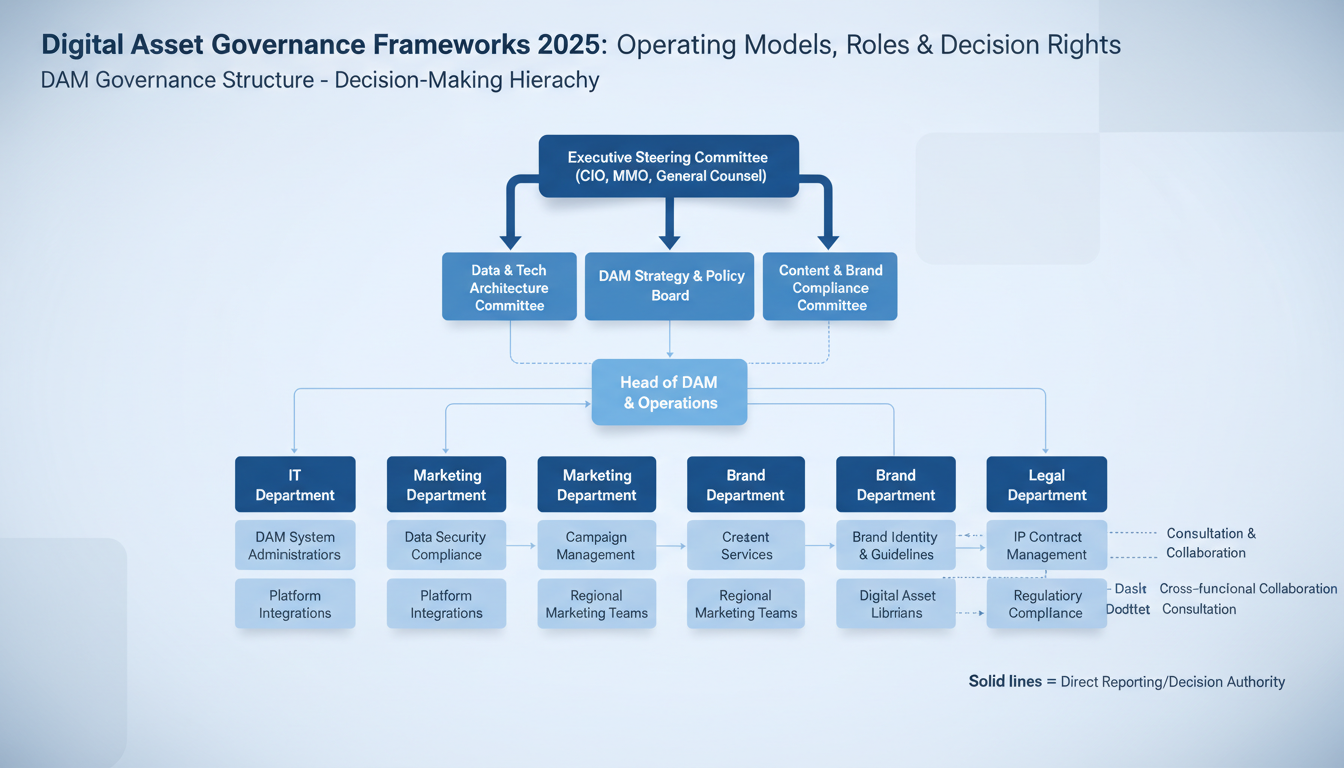
The solution isn't more training or better software features. You need governance frameworks that make the right choice the easy choice. This means defining roles before deployment, establishing DAM decision rights that prevent territorial disputes, and creating workflows that support how people actually work.
Over the next sections, we'll build your complete governance blueprint. You'll get specific role definitions for each stakeholder, decision-making matrices that prevent bottlenecks, and measurable success metrics that prove ROI to executives. No more hoping adoption happens organically.
The numbers tell a brutal story. Failed DAM projects cost organizations an average of $2.5 million over three years when you factor in wasted licensing fees, implementation costs, and lost productivity. Yet 67% of teams abandon their systems within 18 months.
Three patterns emerge from these expensive failures.
Pattern #1: The Ownership Wars
Marketing claims creative control. IT demands technical oversight. Legal wants compliance approval. This territorial dispute kills 45% of digital asset governance initiatives before they gain traction. Without clear decision rights, simple tasks like updating a logo become month-long battles between departments.
Pattern #2: Approval Purgatory
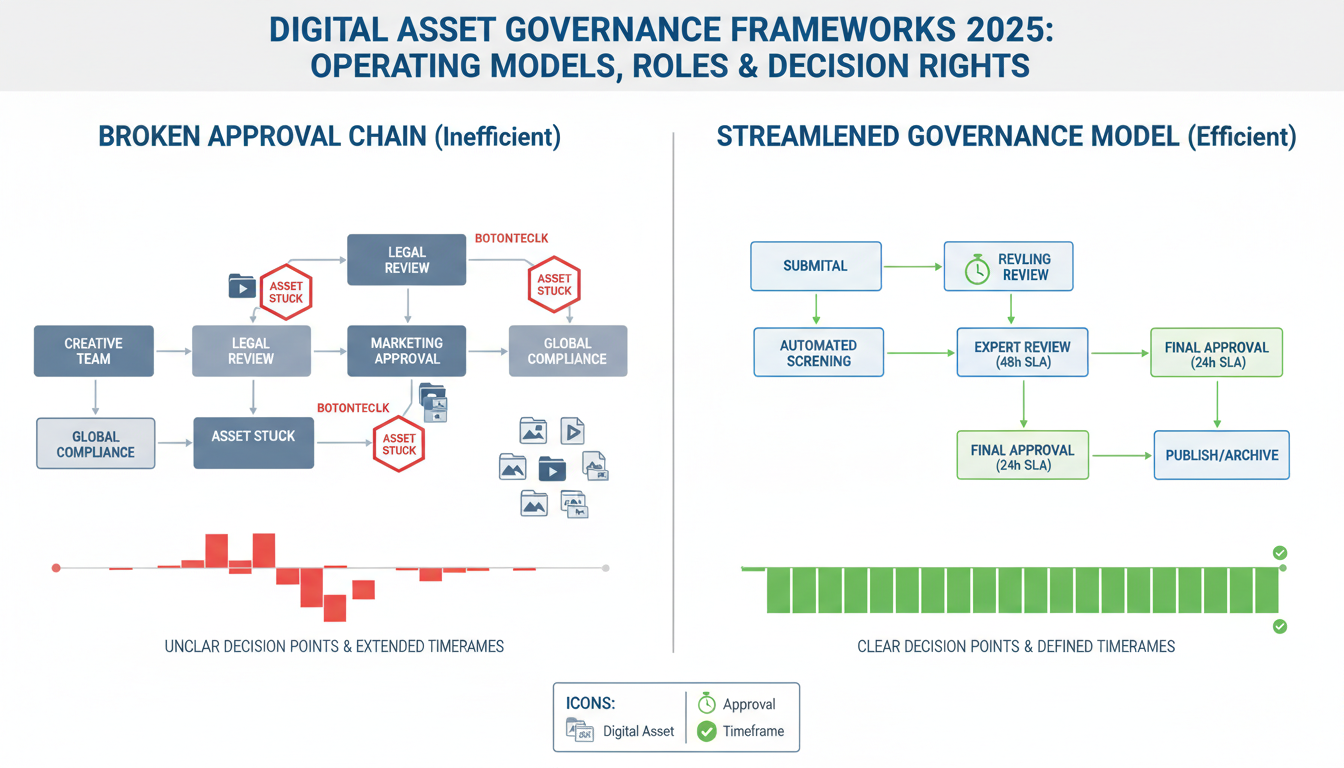
Assets sit in review queues for weeks because nobody defined the workflow. Who approves social media graphics? What about product photography? When approval chains aren't mapped in your DAM operating models, content creators resort to workarounds that bypass the system entirely.
Pattern #3: Metadata Chaos
A global retailer we analyzed had 50,000+ digital assets using three different naming conventions. Marketing used "Brand_Campaign_Date." IT preferred "YYYY-MM-DD_Category." Regional teams created their own system entirely. Without standardized metadata frameworks, findability drops to zero.
The connection between governance gaps and user abandonment is direct. Teams that can't locate approved assets in under 30 seconds will find alternatives. They'll use Google Images, create new versions, or dig through email attachments.
The Real Cost
Beyond the $2.5 million price tag, failed digital asset governance creates brand inconsistency, compliance risks, and team frustration. Your expensive DAM platform becomes digital shelf-ware while employees revert to Dropbox and email chains.
The solution isn't better technology—it's clearer operating models that define who owns what, when decisions get made, and how assets flow through your organization.
Most organizations approach digital asset governance backwards. They buy the technology first, then scramble to define who does what. The result? A $200,000 DAM system that becomes a glorified file dump.
Successful digital asset governance rests on four operational pillars that must be established before any technology deployment.
Create a RACI matrix that defines who Recommends, Approves, Creates, and is Informed for every asset decision. Your creative director shouldn't wait three days for legal approval on a simple social media graphic. Map approval thresholds: assets under $5,000 in media spend get manager approval, anything above requires director sign-off.
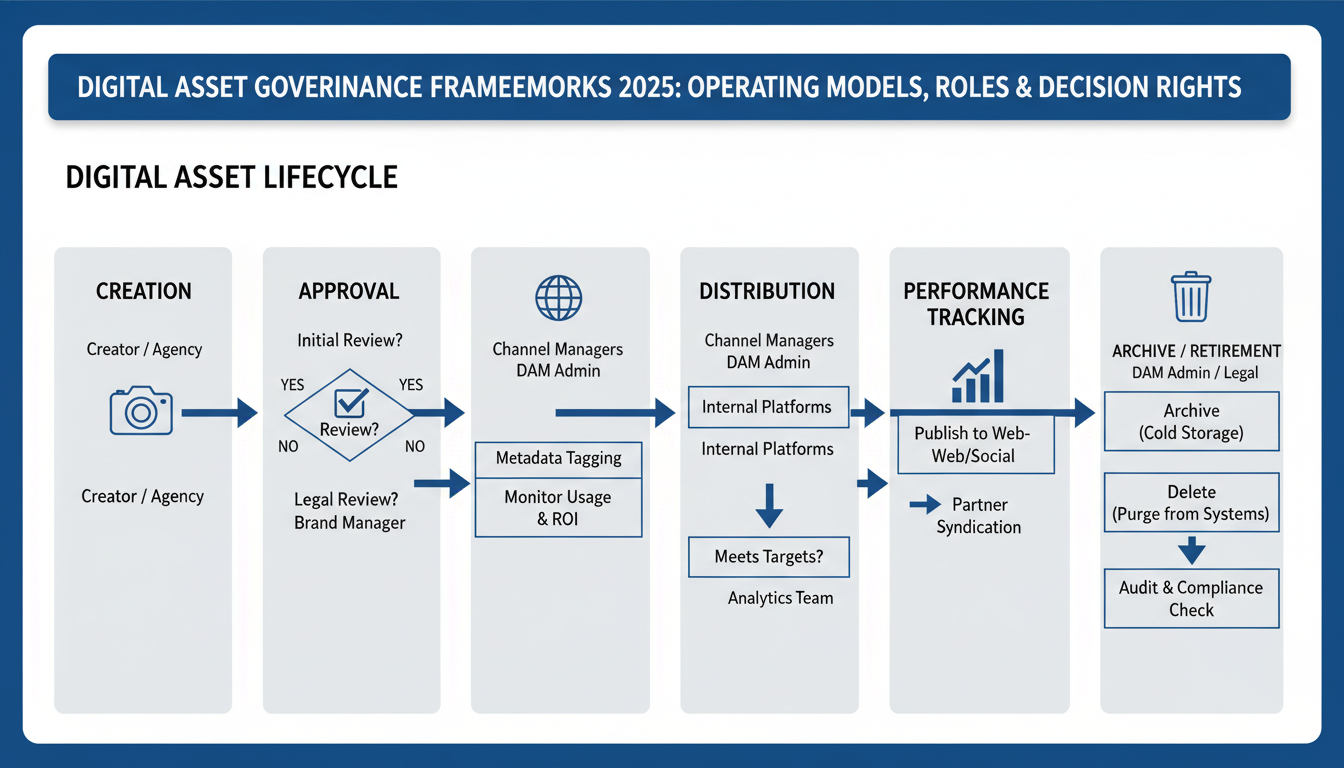
Document every step from asset creation to retirement. This includes naming conventions, version control, approval workflows, and archival processes. Your DAM operating models should specify exactly how a product photo moves from raw capture to final distribution across channels.
Define user permissions based on actual job functions, not org charts. Regional marketing managers need broader access than local franchisees. Build escalation paths that don't bottleneck at one person.
Track asset utilization rates, approval cycle times, and compliance metrics. Set targets: 80% asset reuse rate, 24-hour approval cycles for routine requests.
Real-World Success: Coca-Cola's Global Framework
Coca-Cola structured their DAM decision rights across 200+ markets by creating regional asset councils. Each council has defined authority levels—local markets can adapt campaigns within brand guidelines, but core brand assets require Atlanta approval. This approach reduced approval times by 60% while maintaining brand consistency.
The governance maturity progression follows predictable stages: Ad-hoc (chaos) → Defined (documented) → Managed (measured) → Optimized (continuous improvement).
Your organization's size and structure determine which DAM operating model will actually work. Get this wrong, and you'll spend months restructuring while your $200K system sits unused.
Centralized Control works best for organizations with fewer than 5,000 digital assets. A single team of 3-5 full-time employees manages everything from metadata standards to access permissions. Setup takes about 6 months, and you'll see ROI within 8 months because decision-making is fast. The downside? This model breaks when you hit enterprise scale.
Federated Management distributes digital asset governance across departments while maintaining central standards. Each department gets 0.25 FTE dedicated to asset management, plus one central coordinator. Microsoft uses this approach across their product divisions. Setup requires 12 months, but it scales beautifully for global organizations with complex compliance requirements.
Hybrid Structure combines both approaches—a core team of 2-3 people sets standards while department stewards handle day-to-day operations. This is the most common model, requiring 9 months to implement properly.
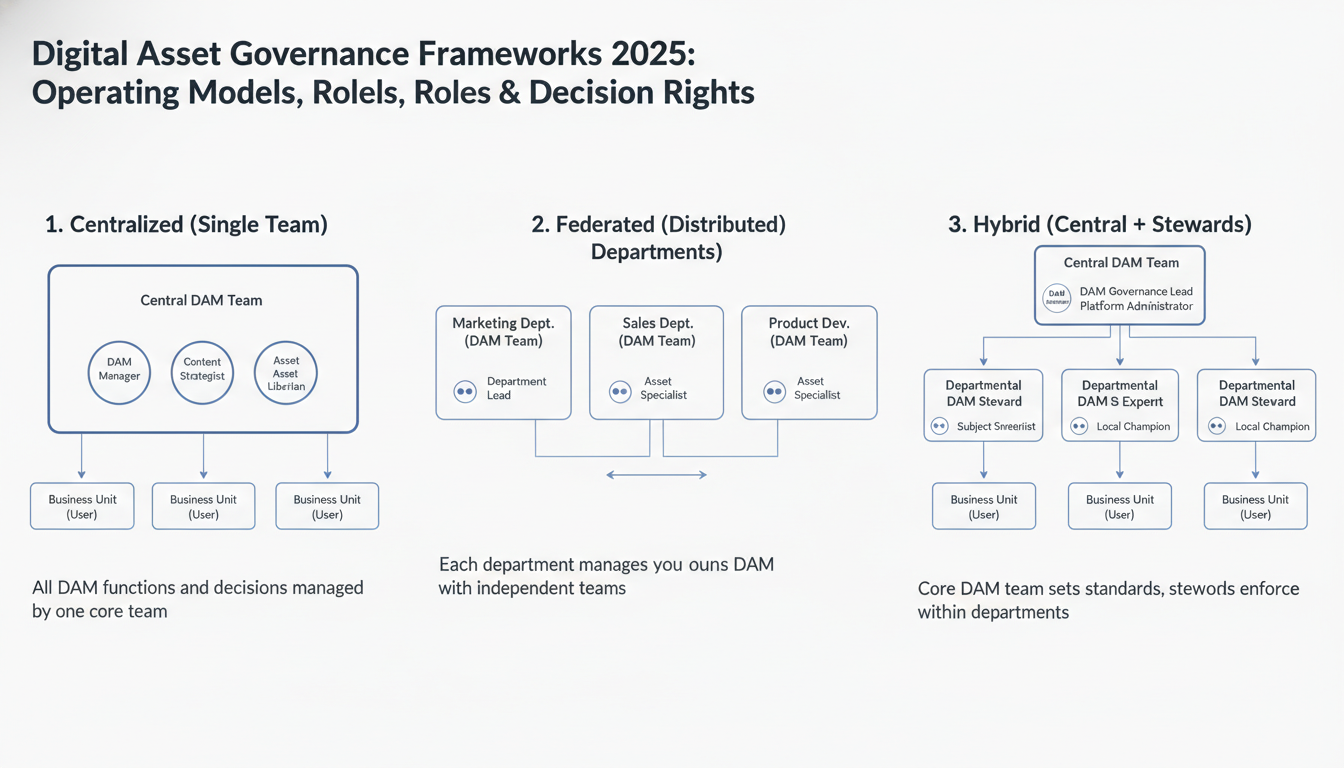
Your decision matrix should weigh three factors: organization size, geographic distribution, and regulatory requirements. Companies with operations in multiple countries typically need federated models to handle local compliance rules. Adobe's centralized approach works because most creative decisions happen in their San Jose headquarters.
Resource allocation reality check: Centralized models need 3-5 dedicated FTEs but show faster initial ROI. Federated structures require more people (1 central + 0.25 per department) but deliver better long-term scalability.
The key? Match your governance model to your actual decision-making culture, not your org chart.
The difference between DAM success and failure comes down to who owns what decisions. Here's how to structure your team without creating bureaucratic nightmares.
Your DAM Owner needs budget authority and cross-functional influence. This executive spends roughly 10% of their time on strategic oversight—approving major workflow changes, resolving departmental conflicts, and securing resources. They don't manage day-to-day operations but make the big calls when marketing and legal can't agree on brand guidelines.
DAM Manager ($85K-$120K): Your full-time quarterback handling vendor relationships, training programs, and system performance. They report usage metrics to the DAM Owner and translate business needs into technical requirements.
Content Librarian ($55K-$75K): Three-quarters dedicated to metadata schemas, taxonomy updates, and quality audits. They catch inconsistent tagging before it becomes a search problem.
Technical Administrator: Half-time role managing integrations with Creative Cloud, CMS platforms, and security protocols. Often filled by existing IT staff with expanded responsibilities.
Each major department assigns a representative at 25% capacity. Marketing's steward ensures brand compliance, while sales focuses on customer-facing asset accuracy. These aren't new hires—they're existing team members with defined DAM responsibilities.

For asset approval workflows: DAM Manager is Responsible for processing, Content Librarian Accountable for quality standards, department stewards Consulted on relevance, and Technical Administrator Informed of system impacts.
Career progression typically flows from Content Librarian to DAM Manager, then potentially to DAM Owner as digital asset governance becomes more strategic. The key skill evolution: tactical execution to cross-functional leadership.
This structure scales from 50-person agencies to enterprise teams managing millions of assets.
Successful digital asset governance requires clear decision-making boundaries. Without defined authority levels, simple metadata updates can trigger month-long approval chains while strategic platform decisions get rushed through by whoever speaks loudest in meetings.
Level 1 (Operational) covers daily DAM activities: metadata updates, basic asset approvals, and user access requests. Your content managers and librarians own these decisions with a 24-hour SLA. No committee required.
Level 2 (Tactical) handles workflow modifications, third-party integrations, and budget variances under $10K. Department heads collaborate here with a 5-business-day timeline. This prevents operational bottlenecks while maintaining oversight.
Level 3 (Strategic) governs platform changes, major system integrations, and budgets exceeding $50K. Your steering committee takes 30 days maximum—enough time for proper evaluation without analysis paralysis.
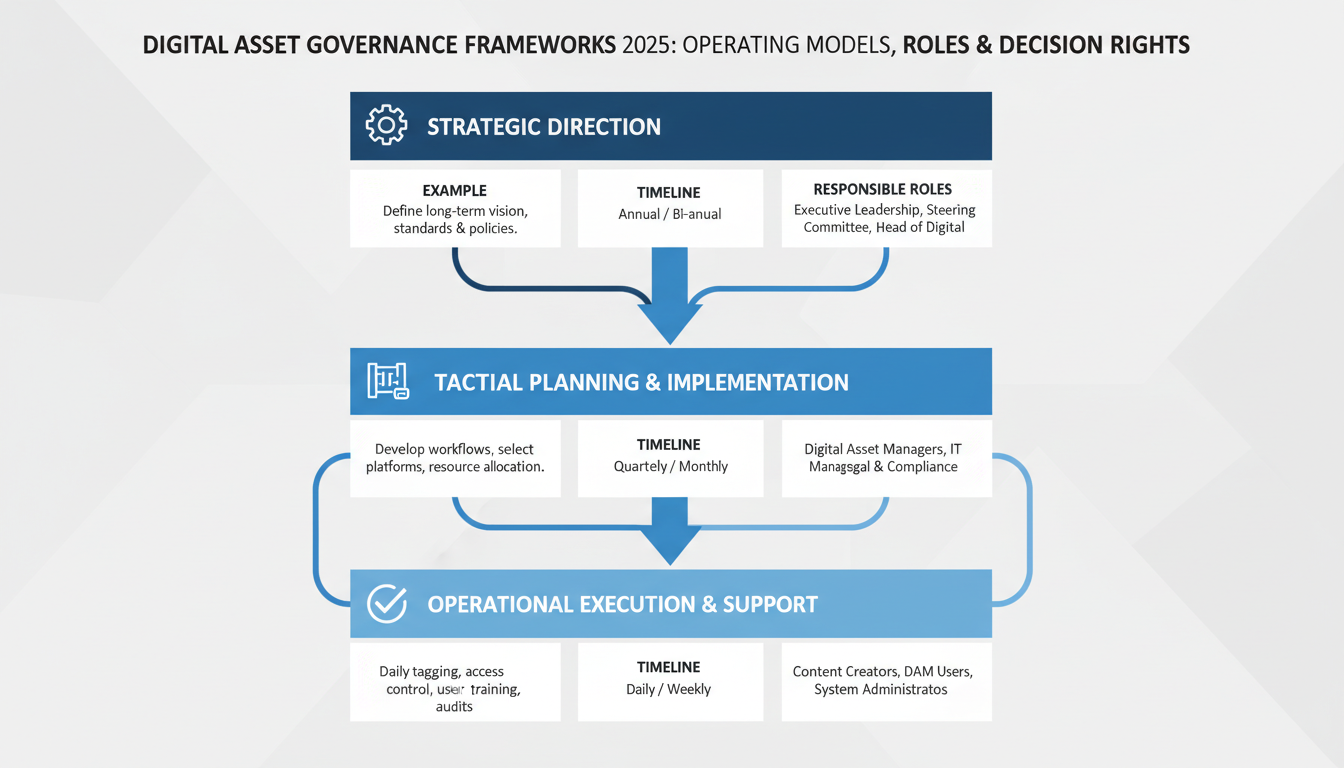
When departments disagree on asset classification or usage rights, your escalation matrix kicks in. Marketing wants hero images accessible to sales, but brand insists on approval workflows. Level 1 conflict escalates to Level 2 within 48 hours, then Level 3 if unresolved after one week.
Real-world example: New brand guidelines require taxonomy restructure affecting 15,000 assets. This starts as Level 1 (metadata updates) but escalates to Level 3 when IT estimates $75K in consultant fees. Your governance framework prevents scope creep by clearly defining when operational tasks become strategic decisions.
DAM decision rights form your governance cornerstone. Document who approves what, when decisions must escalate, and how conflicts get resolved. Otherwise, you'll spend more time debating permissions than managing assets.
The best frameworks feel invisible to daily users while preventing expensive mistakes at the strategic level.
The most successful digital asset governance implementations follow a deliberate three-phase expansion model. Here's how to build your steward network without overwhelming your organization.
Start small with 3-5 power users from a single department—typically marketing or creative teams. These early adopters become your proof-of-concept champions. Focus on perfecting workflows and identifying pain points before expanding.
Add 2-3 departments and establish your formal steward network of 15-20 people. This is where DAM operating models either gain momentum or stall. Choose stewards based on a proven formula: 20% technical aptitude, 40% process orientation, and 40% organizational influence.
Technical skills matter less than you think. Process-oriented people who can influence others drive adoption faster than tech experts who work in isolation.
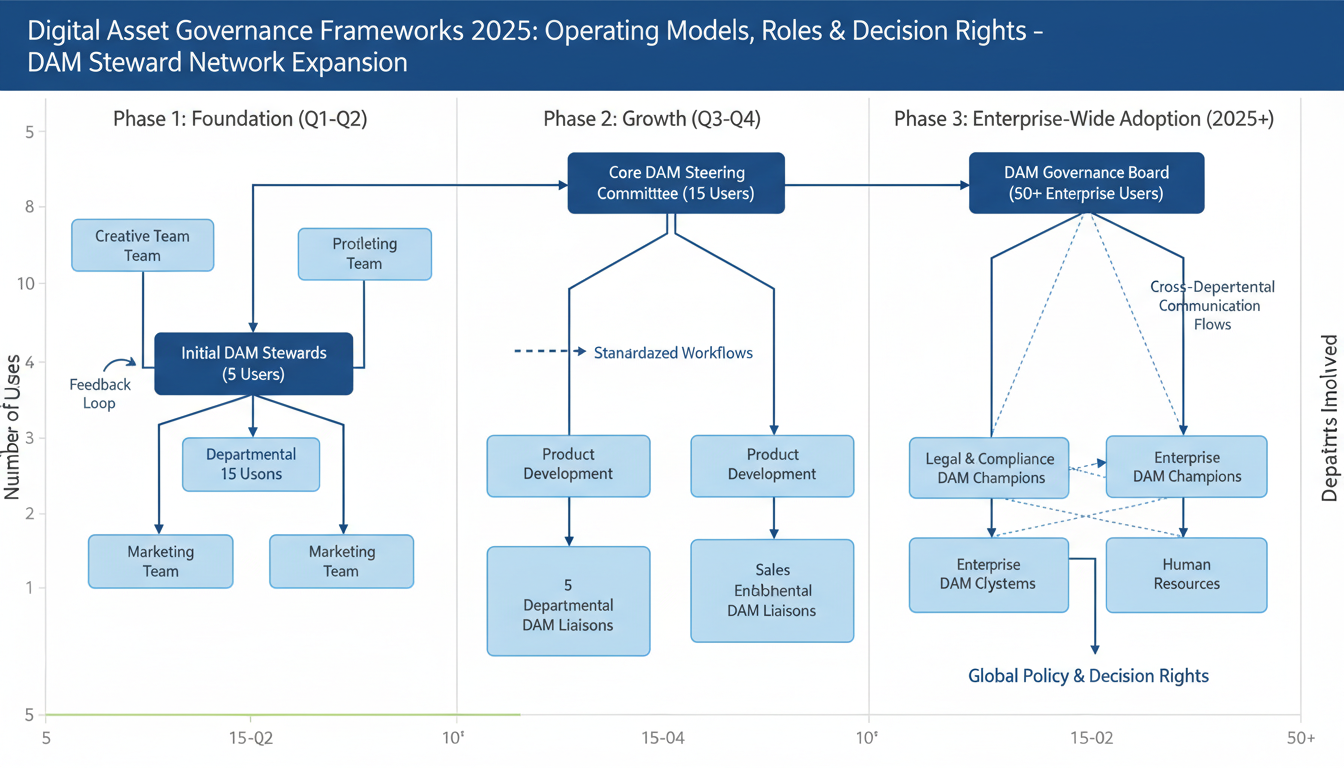
Scale to 50+ active users with regional stewards managing local needs. Unilever's DAM expansion across 190 countries succeeded because they appointed country-level stewards who understood local market requirements while maintaining global standards.
Your steward program needs consistent touchpoints:
Integrate DAM decision rights into performance reviews. Recognition programs work better than monetary incentives—stewards want visibility for their contributions to digital asset governance success.
Most organizations underestimate the communication overhead. Plan for 20% more meeting time than you initially think you'll need.
Digital asset governance frameworks need flexible workflows that balance oversight with speed. Most organizations benefit from three distinct approval pathways that adapt to asset complexity and urgency.
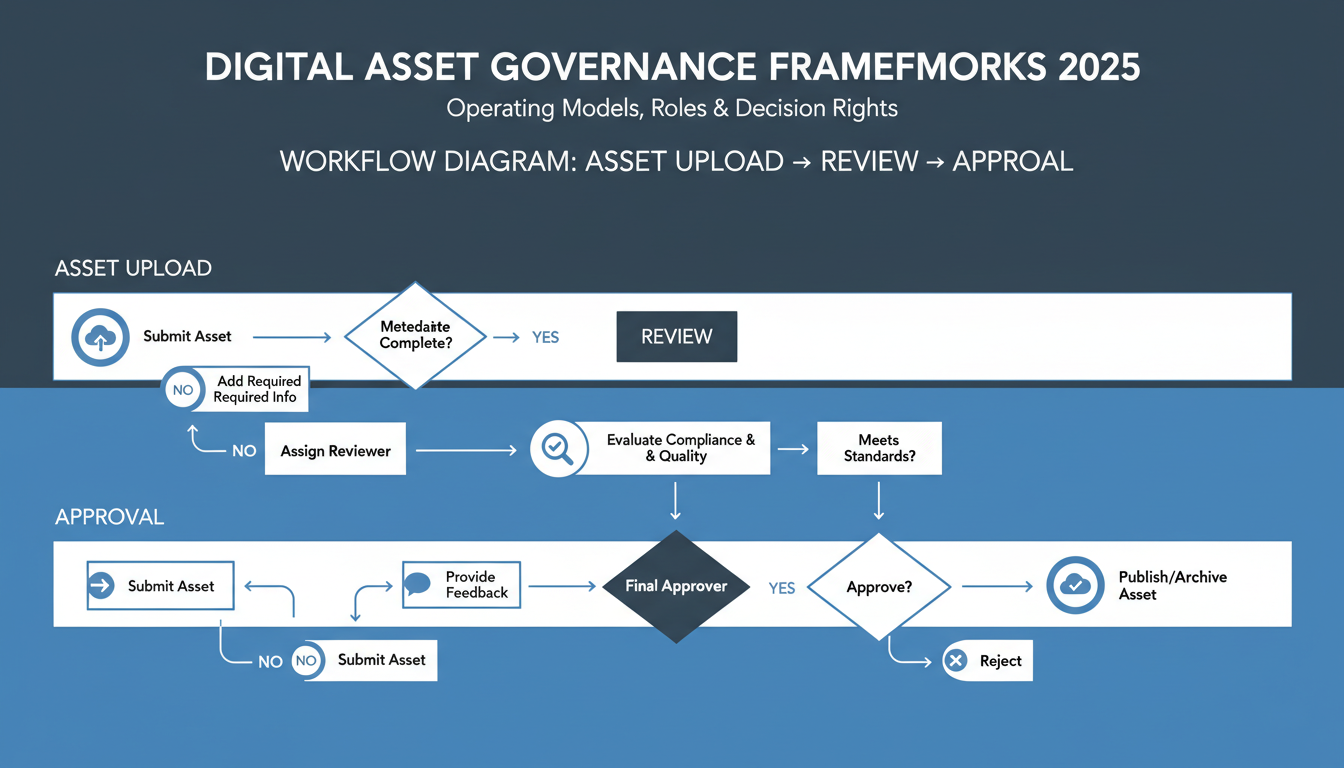
The standard workflow follows a straightforward Creator → Reviewer → Approver → Publisher sequence with a 48-hour SLA. This covers 80% of routine assets like blog images, social media graphics, and internal presentations. Each stakeholder gets automatic notifications through Slack or email, with calendar blocking to reserve review time.
For breaking news or campaign launches, the express workflow enables auto-approval with post-review validation. Assets move to publication within 4 hours, but reviewers still examine them afterward. This prevents bottlenecks during product launches or crisis communications while maintaining DAM decision rights.
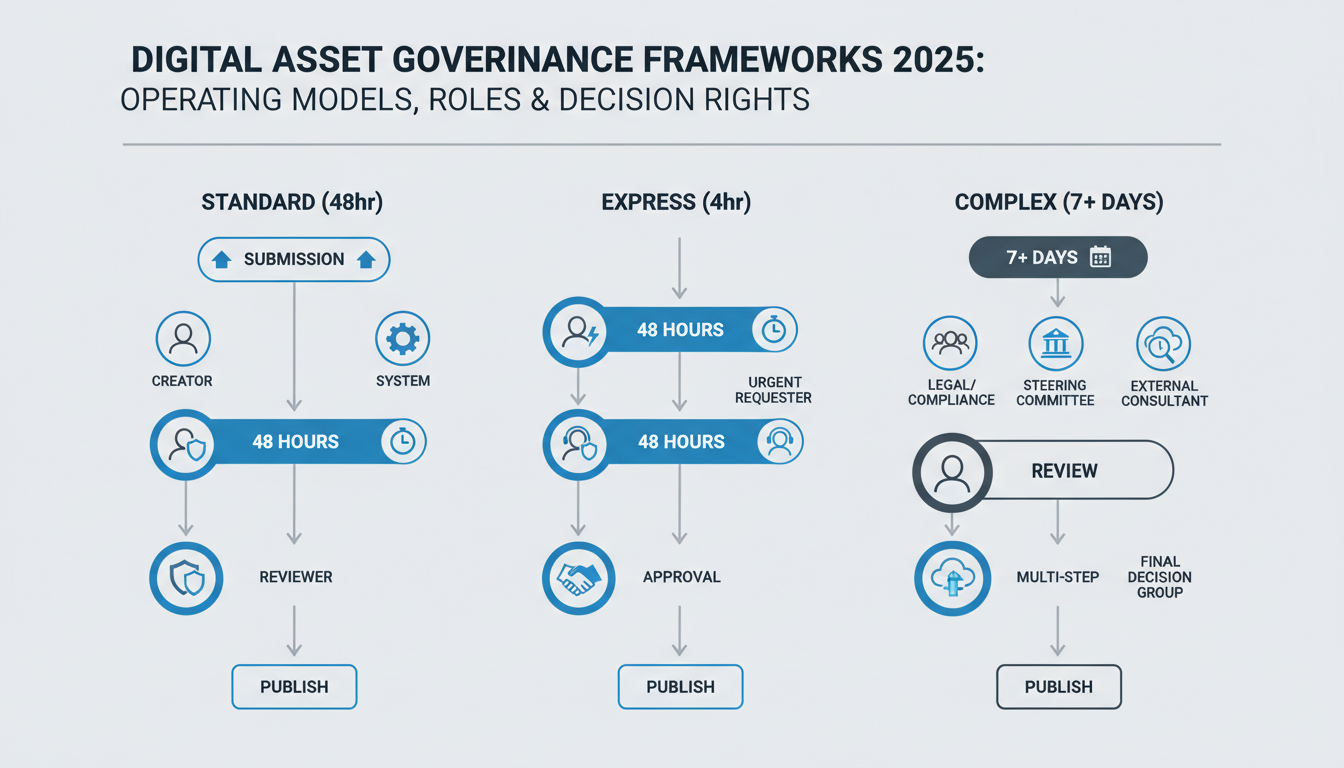
Complex workflows kick in automatically when assets trigger specific conditions: files over 100MB, external usage rights, or keywords like "legal," "merger," or "FDA." These routes include compliance officers, legal counsel, and brand managers, extending timelines to 7-10 days.
Smart automated triggers eliminate guesswork about which workflow applies. The system scans file properties, metadata, and content to route assets appropriately. A 500MB video with "customer testimonial" tags automatically enters complex review, while a 2KB logo update stays in standard processing.
Exception handling covers real-world scenarios through workflow bypasses and emergency procedures. CMOs can override approvals during crisis communications, but the system logs these actions for retroactive review.
Bottleneck analytics reveal which departments consistently miss SLAs. If marketing reviews average 72 hours while legal averages 18, you can redistribute workloads or adjust expectations.
Mobile approval capabilities let executives approve assets from anywhere, preventing delays when key stakeholders travel. Integration with existing tools means reviewers don't need new logins or training.
Strong metadata architecture separates functional DAM systems from digital chaos. Your digital asset governance framework needs standardized metadata that works across departments while maintaining search accuracy above 85%.
Start with 15 core fields that every asset requires: asset type, creation date, file format, dimensions, usage rights, campaign tags, creator, approval status, expiration date, keywords, description, brand guidelines compliance, version number, source system, and last modified date. These fields create the baseline for asset discoverability.
Department-specific metadata extends this foundation. Marketing teams need campaign ID, audience segment, channel deployment, and performance metrics. Legal requires approval status, rights expiration, territory restrictions, and compliance flags. Creative teams track mood, style, color palette, and design iteration.
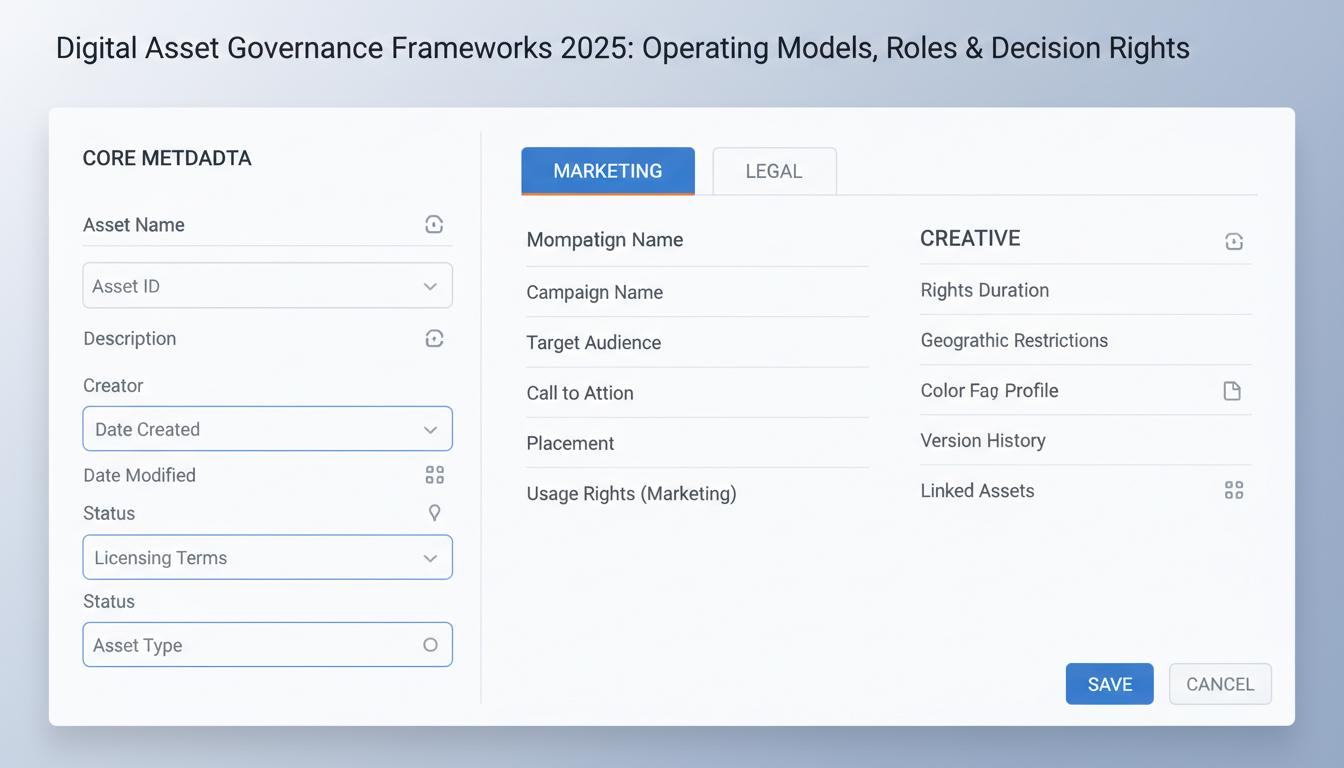
Keep your taxonomy structure to three levels maximum. Deeper hierarchies create confusion and inconsistent tagging. Use controlled vocabularies with synonym management—when someone searches "automobile," they should find assets tagged "car" or "vehicle."
Netflix maintains metadata consistency across 50+ content types and 190+ countries by using controlled vocabularies with regional synonym mapping. Their three-tier structure runs: Content Type > Genre > Sub-genre, with controlled terms at each level.
Implement metadata quality scoring: completeness (40%), accuracy (35%), and consistency (25%). Assets scoring below 70% get flagged for cleanup. Monthly taxonomy reviews catch emerging terms, while quarterly cleanup campaigns address orphaned tags and duplicate entries.
Auto-tagging capabilities reduce manual work by 60%. AI-powered suggestions analyze visual content, text, and historical patterns to recommend tags. Bulk metadata updates handle campaign launches efficiently.
Quality checkpoints include upload validation, periodic audits, and user feedback loops that continuously improve your digital asset governance accuracy.
Your digital asset governance framework needs measurable outcomes, not vanity metrics. Most organizations track downloads but miss the indicators that actually predict long-term success.
Start with usage depth over breadth. Monthly active users should hit 80% of your licensed seats within six months. More telling: track downloads per user monthly. High-performing DAM systems see power users downloading 15-20 assets monthly, while struggling systems hover around 3-5. This gap reveals whether your DAM operating models actually serve daily workflows.
Quality metrics separate functional systems from digital junkyards. Target 95% metadata completeness across core fields—anything below 85% kills search effectiveness. Monitor duplicate asset rates religiously. Organizations exceeding 5% duplicates waste 30% more storage and confuse users. One Fortune 500 company discovered 847 versions of their logo after implementing duplicate detection.
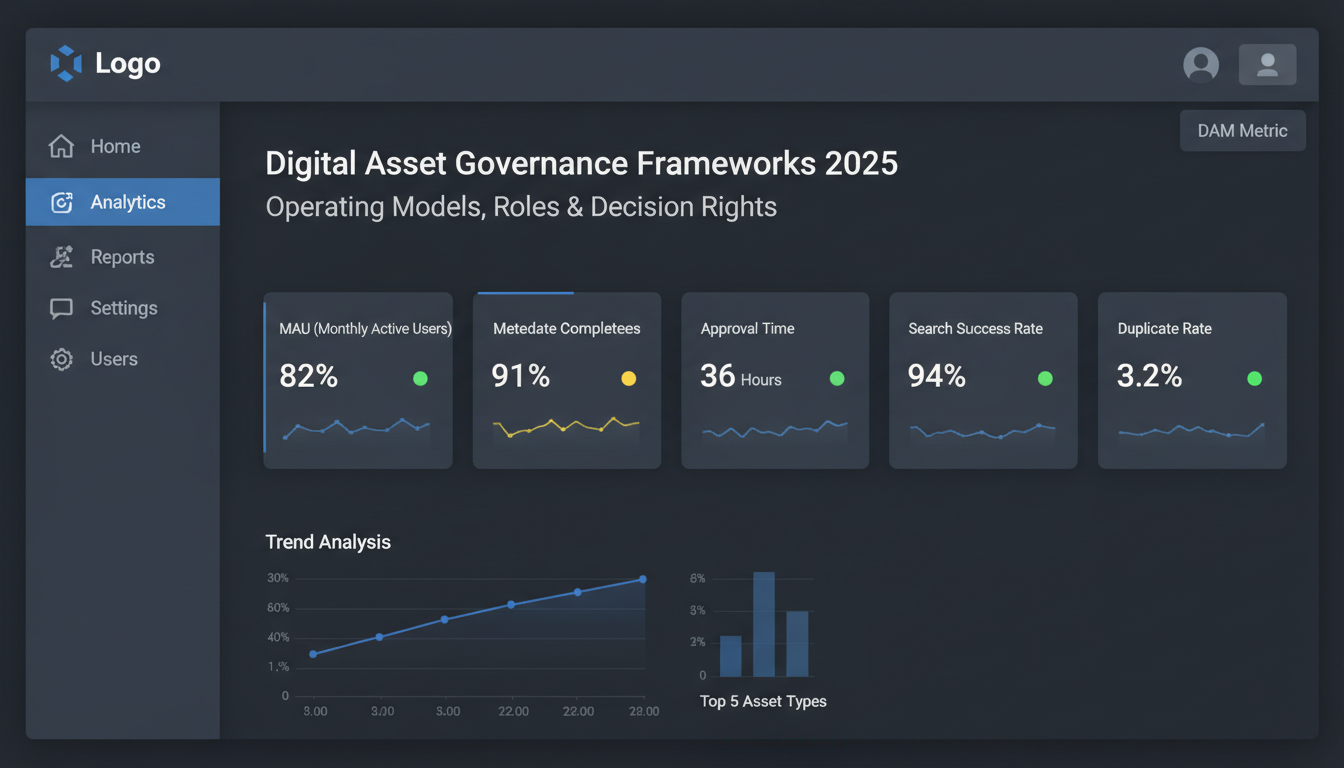
Speed matters for adoption. Average approval times exceeding 48 hours kill momentum. Track search success rates—users finding relevant assets within three queries. Benchmark against industry standards: SaaS companies average 92% search success, while manufacturing organizations typically achieve 87%.
Business impact metrics justify your investment. Calculate cost per asset managed annually, including storage, licensing, and staff time. Document time savings versus previous processes. One mid-size agency reduced creative project timelines by 23% after implementing structured DAM decision rights.
Weekly executive dashboards work best with five core metrics using red/yellow/green indicators. Include NPS scores targeting above 50 and support ticket trends. Compliance metrics—expired asset usage incidents and rights violations—protect against legal exposure while measuring governance effectiveness.
Your digital asset governance framework means nothing if people won't use it. Real adoption requires systematic change management that addresses human behavior, not just technical implementation.
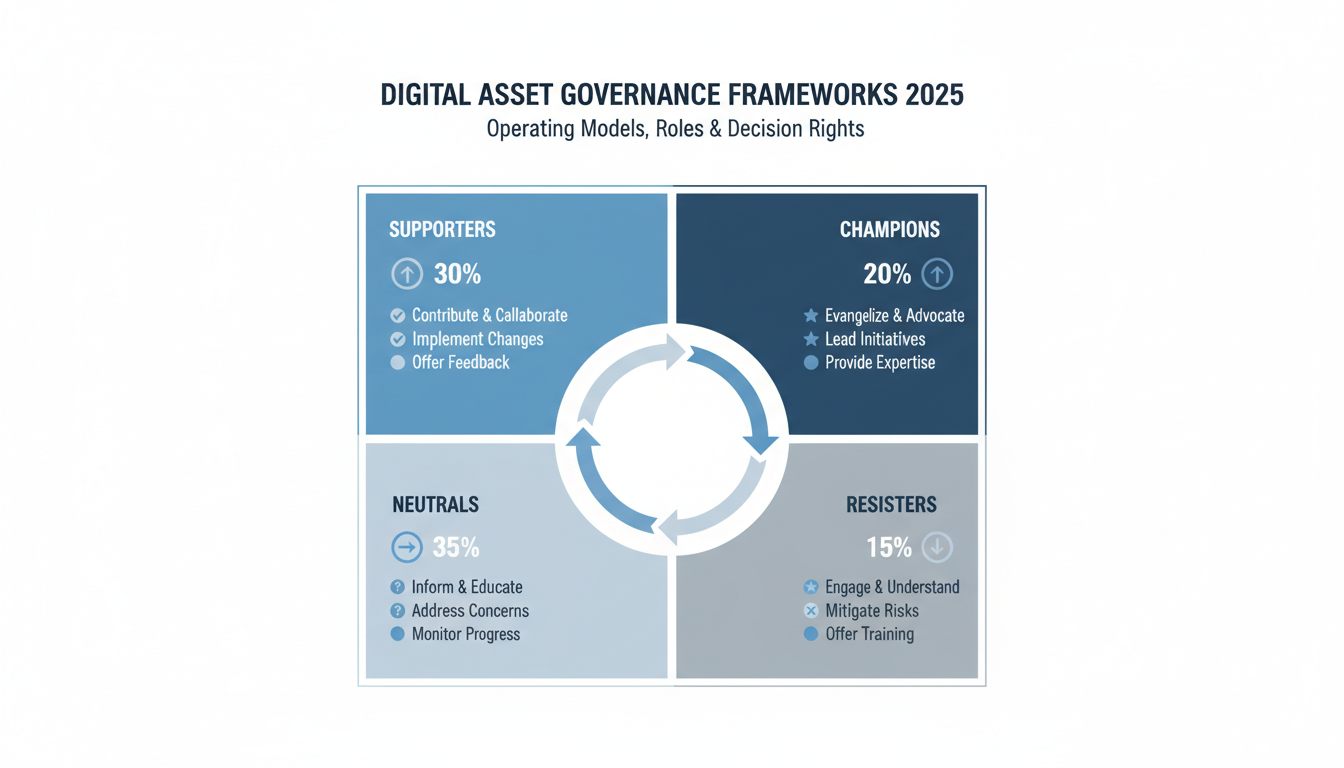
Start with stakeholder mapping. Expect 20% champions who'll drive adoption, 30% supporters who need gentle nudging, 35% neutrals waiting to see results, and 15% active resisters. Your communication strategy must address each group differently.
Champions become your internal evangelists. Give them early access and let them shape the rollout. Supporters respond to department-specific benefits – show marketing teams how DAM decision rights eliminate approval bottlenecks, while IT sees reduced storage costs and security compliance.
Training drives sustainable adoption. Create role-based learning paths instead of one-size-fits-all sessions. Creative teams need hands-on workshops with actual asset workflows. Executives want 15-minute overviews focused on ROI metrics. Pair new users with peer mentors who've already mastered the system.
Resistance follows predictable patterns. "Too complex" means your workflows need simplification – reduce clicks, automate tagging, streamline approval chains. "No time to learn" disappears when you demonstrate 30% faster asset retrieval and eliminated duplicate work.
Quick wins matter more than perfect rollouts. Target existing pain points first. If brand teams waste hours hunting logo versions, make that your proof of concept. Document time savings and broadcast success stories internally.
Build feedback loops into your digital asset governance from day one. Monthly pulse surveys catch problems early. Focus groups reveal workflow gaps your metrics miss. Suggestion systems turn resisters into contributors.
Expect a six-month adoption curve with 18-month full maturity. Organizations rushing this timeline see 40% higher failure rates. Sustainable DAM operating models require patience, consistent communication, and relentless focus on user value over technical features.
Your digital asset governance framework needs technical backbone that actually works with your existing systems. Most organizations bolt DAM onto their current tech stack without considering how governance workflows will function across platforms.
Start with your CRM integration. Salesforce users need automatic access to approved brand assets without logging into separate systems. This requires API connections that sync user roles from Salesforce directly to your DAM's permission structure. When a sales rep gets promoted to regional manager, their asset access rights should update automatically.
Marketing automation platforms like HubSpot create different challenges. Your governance framework must handle real-time asset requests during campaign creation. Build APIs that route approval requests to brand managers within your DAM system, then push approved assets back to HubSpot campaigns without manual intervention.
Adobe Creative Cloud integration determines whether designers actually follow your governance rules. Connect your DAM directly to Photoshop, InDesign, and Illustrator so designers can access approved templates and brand assets without circumventing your approval workflows.
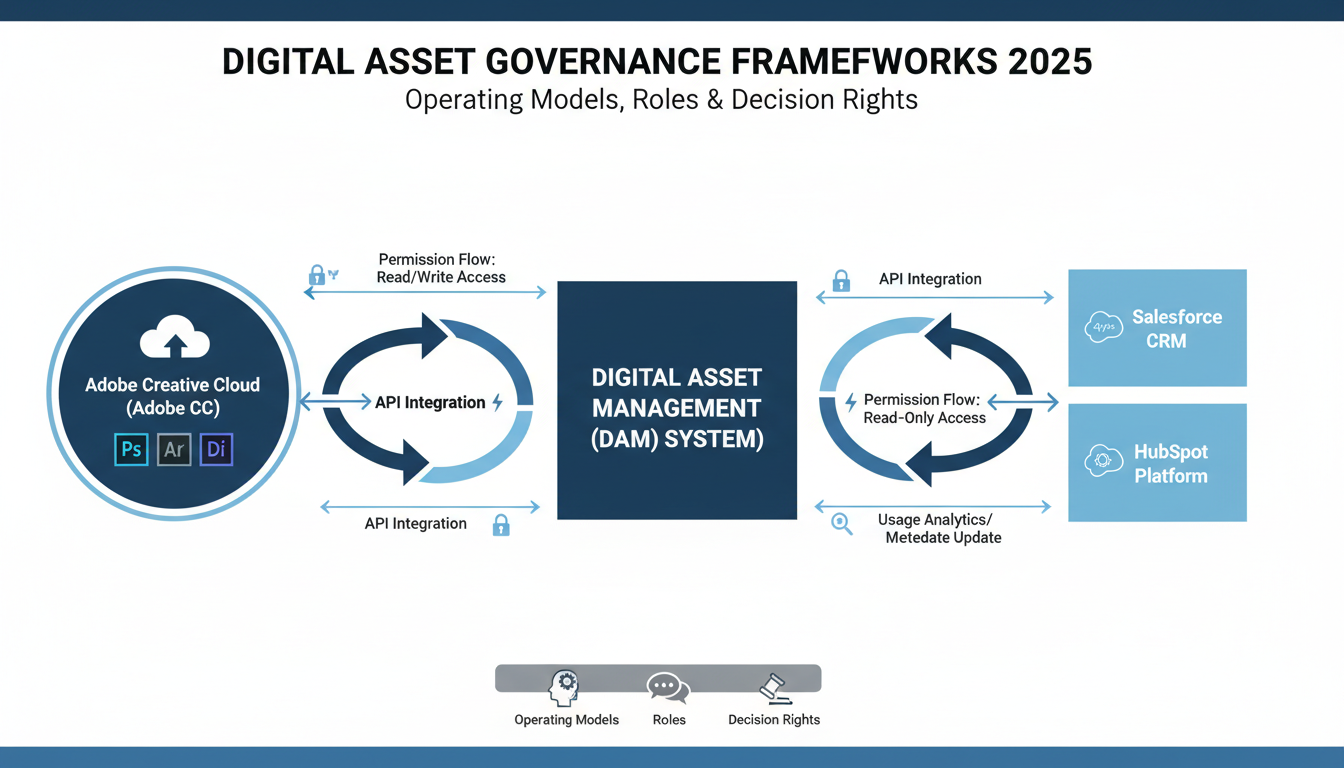
Focus automation on time-consuming governance tasks. Set up rights management alerts that notify legal teams 60 days before image licenses expire. Build duplicate detection that flags similar assets during upload, preventing brand confusion.
Usage reporting automation tracks which assets perform best across channels. This data informs future governance decisions about asset types and approval priorities.
Implement SSO integration that respects your existing Active Directory structure. Role-based permissions should mirror your organizational hierarchy, not create parallel governance structures.
Plan for 3x storage growth annually and 50% user increases. Your governance workflows must function whether you're managing 10,000 assets or 100,000. Cloud-based solutions typically scale governance processes more effectively than on-premise systems, especially for distributed teams requiring consistent DAM decision rights across regions.
After helping dozens of organizations implement digital asset governance frameworks, the same questions come up repeatedly. Here are practical answers based on actual deployment data.
Timeline and Resources
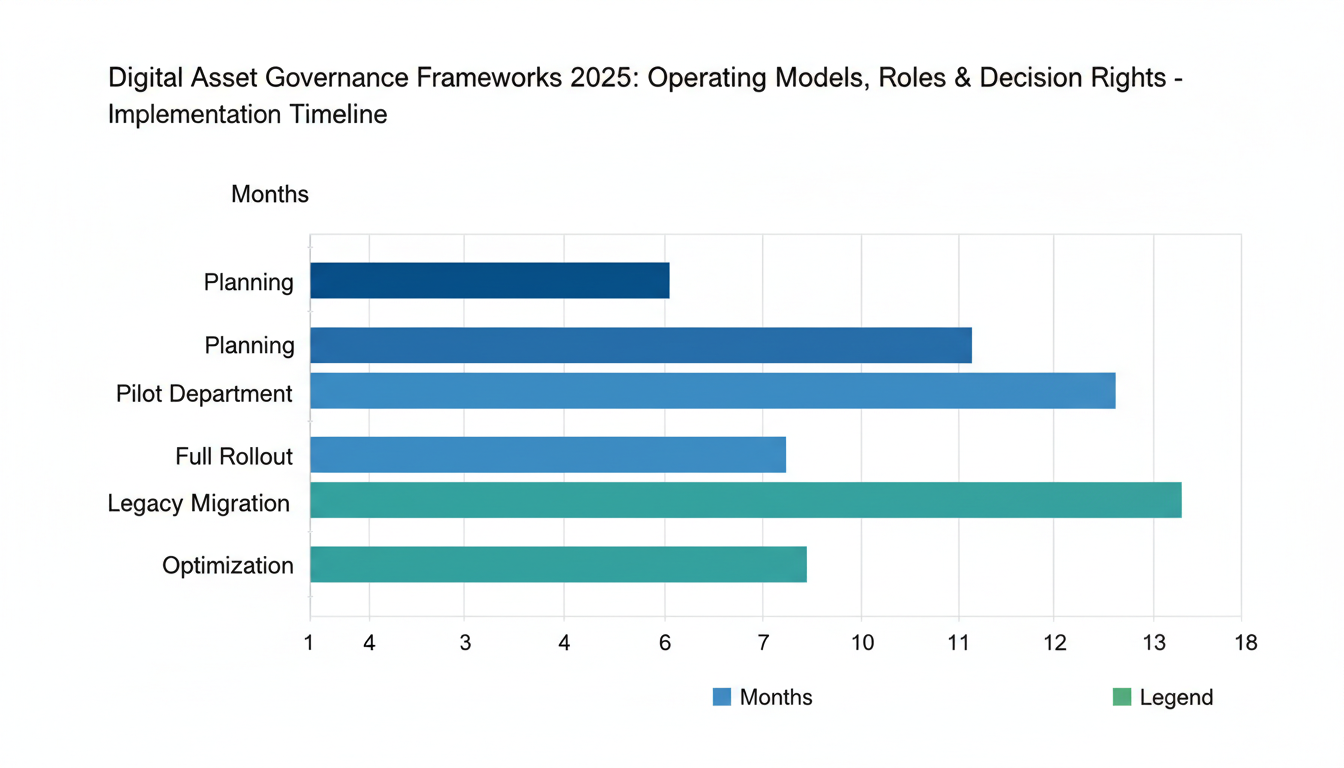
Most companies need 6-12 months to reach full governance maturity. Don't expect immediate perfection. Start with your minimum viable team: one full-time DAM manager plus 3-5 part-time departmental stewards. This structure handles up to 50,000 assets effectively.
Budget 15-25% of your total DAM investment for governance setup. A $100,000 DAM platform needs $15,000-25,000 for governance infrastructure, training, and process development.
Legacy Asset Migration
You can't migrate 20,000 legacy assets overnight. Plan for 18-24 months of phased migration. Start with your most valuable content - recent marketing materials, brand assets, and frequently accessed files. Archive rarely-used assets rather than spending time organizing them.
Handling Resistance
When departments resist standardization, start with willing adopters. Marketing teams typically embrace DAM operating models faster than IT or legal departments. Document your wins - 40% faster asset retrieval, 60% reduction in duplicate files - then expand to skeptical groups.
Ongoing Management
Review governance monthly for operational issues, quarterly for strategic adjustments. Track ROI through time savings (average 2-3 hours per week per user), reduced asset duplication (typically 30-50% decrease), and compliance value.
Multi-System Environments
DAM decision rights work across multiple platforms when you maintain central policy coordination. Your governance framework should define standards that translate across Dropbox, SharePoint, and dedicated DAM systems. Focus on consistent metadata schemas and approval workflows rather than forcing single-platform adoption.
Rolling out digital asset governance doesn't happen overnight. Here's the proven 90-day timeline that works for most mid-sized organizations.
Start with stakeholder alignment meetings. You need buy-in from marketing, IT, legal, and brand teams before touching any systems. Define core roles during week two - typically a DAM administrator, 3-5 content stewards, and executive sponsor.
Common mistake: Skipping the executive sponsor role. Without C-level backing, your governance framework becomes another "nice-to-have" project that dies in month four.
Form your initial governance team by day 20. Keep it small - 5-7 people maximum. Larger groups create decision paralysis.
Map out your three core workflows: asset approval, version control, and archive/deletion processes. Pick one pilot department - usually marketing or creative teams work best since they're heavy DAM users.
Develop training materials during this phase. Create 15-minute video tutorials, not 2-hour presentations. People won't watch lengthy content.
Launch your pilot with realistic expectations. You'll discover gaps in your DAM operating models within the first week. That's normal.
Collect feedback weekly, not monthly. Digital asset governance frameworks need rapid iteration during early deployment.
By day 90, you should have three defined workflows, five trained stewards actively using the system, and one department successfully managing assets through your new DAM decision rights structure.
Your scaling roadmap starts on day 91. Plan department-by-department rollouts over the next six months.
Ready to implement? Download our governance framework template and schedule a 30-minute consultation to customize your timeline. Organizations using structured approaches see 40% faster deployment and 60% better user adoption rates.

Interested in a joint project, a web demo or just getting to know us? We'll get back to you as soon as possible.
