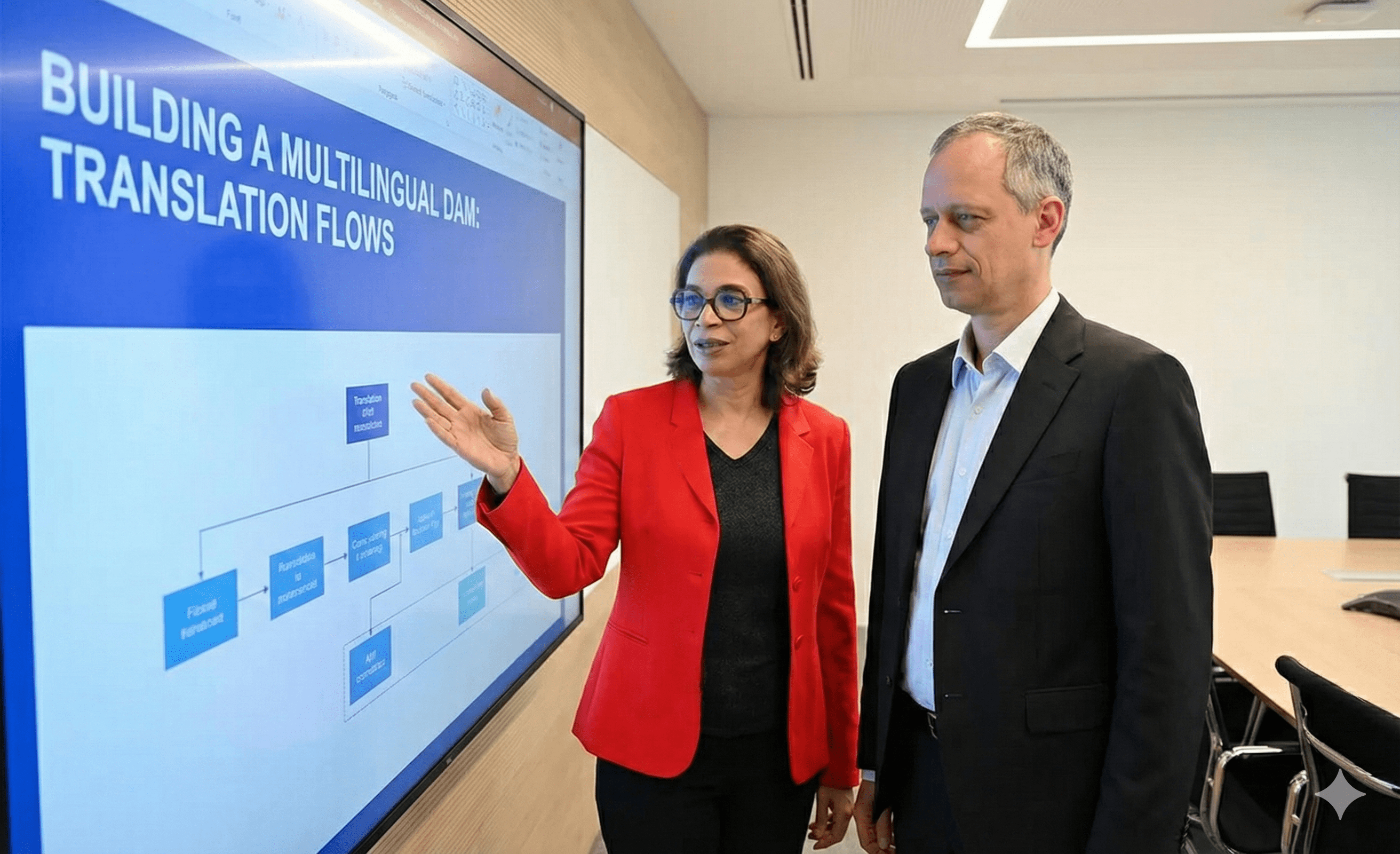
Managing digital assets across multiple markets shouldn't feel like herding cats. Yet research shows companies lose 25% efficiency when handling multilingual content manually — that's roughly 10 hours per week for a typical marketing team juggling five languages.
If you're a DAM manager watching your team scramble to find the German version of last month's product launch video, or a localization director trying to track which assets need French translations, you're not alone. The problem isn't just finding files. It's maintaining consistency, version control, and brand standards across languages while keeping everyone sane.
Multilingual DAM systems solve this by creating structured translation workflows that connect your content creation to your global distribution. Instead of separate folders for each language (a nightmare waiting to happen), you build relationships between assets and their localized versions.

The real challenge lies in localized metadata. Your English asset tagged "summer campaign" might need completely different keywords in Japanese markets. Smart organizations create metadata models that account for cultural context, not just literal translations.
Here's what you'll learn in this guide:
Whether you're managing 500 assets across 3 languages or 50,000 assets across 15 markets, the principles remain consistent. You need systems that think globally but act locally — connecting your creative workflows to your distribution channels without creating bottlenecks.
The payoff? Teams report 40% faster time-to-market for localized campaigns once proper multilingual DAM workflows are established.
Smart companies don't just implement multilingual DAM systems—they measure the financial impact. The numbers tell a compelling story.
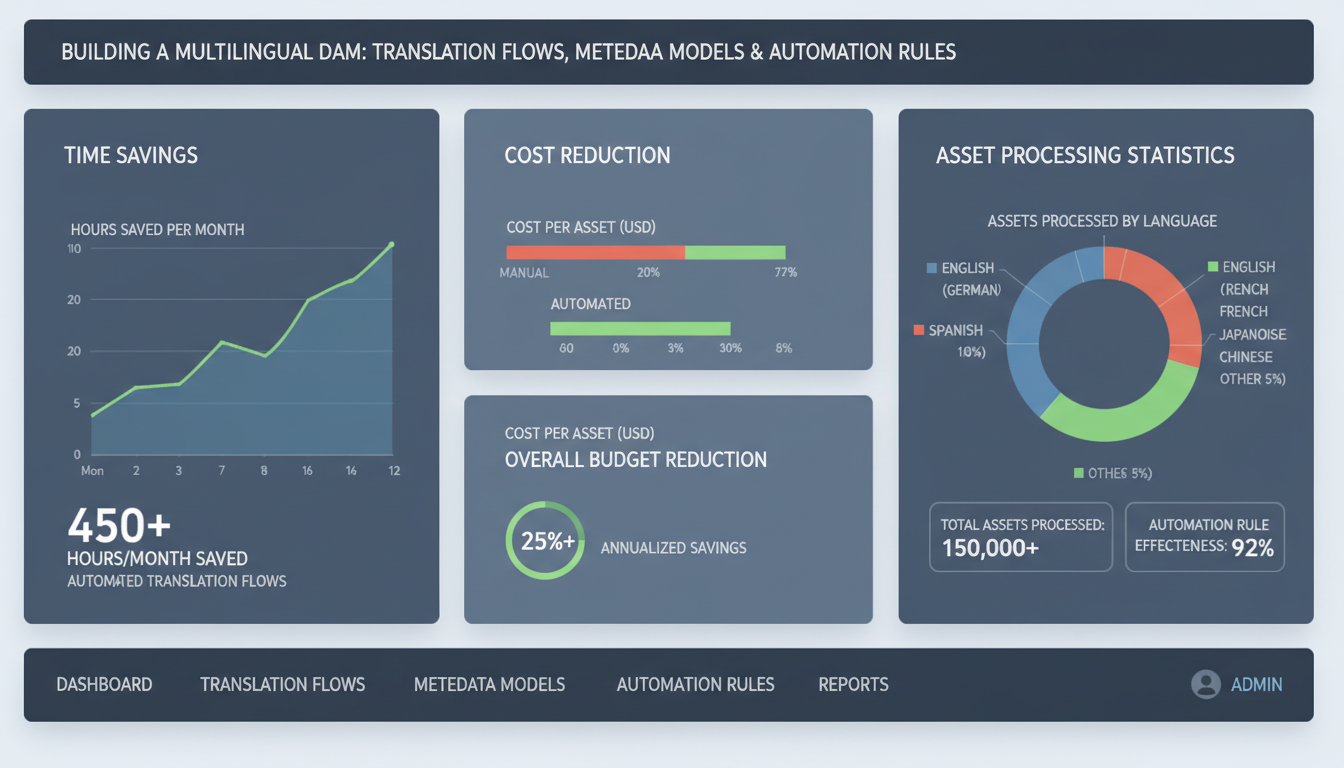
Consider a mid-sized SaaS company managing assets across 18 European markets. Before automation, their translation workflows required three full-time coordinators juggling spreadsheets, email chains, and missed deadlines. Annual coordination costs: $180K. After implementing automated translation workflows with centralized metadata models, they cut this to $130K—a $50K annual savings that compounds yearly.
Time compression delivers even bigger wins. Manual asset localization cycles that once took 3-4 weeks now complete in 10 days. That's a 60% reduction in time-to-market for localized campaigns. When you're launching seasonal promotions across multiple regions, those extra weeks can cost millions in lost revenue.
Brand consistency becomes measurable too. A pharmaceutical client avoided a $120K regulatory fine in Germany because their multilingual DAM caught inconsistent medical disclaimers before publication. The automated governance rules flagged assets lacking proper German medical translations—something manual processes had missed repeatedly.
The risk mitigation extends beyond compliance. Luxury brands face enormous reputation costs when translations go wrong. One automotive company's multilingual DAM prevented a marketing disaster when automated checks caught culturally inappropriate imagery scheduled for Middle Eastern markets. The potential brand damage? Incalculable.
Pro tip: Track your "near-miss" savings alongside direct cost reductions. Document every compliance issue caught, every brand inconsistency prevented, every deadline met through automation. These metrics justify expansion budgets and prove ROI to skeptical executives.
The math is straightforward: multilingual DAM systems pay for themselves within 12-18 months through reduced coordination overhead, faster cycles, and risk prevention alone.
Your multilingual DAM's metadata structure determines whether you'll scale smoothly or hit walls at 50,000 assets. The foundation starts with how you handle primary versus translated fields.
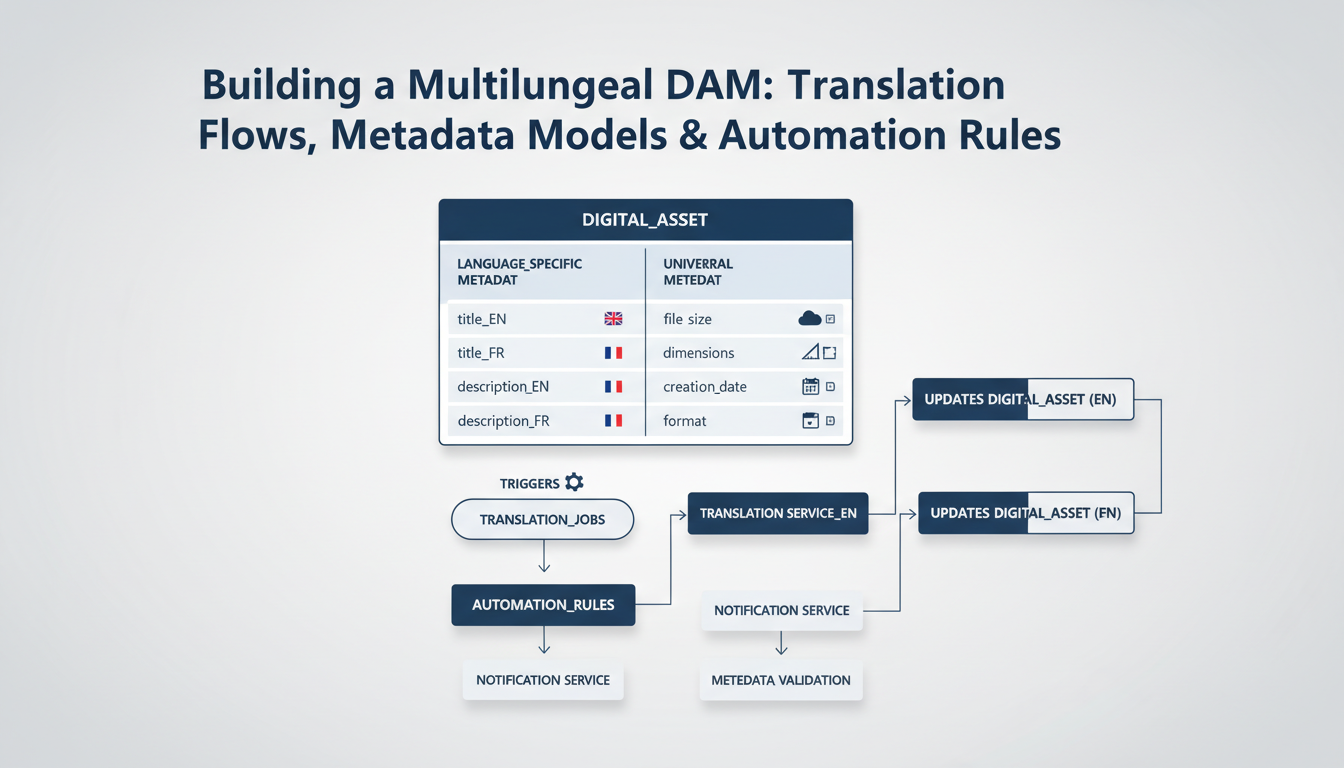
Smart organizations use suffix-based field naming: title_EN, title_FR, title_DE for content requiring localization. This keeps your database clean while supporting unlimited language variants. Adobe Experience Manager and Bynder both follow this pattern—it works at enterprise scale.
But here's where many teams waste effort: not everything needs translation. Language-agnostic fields like file formats, pixel dimensions, creation timestamps, and rights management data remain universal. A 1920x1080 JPEG created on March 15th stays that way regardless of market.
Your category structure needs deeper planning than most realize. Building hierarchical taxonomies supporting 8+ language variants means thinking beyond direct translation.
Consider product categories: "Athletic Footwear" might translate to "Chaussures de Sport" in French, but your German market uses "Sportschuhe." Each needs consistent hierarchy mapping while respecting local search behavior.
The technical reality? Unicode UTF-8 encoding isn't optional—it's mandatory. Arabic scripts flow right-to-left, Chinese characters need proper font rendering, and Cyrillic requires specific collation rules. Your DAM must handle these natively, not as afterthoughts.
Pro tip: Test your metadata search with actual foreign characters early. Many systems claim multilingual support but break when users search for "résumé" or input Japanese keywords.
Translation workflows become exponentially more complex without proper metadata architecture. Get the foundation right, and your content teams can focus on creating rather than wrestling with system limitations.
Your multilingual DAM needs smart workflows that move assets from upload to localized publication without manual bottlenecks. The key is building trigger-based systems that know what needs translation and when.
Modern DAMs can automatically detect when new assets require translation based on metadata tags, folder locations, or campaign assignments. For example, when a designer uploads a product banner tagged "global-campaign," the system immediately routes it to your translation queue and notifies relevant stakeholders.
Integration with translation management systems like Phrase or Lokalise streamlines this process. Your DAM pushes source files directly to the TMS, maintains version control, and pulls completed translations back automatically. No more email chains or lost files.
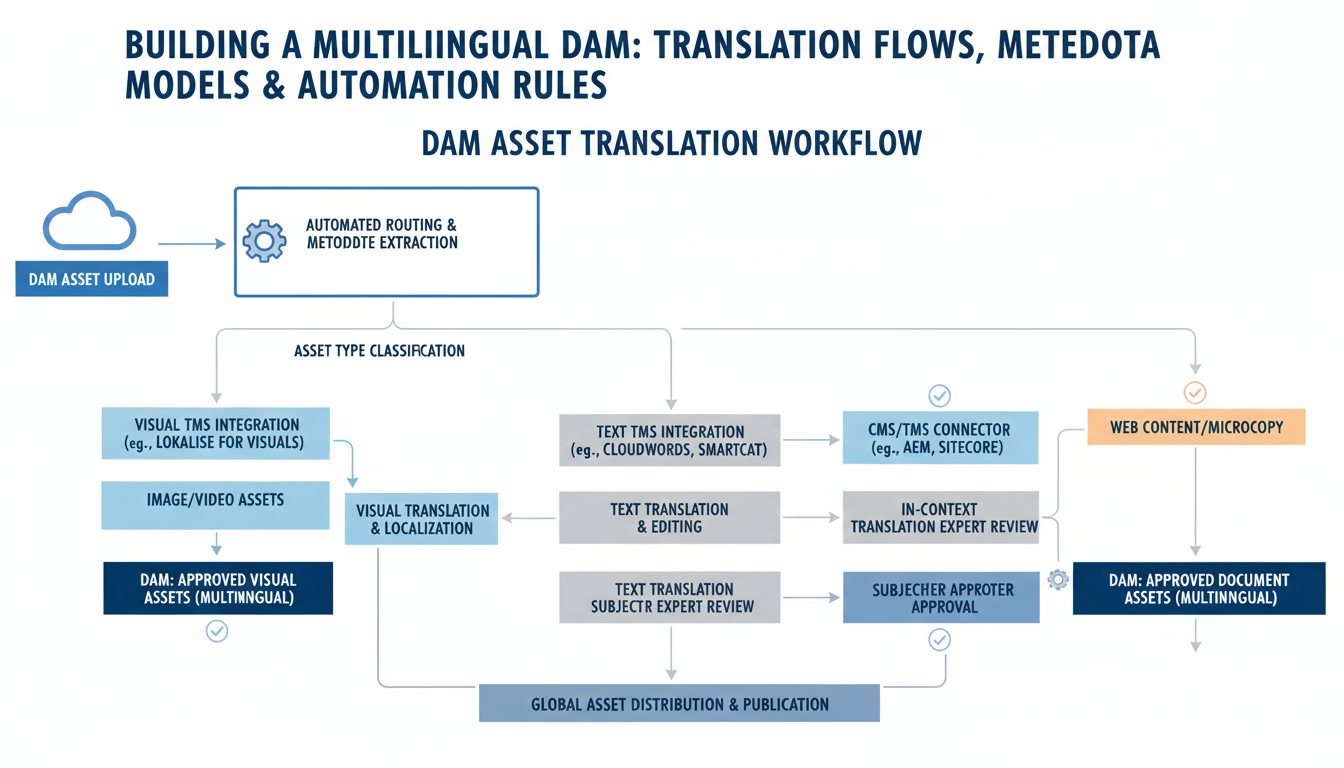
Not every asset needs the same scrutiny. Brand-critical materials like homepage banners require human review before publication, while product specification sheets can often auto-approve after translation. Set up quality gates based on asset type and business impact.
Your workflow should distinguish between marketing materials needing 48-hour turnaround and legal documents requiring 2-week review cycles. Build these SLA requirements into your automation rules.
Smart companies create different workflow tracks for different content types. Marketing assets get priority routing with tight deadlines, while technical documentation follows slower, more thorough review processes. Your DAM should track these timelines and send alerts when deadlines approach.
Consider implementing escalation rules: if a high-priority translation sits in review for 24 hours, automatically notify the next approval level. This prevents bottlenecks that can delay product launches or campaign rollouts across multiple markets.
The result? Assets flow smoothly from creation to global distribution without manual intervention.
Different asset types require specialized metadata fields that adapt to regional markets. Your multilingual DAM needs flexible schemas that handle these variations without creating chaos.
Campaign materials need region-specific tracking codes that integrate with local analytics platforms. Store campaign IDs separately for each market – "US_SUMMER24_001" versus "DE_SOMMER24_001" – rather than forcing universal codes that break regional reporting.
Add compliance flags for markets with strict advertising regulations. Germany's competition law requires different disclosures than US FTC guidelines. Tag assets with "GDPR_compliant", "CCPA_ready", or "COPPA_restricted" to prevent costly mistakes.
Cultural sensitivity tags prevent embarrassing launches. Mark assets containing religious symbols, color associations, or gestures that might offend specific regions. Your translation workflows can then route these for cultural review before localization.
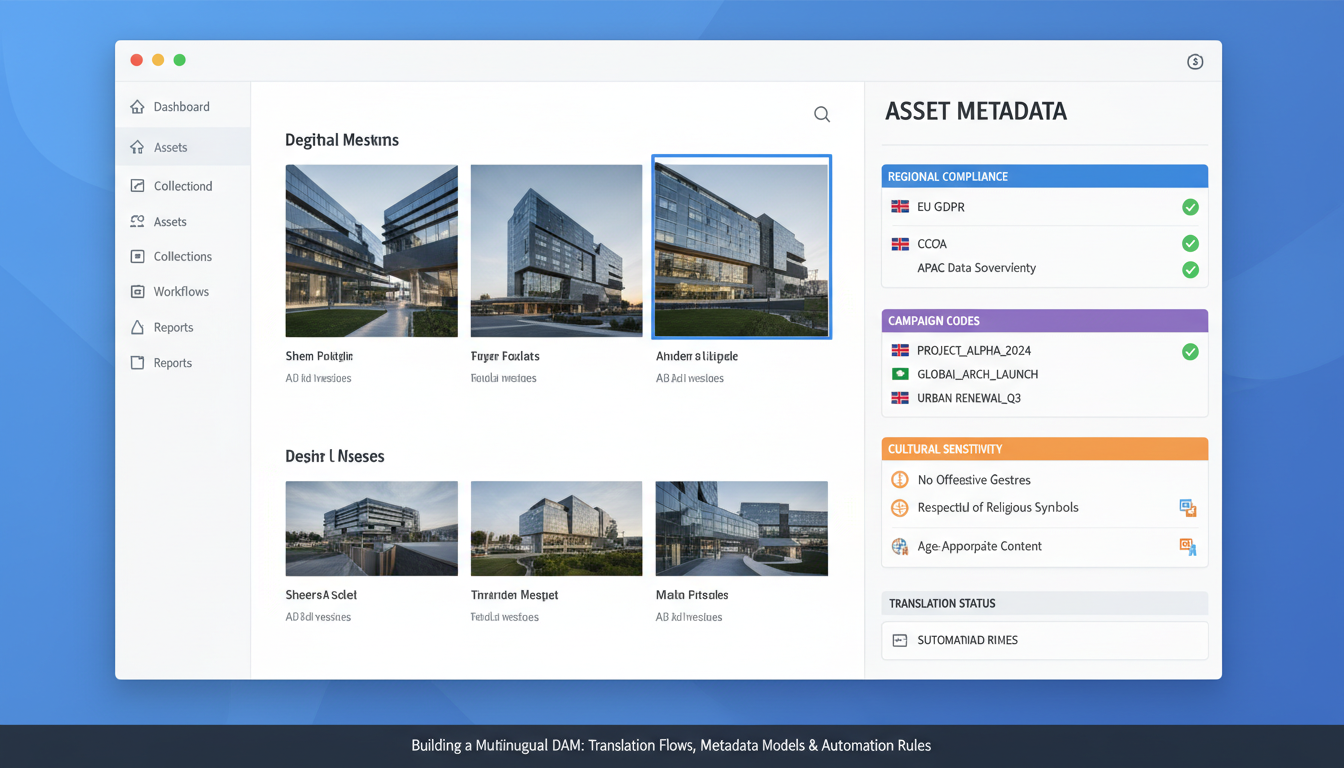
Product imagery metadata should include local pricing display rules and regulatory certifications. A power tool might need CE marking in Europe but UL certification in North America. Store these as arrays: certifications: ["CE", "RoHS", "WEEE"] for flexible filtering.
Video content requires the most complex metadata structures. Track subtitle files by language code and format: subtitles.es-MX.srt for Mexican Spanish versus subtitles.es-ES.srt for Spain. Store dubbing versions as related assets with clear parent-child relationships.
Regional content ratings vary dramatically. What's "General Audiences" in the US might be "6+" in Germany. Map these equivalencies in your metadata model to automate appropriate tagging during localization.
Legal documents need jurisdiction-specific approval chains. Your DAM should route German privacy policies through Frankfurt legal teams while US terms of service go to New York counsel. Build these approval hierarchies into your translation workflows to maintain compliance across markets.
Your multilingual DAM needs approval workflows that balance speed with control. Without proper governance, you'll either create bottlenecks or lose brand consistency across markets.
Set up tiered approval systems that match your organizational structure. Regional marketing managers can approve local campaign adaptations and market-specific copy changes, while your global brand team maintains veto power over master assets and brand guidelines. This prevents the common scenario where a regional team accidentally uses outdated logos or off-brand messaging.
For translation workflows, assign language leads who understand both the target market and brand voice. They can approve routine translations under $2,000 while escalating larger projects to senior stakeholders.

Configure automatic escalation triggers based on project scope and budget. Translation projects exceeding $5,000 should route to senior management for approval, while routine product description updates can flow through standard regional approval.
Set content-type triggers too. New video assets always need global brand review, but social media adaptations can stay at the regional level if they use pre-approved templates.
Your multilingual DAM must prevent distribution of outdated translations. Configure automatic expiration dates for localized content and block download access to superseded versions. This is critical for regulated industries like pharmaceuticals, where outdated safety information creates legal liability.
Build comprehensive audit trails that track every approval decision, translation change, and asset distribution. Financial services companies need this documentation for compliance reporting, and it helps identify workflow bottlenecks during quarterly reviews.
Configure automated alerts when assets sit in approval queues longer than 48 hours to prevent campaign delays.
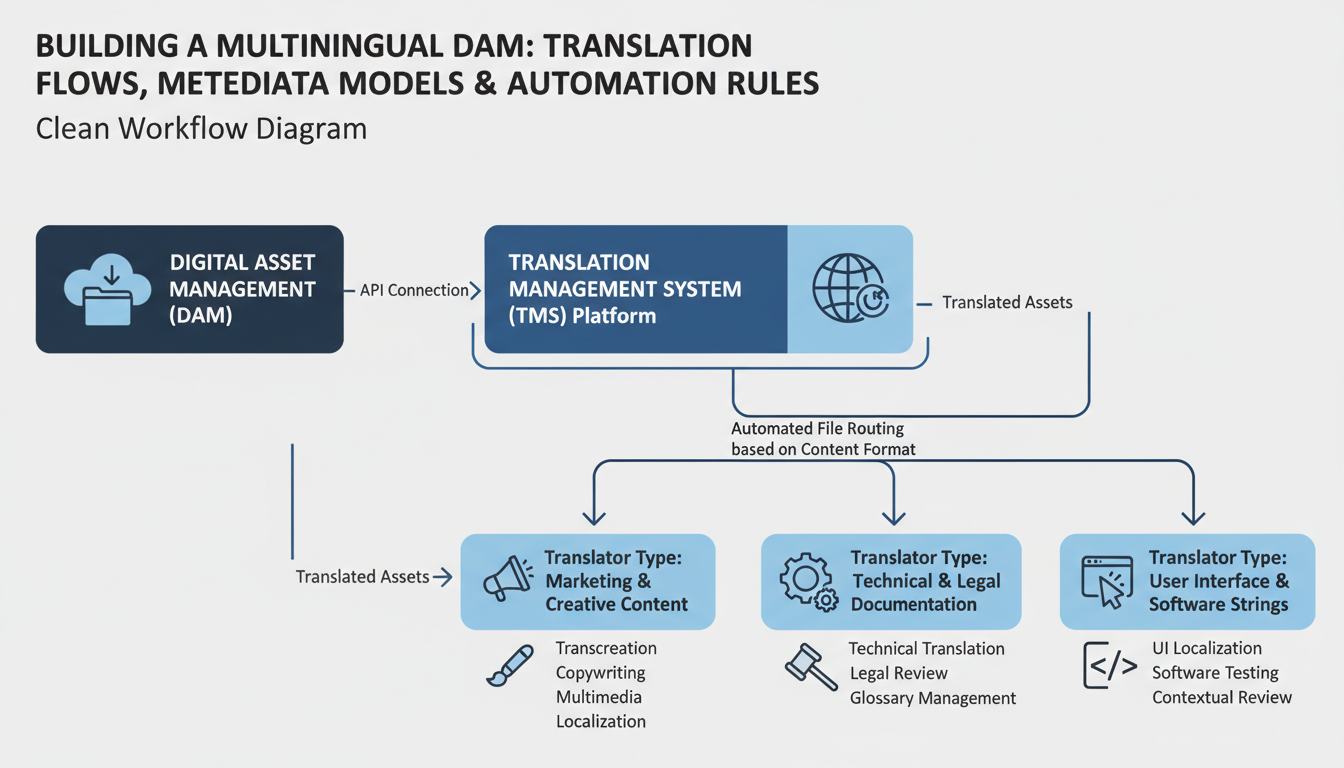
Smart translation workflows eliminate the manual handoffs that slow down multilingual campaigns. Your multilingual DAM should integrate directly with translation management systems (TMS) through APIs that sync content in real-time.
Connect your DAM to platforms like Phrase, Lokalise, or Smartling through REST APIs. When editors upload a new campaign asset, the system automatically extracts translatable text, sends it to your TMS, and updates the DAM once translations return. This eliminates the export-translate-reimport cycle that typically adds 2-3 days to campaign launches.
Set up webhook triggers for specific asset types. InDesign files route to design-specialized translators who maintain layout integrity, while video scripts go to audiovisual teams that understand timing constraints.
Your TMS integration should leverage translation memory across all asset types. Companies typically see 40% cost reduction by reusing previous translations for product descriptions, UI elements, and marketing copy. Configure your multilingual DAM to tag similar content automatically - when uploading banner ads for a product line, the system suggests existing translations for headlines and CTAs.
Different content needs different expertise. Set up automation rules that route technical documentation to specialized technical translators, while marketing materials go to transcreation specialists. Your DAM can analyze metadata like "content_type" and "target_market" to make these decisions automatically.
For high-volume markets like Spanish or German, maintain dedicated vendor relationships. Smaller markets can share generalist providers. This vendor management through your DAM's workflow engine ensures consistent quality while optimizing costs across your translation budget.
Translation workflows get your content into multiple languages, but quality control ensures it actually works for each market. Your multilingual DAM needs systematic checks that catch issues before they reach customers.
Set up native speaker reviews for all customer-facing content. Machine translation handles internal documentation fine, but marketing materials need human expertise. Create approval stages where native speakers from target markets review translations for accuracy and cultural appropriateness.
Configure your DAM to flag high-visibility assets – homepage banners, product launches, campaign materials – for mandatory linguistic review. Lower-priority content like FAQ updates can use streamlined approval paths.
German text expands 30% longer than English. Japanese requires different line spacing. Your multilingual DAM should automatically flag assets that need layout adjustments based on target languages.
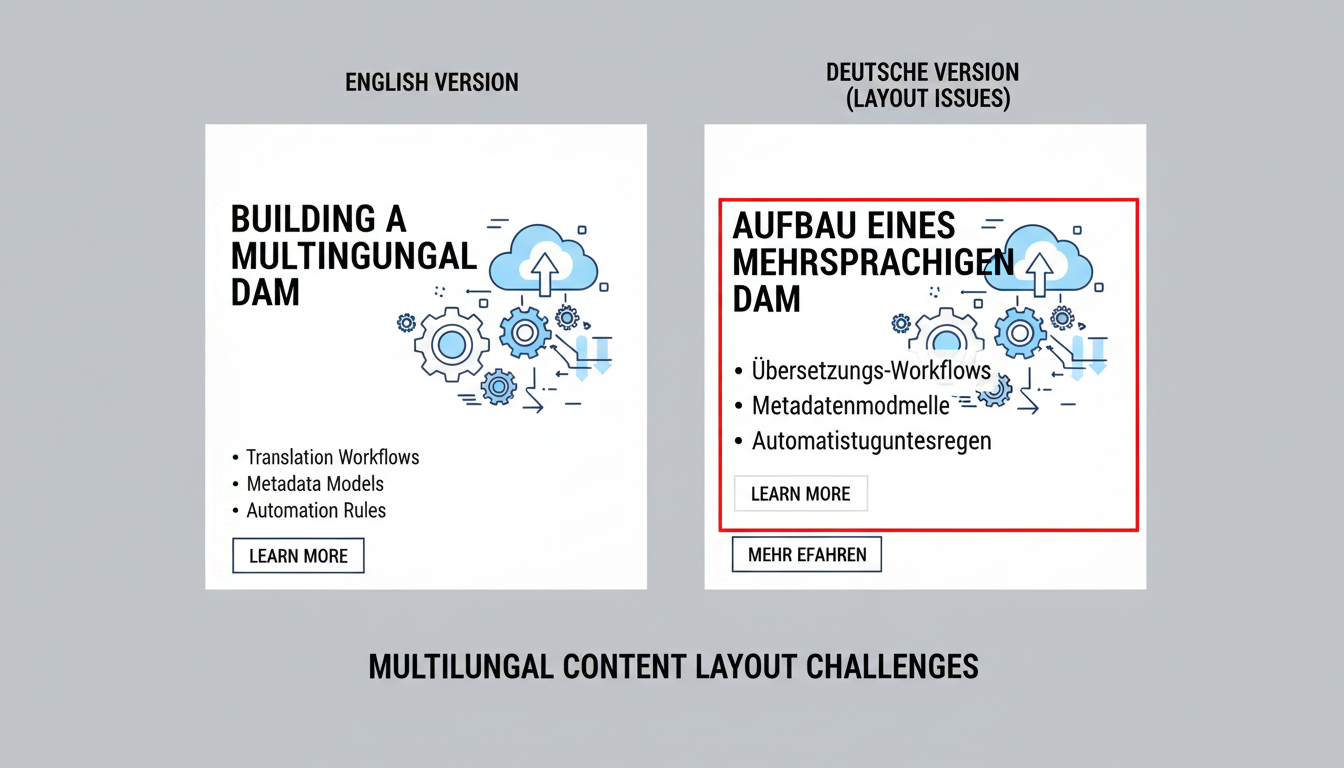
Set up automated checks that measure text expansion ratios and flag designs likely to break. Create templates with flexible text containers that accommodate language variations without manual redesign.
Build terminology databases directly into your translation workflows. When translators work on new content, your DAM should surface approved translations for key product names, taglines, and brand messaging.
This prevents inconsistencies like translating "Premium Plan" three different ways across markets. Your localized metadata should include approved terminology variants for each region.
Beyond language, consider cultural preferences. Red signifies luck in China but danger in Western markets. Your DAM should include cultural guidelines that trigger review workflows when certain colors, imagery, or messaging combinations are detected for specific regions.
Set up automation rules that flag culturally sensitive content combinations – like promotional materials using inappropriate color schemes or imagery that doesn't resonate with local audiences.
Your multilingual DAM's translation workflows mean nothing if users can't access assets quickly. Performance optimization becomes critical when serving localized content to diverse markets with varying connectivity speeds and device capabilities.
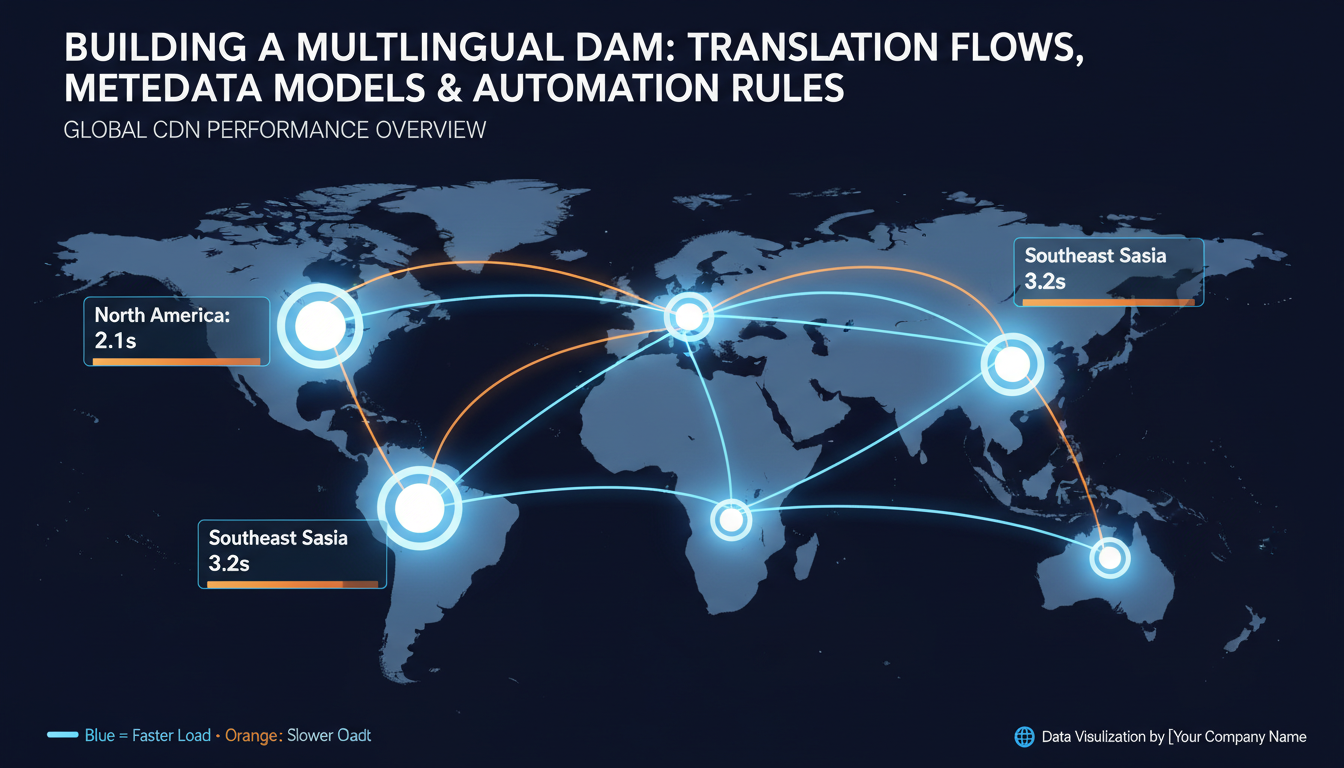
Configure your CDN to cache assets regionally based on user location and language preferences. A properly configured multilingual DAM can reduce load times by 70% through strategic edge caching. Set up separate cache rules for each market – your German users shouldn't wait for assets served from a Tokyo server.
Create regional asset variants automatically. When uploading a 4K product video, your system should generate compressed versions for mobile-first markets like India or Southeast Asia. This isn't just about file size – it's about matching technical infrastructure to user needs.
Multilingual search algorithms need different approaches than single-language systems. Implement auto-complete that works with partial translations and handles character sets properly. Your Japanese users typing "車" should see relevant automotive assets, not empty results.
Build search indexes for each language separately. Don't rely on machine translation for search – index your localized metadata directly. This improves search speed and accuracy across all markets.
Progressive loading becomes essential for markets with limited connectivity. Implement lazy loading for asset previews and offer multiple quality options. Users in bandwidth-constrained regions should access low-res previews first, with full-resolution downloads available on demand.
Your multilingual DAM should detect connection speed and automatically serve appropriate asset versions. A user on 3G shouldn't wait 30 seconds for a high-res banner to load when a compressed version delivers the same message in 3 seconds.
Your multilingual DAM generates massive amounts of data about translation workflows and asset usage. Smart organizations track specific metrics to optimize their localization investments and improve translation workflows.
Translation velocity measures the complete journey from source asset upload to localized version availability. Top-performing teams achieve 2-3 day turnaround for standard marketing materials, while complex video content might take 7-10 days. Track this metric by asset type and language pair – you'll often find German translations complete 40% faster than Japanese due to workflow maturity differences.
Cost per asset per language reveals translation efficiency trends over time. A typical B2B company might spend $45 per marketing image for Spanish localization, including copywriting and cultural adaptation. Monitor this monthly to identify automation opportunities and vendor performance issues.

Usage analytics drive smart prioritization decisions. Your most-requested assets by market should get translation priority. An enterprise software company discovered their product demo videos received 3x more downloads in APAC markets, leading them to prioritize Asian language translations for video content.
Track quality metrics through revision rates and stakeholder satisfaction scores. Healthy translation workflows show revision rates below 15% and satisfaction scores above 4.2/5. French markets often demand higher revision rates due to regulatory compliance, while Nordic countries typically accept initial translations with minimal changes.
Set up automated alerts when translation velocity exceeds baseline by 25% or cost per asset jumps above budget thresholds. Your multilingual DAM should surface these insights automatically, not require manual report generation.
These metrics transform your localized metadata management from reactive to predictive, helping you allocate translation resources where they'll drive the most business impact.
Moving from performance metrics to actual implementation reveals the technical complexities that separate successful multilingual DAMs from failed projects. Four critical challenges consistently emerge during enterprise deployments.
Arabic and Hebrew implementations require fundamental UI restructuring, not simple text direction changes. Your metadata fields, search interfaces, and approval workflows must mirror completely. Adobe Experience Manager DAM handles this through separate CSS frameworks, while custom solutions need bidirectional text rendering libraries. Plan 40% additional development time for RTL languages.
German compound words like "Geschäftsführungsbesprechungsprotokoll" break standard 50-character title fields. Asian languages pack more meaning into fewer characters—a 20-character Japanese description often equals 100+ English characters. Smart multilingual DAMs use dynamic field sizing based on detected language, not fixed character limits.
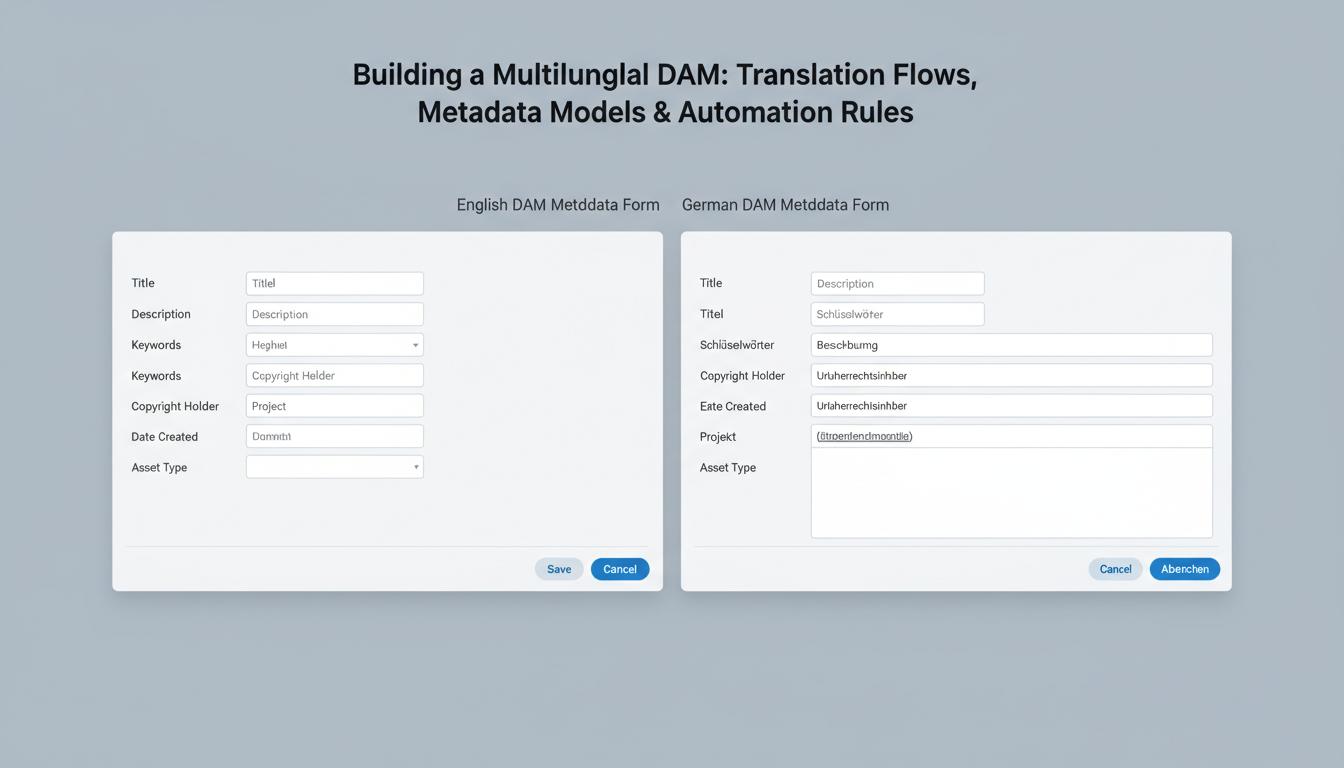
Japanese approval processes require consensus-building (nemawashi) with 5-7 stakeholders before final sign-off. German markets prefer hierarchical approval chains. Your translation workflows must accommodate these cultural differences through configurable approval routing, not one-size-fits-all processes.
Consolidating 100,000+ assets from regional systems creates unique challenges. Conflicting metadata schemas, duplicate assets across markets, and inconsistent naming conventions multiply exponentially. Successful migrations follow a three-phase approach: audit existing assets, establish master taxonomy, then migrate in 10,000-asset batches with rollback capabilities.
The most common failure point? Assuming technical solutions can override cultural workflow preferences. Your multilingual DAM must bend to local market needs, not force global standardization where it doesn't belong.
The translation landscape shifts rapidly. Your multilingual DAM needs architecture decisions that scale with technological advances and regulatory changes.
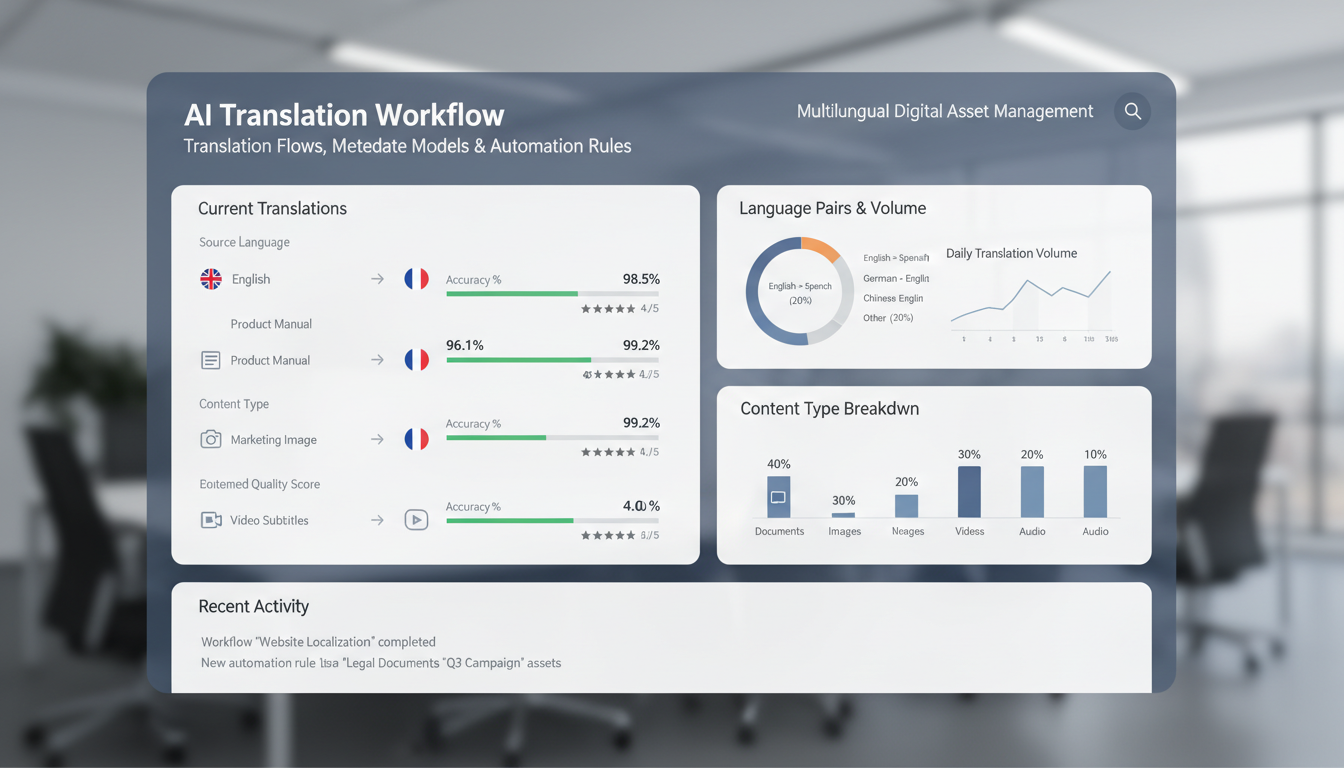
Modern AI translation achieves 95% accuracy for technical content, making human-only workflows obsolete for many asset types. Adobe's latest neural engines handle complex product descriptions with minimal post-editing. But accuracy varies dramatically by language pair—Japanese to English performs better than Arabic to Portuguese.
Smart organizations layer AI with human review for brand-critical assets while automating routine product catalogs entirely. This hybrid approach processes 3x more content while maintaining quality standards.
Automated dubbing technology now generates natural-sounding voiceovers in 40+ languages. Synthesis.io creates localized video content that previously required expensive studio time and voice talent. Their subtitle generation integrates directly with popular DAM platforms.
Video localization costs dropped 60% in two years. What once required $500 per minute now costs $200 with better consistency across languages.
EU AI Act requirements affect how you store and process multilingual content. Your DAM must document AI translation decisions and maintain audit trails. Chinese regulations require local data processing for certain content types.
Build compliance checkpoints into translation workflows now. Retrofitting regulatory controls costs 4x more than planning ahead.
Supporting 500K+ assets across 50+ languages demands different database structures than smaller deployments. Partition metadata by language family rather than individual languages. This reduces query times by 40% when users filter localized content.
Plan your translation workflows around content clusters, not individual assets. Batch processing similar content types improves both speed and consistency while reducing API costs.
The translation landscape shifts rapidly. Your multilingual DAM needs architecture decisions that scale with technological advances and regulatory changes.
Modern multilingual DAMs can realistically support 50-100 languages without performance degradation. The constraint isn't technical—it's operational. You'll need dedicated managers for every 15-20 languages to maintain quality.
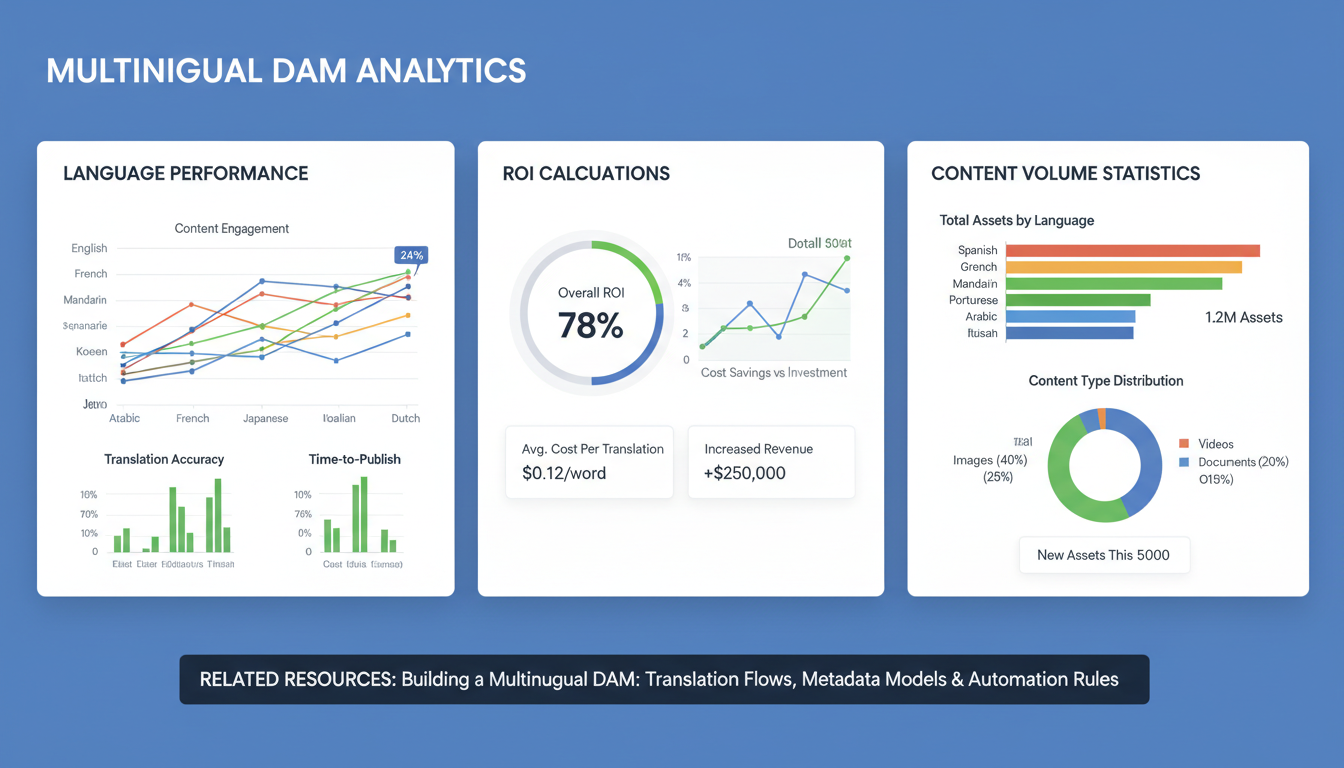
ROI timelines vary dramatically. Companies see breakeven at 8-12 months for high-volume content operations (500+ assets monthly). Low-volume implementations often take 18-24 months to justify costs.
Right-to-left languages require specific database collation settings and UI framework choices. MySQL with utf8mb4_unicode_ci handles Arabic and Hebrew text direction, but your frontend needs CSS logical properties (margin-inline-start instead of margin-left).
Translation automation works best for structured content. Product descriptions achieve 85% automation success rates. Creative briefs and brand messaging need human oversight—automation handles initial drafts only.
Cultural adaptation goes beyond translation. Your metadata models need regional brand guideline fields. McDonald's uses different color schemes in India versus Germany—your DAM should enforce these automatically through regional approval workflows.
Marketing tool integration creates the biggest headaches. Salesforce supports 17 languages natively, but HubSpot requires custom properties for multilingual metadata. Plan for 40-60 hours of integration work per marketing tool.
Your translation workflows need API-first architecture. Contentful and Phrase integrate seamlessly. Older systems like SharePoint require middleware solutions that add 200-300ms latency per request.
Budget 20% extra development time for edge cases. Currency formatting, date localization, and number separators break more multilingual DAMs than translation quality issues.
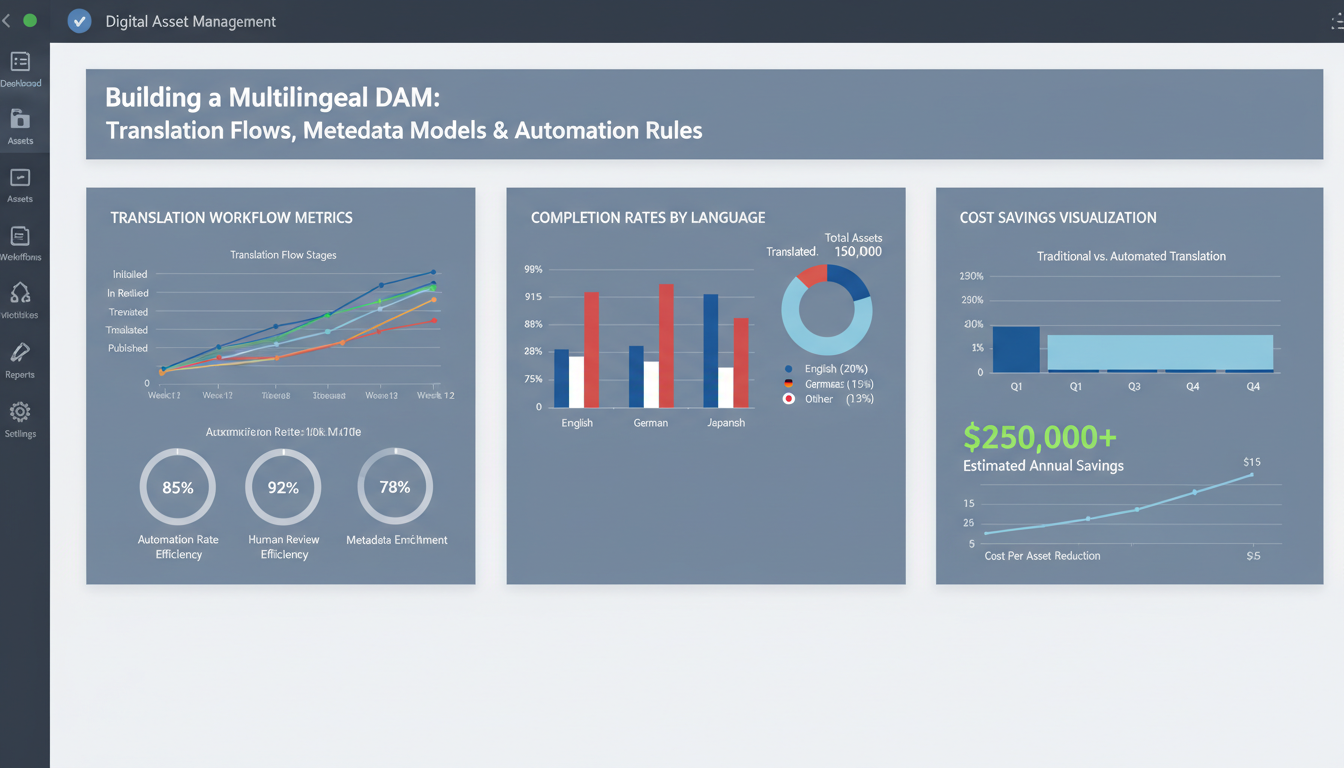
Organizations implementing comprehensive multilingual DAM systems report 60% faster localization cycles and 25% cost reduction within the first year. These results aren't automatic—they require strategic execution across three critical areas.
Metadata architecture drives everything. Companies that design multilingual metadata schemas upfront avoid the costly restructuring that affects 73% of DAM implementations. Your metadata model needs language-specific fields, regional compliance tags, and hierarchical taxonomy support from day one.
Workflow automation eliminates bottlenecks. Manual handoffs between translation teams create delays and version conflicts. Successful multilingual DAMs automate asset routing, approval chains, and status updates. Translation workflows should trigger automatically when source content changes, sending notifications to relevant language teams without human intervention.
Governance prevents chaos. Without clear ownership rules, multilingual content becomes fragmented across departments. Establish who approves translations, how often metadata gets updated, and which team manages regional variations. Document these processes—they become your operational backbone.
Evaluate your organization's multilingual content challenges with these diagnostic questions:
Your answers reveal specific gaps that multilingual DAM architecture addresses.
The future of global content management demands systems that adapt to regulatory changes, integrate emerging translation technologies, and scale across markets. Organizations building robust multilingual DAMs today position themselves to capture international opportunities while competitors struggle with fragmented, manual processes.
Start your multilingual DAM assessment now—competitive advantages compound quickly in global markets.

Interested in a joint project, a web demo or just getting to know us? We'll get back to you as soon as possible.
