
A recent enterprise survey revealed that 73% of organizations face unauthorized asset distribution issues that cost them an average of $2.4 million annually in legal disputes and licensing violations. Your marketing team downloads a premium stock photo for a campaign, but six months later, you discover it's still being used across 12 different projects—well beyond the original single-use license terms.
Digital rights management DRM in the context of Digital Asset Management (DAM) systems addresses this exact problem. Unlike traditional DRM that focuses on preventing piracy, DRM within DAM platforms manages usage permissions, tracks asset lifecycles, and enforces licensing agreements automatically.
Think of it as your digital asset's built-in legal advisor. When a designer searches for images in your DAM, they immediately see which assets require attribution, have geographic restrictions, or expire next month. No more guesswork about whether that Getty Images photo can be used in your European campaign.
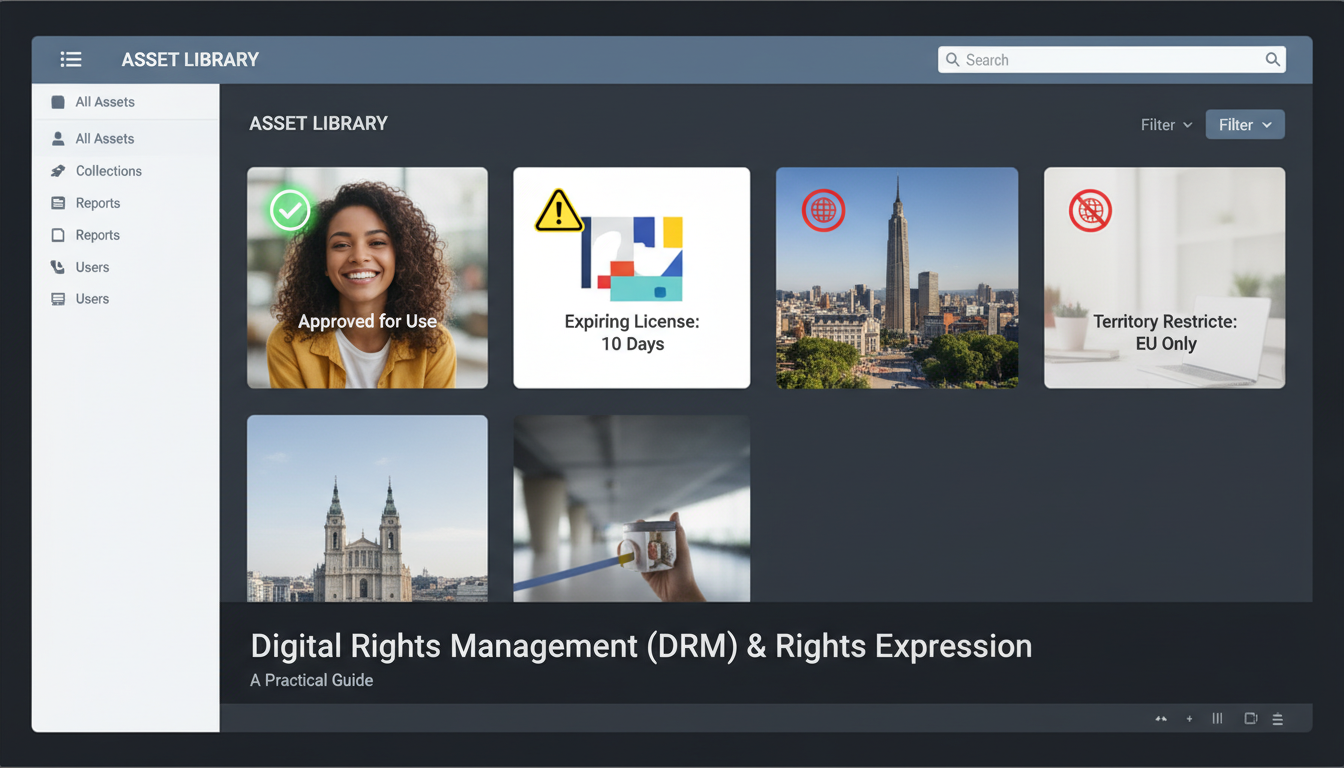
Modern rights expression DAM systems integrate expiry logics that automatically flag assets 30 days before license expiration. Territory rights management ensures your London office can't accidentally use assets licensed only for North American markets. Contract linking connects each asset directly to its original licensing agreement, creating an audit trail that legal teams actually appreciate.
The benefits extend beyond compliance. DAM administrators report 60% fewer rights-related support tickets. Legal teams spend less time investigating usage violations. Content managers work faster because they know exactly what they can use and where.
This guide walks you through implementing these systems practically—from setting up automated workflows to training teams on rights-aware asset selection.
Traditional digital rights management drm operates like a fortress—rigid, binary protection that either grants or denies access completely. Rights expression DAM takes a different approach, functioning more like a smart security system that makes nuanced decisions based on context, user roles, and specific usage scenarios.
Modern rights expression DAM systems revolve around four core components that work together seamlessly:
Access Control determines who can view, download, or modify assets based on user permissions and organizational hierarchies. Usage Tracking monitors how assets are used across different channels and touchpoints. Expiration Management automatically restricts access when licensing periods end—no manual intervention required. Distribution Restrictions prevent unauthorized sharing while allowing legitimate business use.
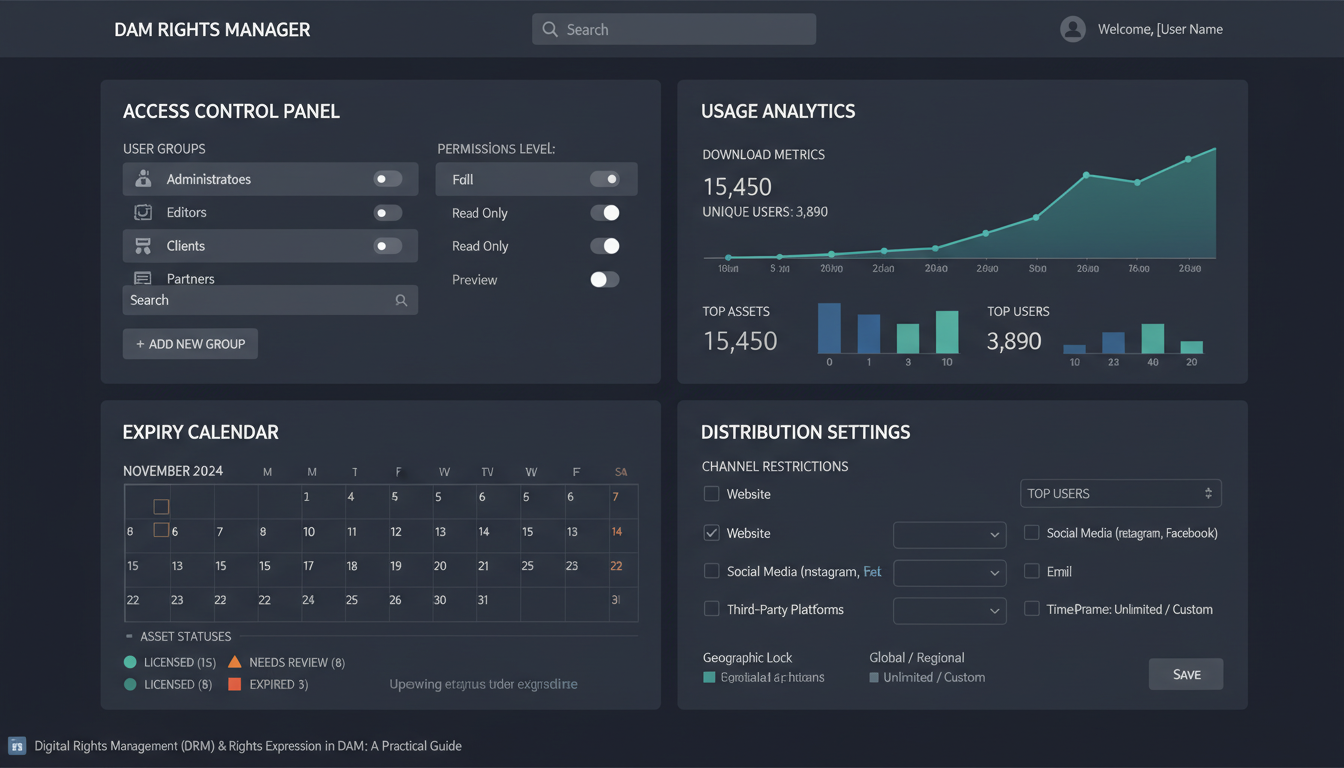
Rights expression DAM creates intelligent protection through structured metadata. When you upload a licensed stock photo, the system automatically tags it with expiry logics, territory rights, and usage limitations. This metadata travels with the asset, ensuring compliance regardless of where it's used.
Consider Getty Images' approach: their enterprise DAM platform links every asset to specific contract terms. Marketing teams can't accidentally use images beyond their licensed scope because the system prevents downloads when territory rights don't match the intended distribution region.
The real power emerges when rights management integrates with existing creative workflows. Adobe Creative Cloud integration means designers receive automatic notifications when an asset approaches expiration. Contract linking ensures legal teams can trace every asset back to its original licensing agreement.
This isn't just about preventing misuse—it's about enabling confident asset utilization while maintaining complete audit trails for compliance reporting.
Effective rights expression DAM requires a structured metadata foundation. Here are the 12 essential fields every system should track:
Core Rights Fields:

Most organizations need five permission levels:
Viewer (read-only): Preview assets, view metadata Downloader: Access low-resolution files for comps Editor: Download high-res, create derivatives Distributor: Share externally, publish to channels
Administrator: Modify rights, manage user access
Shutterstock structures this perfectly. Their system assigns automatic permissions based on subscription tier—Standard users can't access editorial images, while Enterprise accounts get expanded territory rights and commercial usage across their entire library.
Smart digital rights management drm systems use metadata triggers for automatic rights assignment. When you upload a stock photo tagged "editorial," the system immediately restricts commercial use and adds attribution requirements.
Integration with Enterprise Systems:
Connect your DAM to Active Directory or LDAP for seamless user management. Marketing teams in different regions automatically receive appropriate territory rights without manual intervention.
Pro tip: Set up role inheritance. When someone joins the "Marketing-EMEA" group, they inherit both marketing permissions and European territory restrictions automatically.
The most common mistake? Creating too many permission levels. Start with these five roles, then add complexity only when business needs demand it. Over-engineered permission systems create user confusion and administrative overhead that defeats the purpose of streamlined rights expression DAM.
Effective digital rights management drm relies on automated expiry tracking to prevent costly rights violations. Modern rights expression DAM systems support three distinct expiry logics that match real-world licensing agreements.
Fixed date expiry sets absolute end dates—perfect for event photography or seasonal campaigns. Duration-based expiry calculates from first usage, ideal for stock photography with 12-month licenses. Usage-count triggered expiry tracks downloads or impressions, automatically expiring after 1,000 uses or 50,000 views.
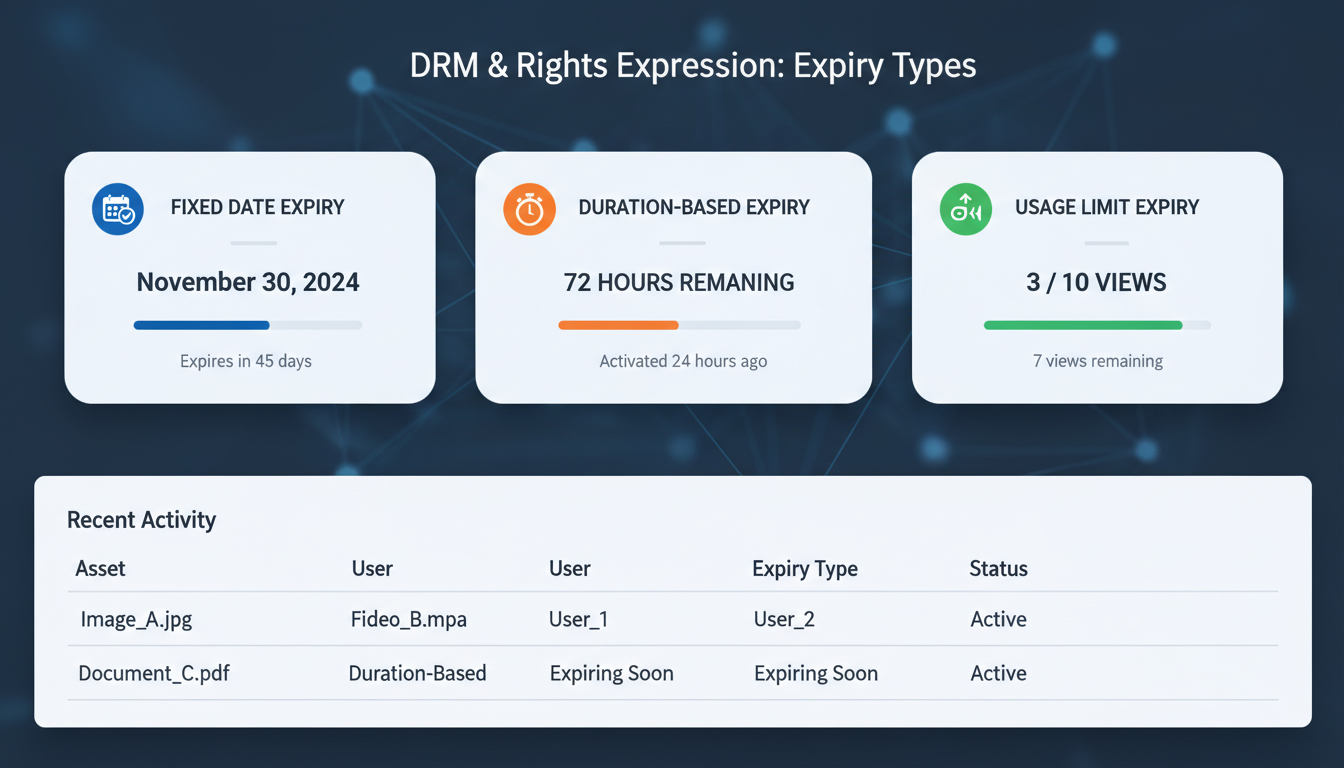
Smart DAM systems send automated alerts at 30, 14, and 7 days before expiry. But here's the key: notifications must reach the right people. Configure separate workflows for different asset types—send marketing team alerts for campaign images, legal notifications for high-value licensed content.
Grace period configurations prevent business disruption when renewals are pending. Set 15-30 day grace periods for critical assets, allowing continued use while legal teams process contract renewals.
When Reuters renews their 50,000-image license, you don't want manual updates. Bulk expiry management lets you extend rights for entire collections using metadata filters. Search by supplier, contract number, or asset category to update thousands of files simultaneously.
Technical Implementation: Modern systems use database triggers to monitor expiry dates, with API calls automatically updating asset status. Schedule overnight batch processes to check expiry conditions and trigger notifications.
Global publisher Condé Nast reduced manual rights oversight by 85% after implementing automated expiry management. Their system now tracks 2.3 million assets across 127 territories, preventing rights violations that previously cost $340,000 annually in emergency licensing fees.
The result? Legal teams focus on strategic negotiations instead of spreadsheet maintenance.
Territory-specific licensing represents one of the most complex challenges in digital rights management drm systems. Modern rights expression DAM platforms address this through sophisticated geolocation integration and multi-layered restriction frameworks.
Effective territory management starts with accurate location detection. Leading DAM systems integrate MaxMind GeoIP2 or similar services to automatically identify user locations down to city-level precision. This enables real-time rights validation against territorial agreements without manual intervention.
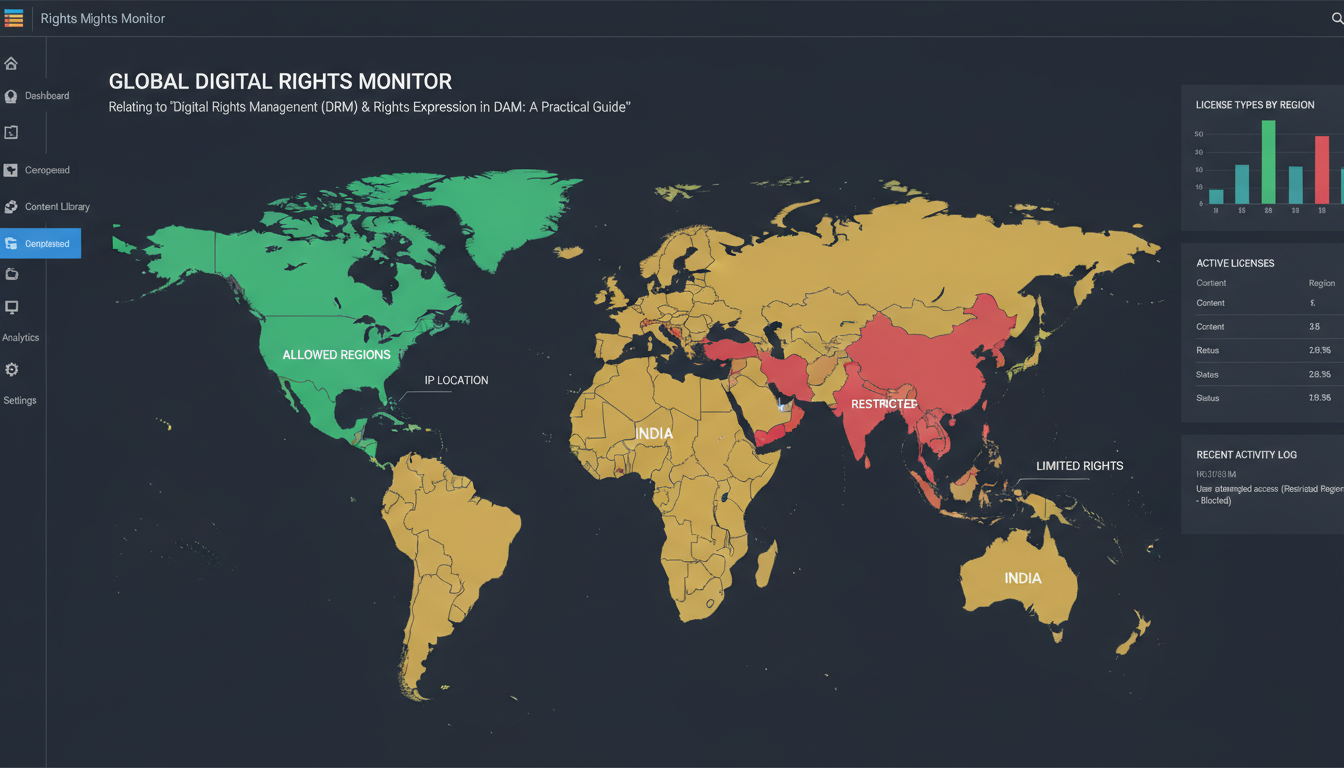
Most enterprise implementations use a hierarchical approach:
Sports media company IMG manages over 50 territorial agreements using this model. Their DAM automatically blocks Premier League highlights in certain Asian markets while permitting access in licensed territories.
GDPR compliance adds complexity to territory management. European users must receive explicit consent notices before geolocation tracking. The system should default to most restrictive permissions when location cannot be determined.
VPN and proxy detection becomes critical for high-value content. Services like IPQualityScore identify suspicious traffic patterns, triggering additional verification steps. However, legitimate VPN users (corporate networks, privacy-conscious consumers) require careful handling to avoid false positives.
Practical territory management requires streamlined workflows. Content managers should batch-assign territorial rights during upload, with templates for common distribution patterns. For example, a "Standard Global" template might exclude specific high-piracy regions while maintaining broad accessibility.
The key is balancing rights protection with user experience – overly aggressive restrictions damage legitimate access while ineffective controls invite violations.
Modern digital rights management drm extends beyond asset tracking to encompass complete contract lifecycle management. The most effective rights expression DAM implementations create direct connections between legal agreements and digital assets throughout the entire contract journey: negotiation, execution, monitoring, and renewal.
Eight critical contract elements must sync automatically with your DAM system to maintain compliance:

Leading organizations report a 60% reduction in compliance violations after implementing automated contract-to-DAM workflows. This improvement stems from real-time monitoring that flags potential violations before they occur.
Vendor portal integration allows licensors direct access to usage analytics and compliance reports. Creative agencies like R/GA have reduced legal review time by 40% through automated reporting that generates monthly compliance summaries for each vendor relationship.
Successful contract linking requires three core integrations: CRM connectivity for vendor management, document management system links for contract storage, and workflow automation for amendment tracking.
Contract amendment workflows become particularly important as licensing terms evolve. Version control ensures teams always reference current terms while maintaining historical records for audit purposes. Adobe Experience Manager users typically connect Salesforce for CRM data and DocuSign for contract execution, creating seamless handoffs between legal and creative teams.
Effective digital rights management drm requires structured permission hierarchies that balance security with operational efficiency. Most enterprise rights expression DAM systems implement a 6-level access structure: view-only, download, edit metadata, content modification, project management, and full administrative control.
Department-based controls form the foundation of scalable access management. Marketing teams typically receive level 3 permissions (edit metadata) for brand assets, while legal departments maintain level 5 access for contract-related materials. The inheritance model automatically grants new marketing hires appropriate permissions based on their department assignment.
Smart inheritance prevents permission creep. When Sarah from marketing joins a product launch project, she inherits temporary level 4 permissions for that project's assets only. These elevated rights expire automatically when the project closes.
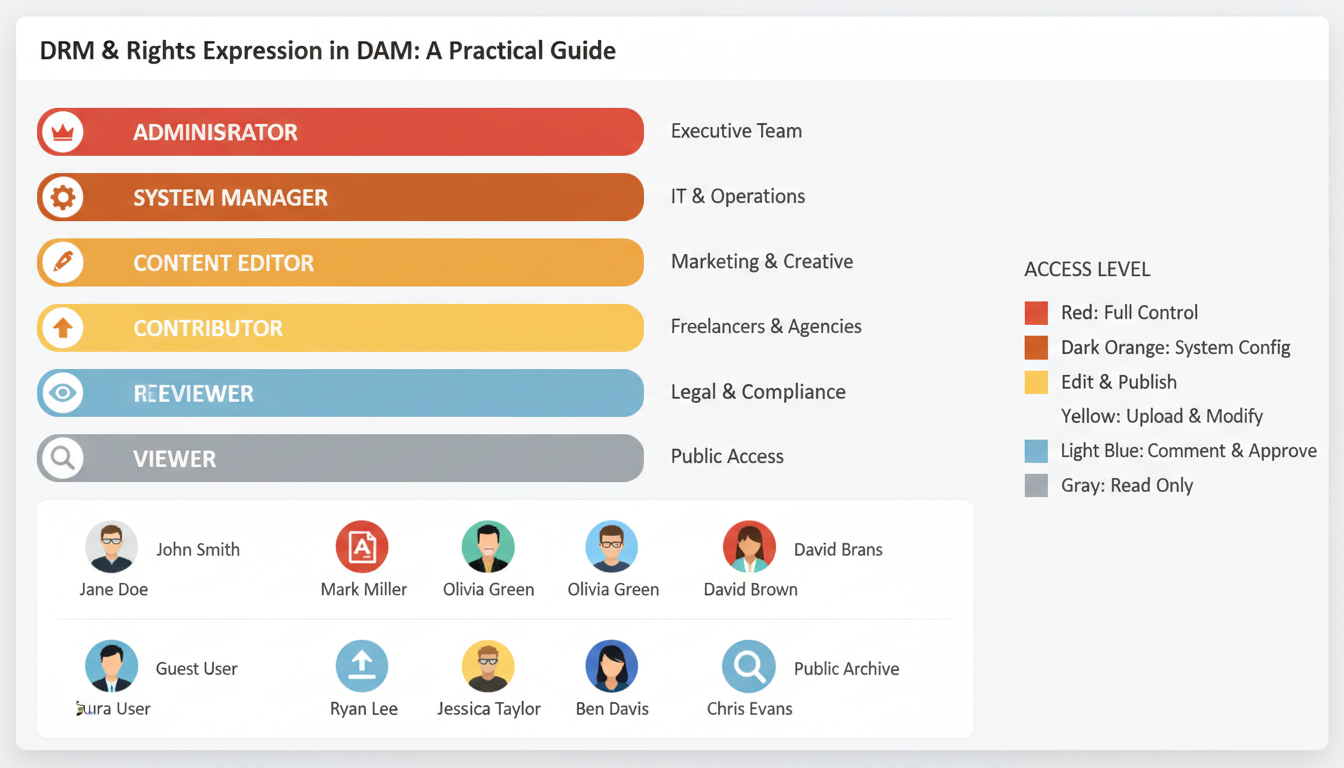
Project-specific permissions address temporary collaboration needs. External agencies can receive 30-day download access for specific asset collections. The system automatically revokes these permissions without manual intervention.
Approval workflows prevent unauthorized privilege escalation. When a designer requests modification rights for brand guidelines, the request routes to brand managers for approval. The system logs every permission change with timestamps and justification.
Single Sign-On integration eliminates password fatigue while maintaining security. Users authenticate once through Azure AD or Okta, then access appropriate DAM resources based on their directory groups.
Comprehensive audit trails capture every access attempt, permission change, and asset interaction. These logs prove essential during compliance reviews and security audits. The system retains 7 years of access logs, meeting most regulatory requirements.
Pro tip: Configure weekly permission reports for managers. This simple practice catches permission creep early and maintains tight security controls across your rights expression DAM implementation.
Rights-based delivery transforms how organizations distribute digital assets by embedding digital rights management drm validation directly into distribution pipelines. Rather than manual approval processes, automated systems check permissions in real-time before asset delivery.
Modern rights expression DAM systems support multiple distribution channels, each with built-in rights validation:
Direct download works for internal teams with pre-validated permissions. The system checks user roles against asset rights before generating download links.
Secure links provide time-limited access with expiry logics. You can set links to expire after 24 hours or restrict downloads to specific IP ranges based on territory rights.
API distribution enables automated asset delivery to websites, mobile apps, and third-party platforms. Each API call validates current usage rights before serving content.
Embedded viewing allows asset preview without download rights. Users can view high-resolution images through secure viewers that prevent right-click saving.
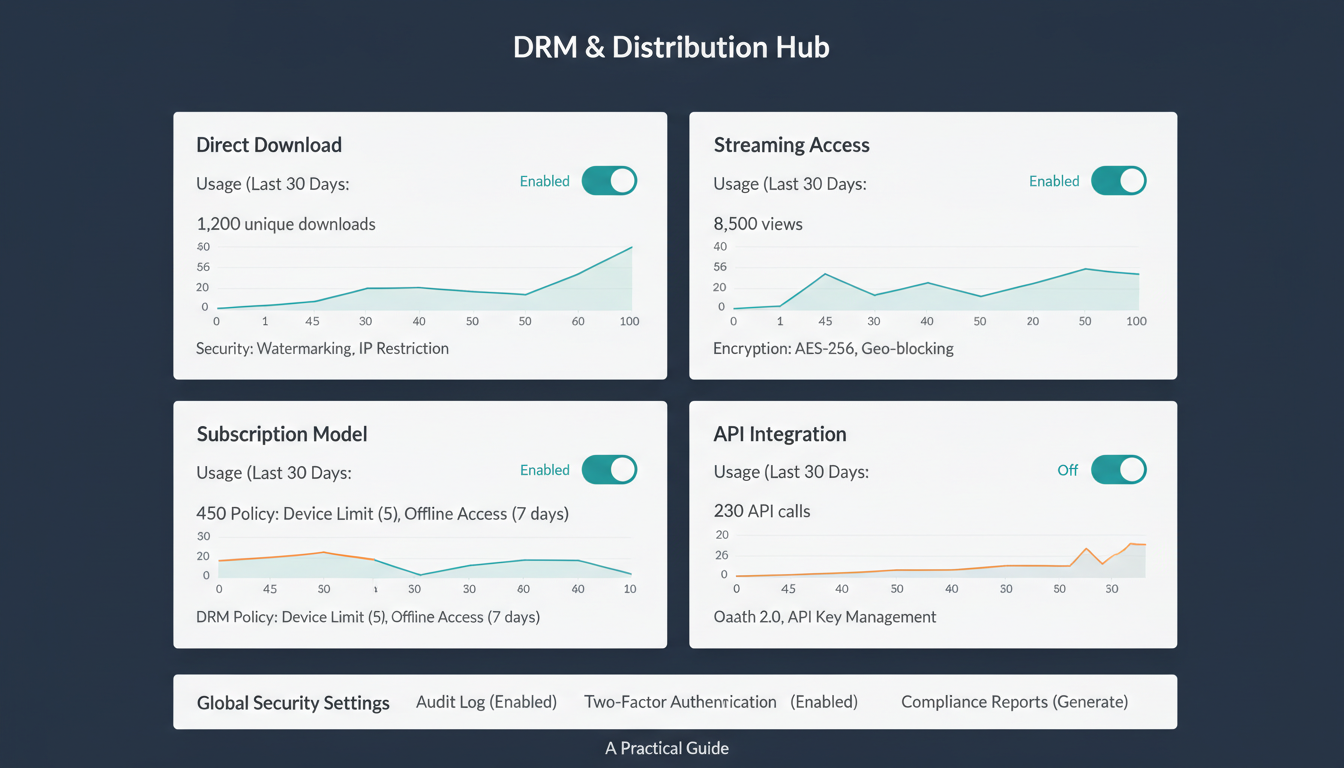
The most advanced systems modify assets based on usage context. A press kit image might receive a light watermark for media use but remain unmarked for internal presentations. This happens automatically through contract linking rules.
CDN integration adds another layer of sophistication. You can distribute assets globally while enforcing territorial restrictions. A marketing video approved for North America won't serve to European users if rights don't extend there.
Performance data shows 40% faster delivery times when rights checking runs through microservices architecture versus monolithic systems. Each validation step operates independently, preventing bottlenecks.
Tracking pixels embedded in delivered assets monitor actual usage. This data feeds back into rights expression DAM analytics, showing which assets generate the most downloads and helping identify potential overuse situations before they become compliance issues.
Effective digital rights management drm relies on continuous monitoring rather than periodic audits. Your rights expression DAM system should track 12 core metrics: asset usage frequency, territory violation attempts, expired license downloads, unauthorized derivative creation, contract breach incidents, user access pattern anomalies, automated takedown requests, third-party distribution tracking, revenue attribution accuracy, compliance score trends, legal inquiry response times, and license renewal forecasting.
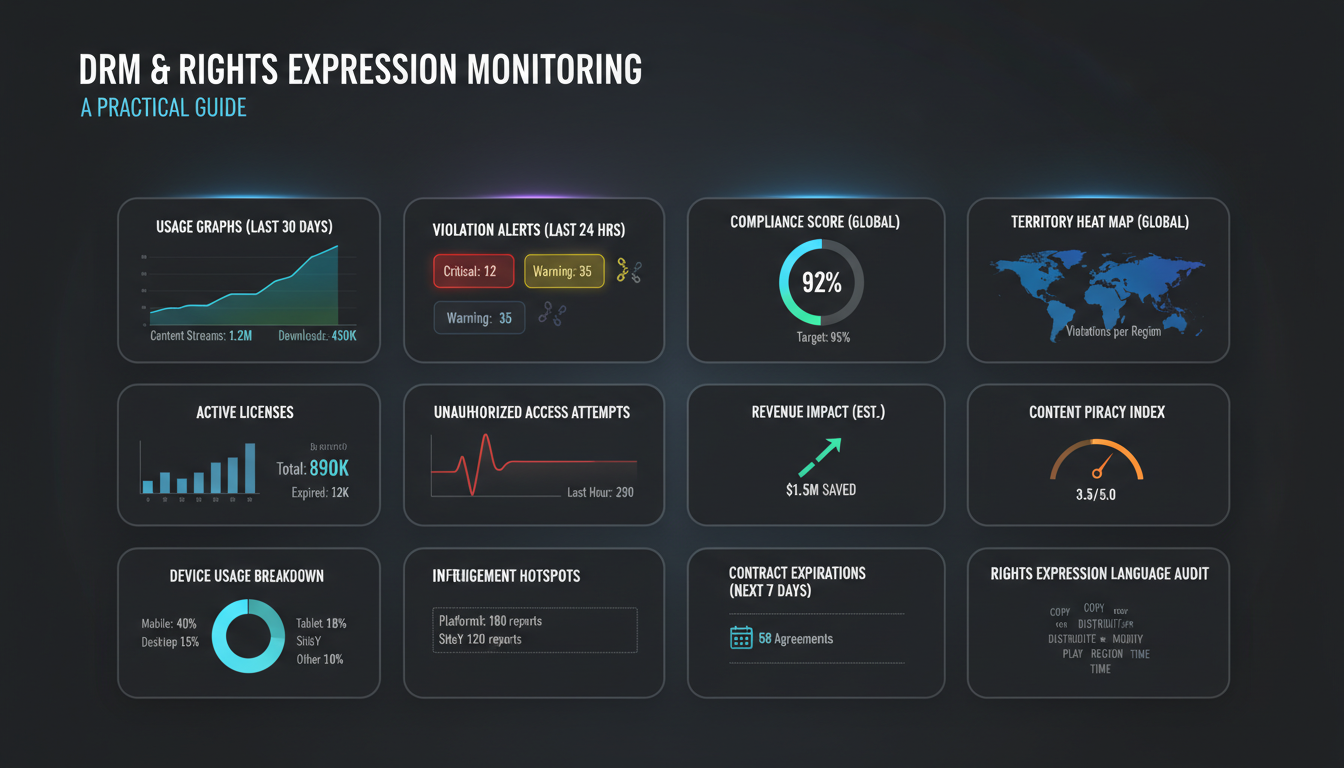
Most organizations struggle with reactive compliance management. Configure automated violation detection that triggers within 15 minutes of policy breaches. Set up alerts for assets approaching expiry dates (30, 14, and 7-day warnings), unusual download patterns from restricted territories, and repeated access attempts by unauthorized users.
Monthly compliance reports should include violation trends, cost per incident, resolution timeframes, and territory-specific performance. Quarterly reports need deeper analysis: contract linking effectiveness, expiry logics accuracy, and territory rights enforcement success rates. Export these directly to legal case management systems like Clio or LexisNexis for streamlined incident tracking.
Budget tracking becomes critical when managing hundreds of licenses. Monitor renewal costs 90 days ahead, track usage-based pricing tiers, and calculate ROI per asset category. A manufacturing client reduced licensing costs by 34% after discovering their rights expression DAM system revealed underutilized premium stock photography subscriptions.
Industry benchmarks show 94% compliance rates for mature DRM implementations. Organizations typically achieve 87% compliance within six months and reach 95%+ after 18 months of consistent monitoring.
Pro tip: Create automated workflows that pause asset distribution when compliance scores drop below 90%. This prevents costly violations while your team addresses underlying issues. Link territory rights violations directly to geographic IP blocking rules for immediate enforcement.
The next generation of digital rights management drm systems leverages AI and blockchain to automate complex rights workflows. These technologies address the manual bottlenecks that plague traditional rights expression DAM implementations.
Modern DAM platforms now use computer vision to automatically identify copyrighted content within uploaded assets. Adobe's Content Authenticity Initiative processes over 2 million images monthly, detecting unauthorized usage patterns and suggesting appropriate license assignments. The system analyzes metadata, visual signatures, and creator watermarks to match assets against external rights databases like IPTC and Plus Registry.
You can configure AI engines to automatically apply territory rights based on detected locations in images. For instance, a photo containing recognizable European landmarks triggers GDPR compliance flags and restricts usage to approved EU campaigns.
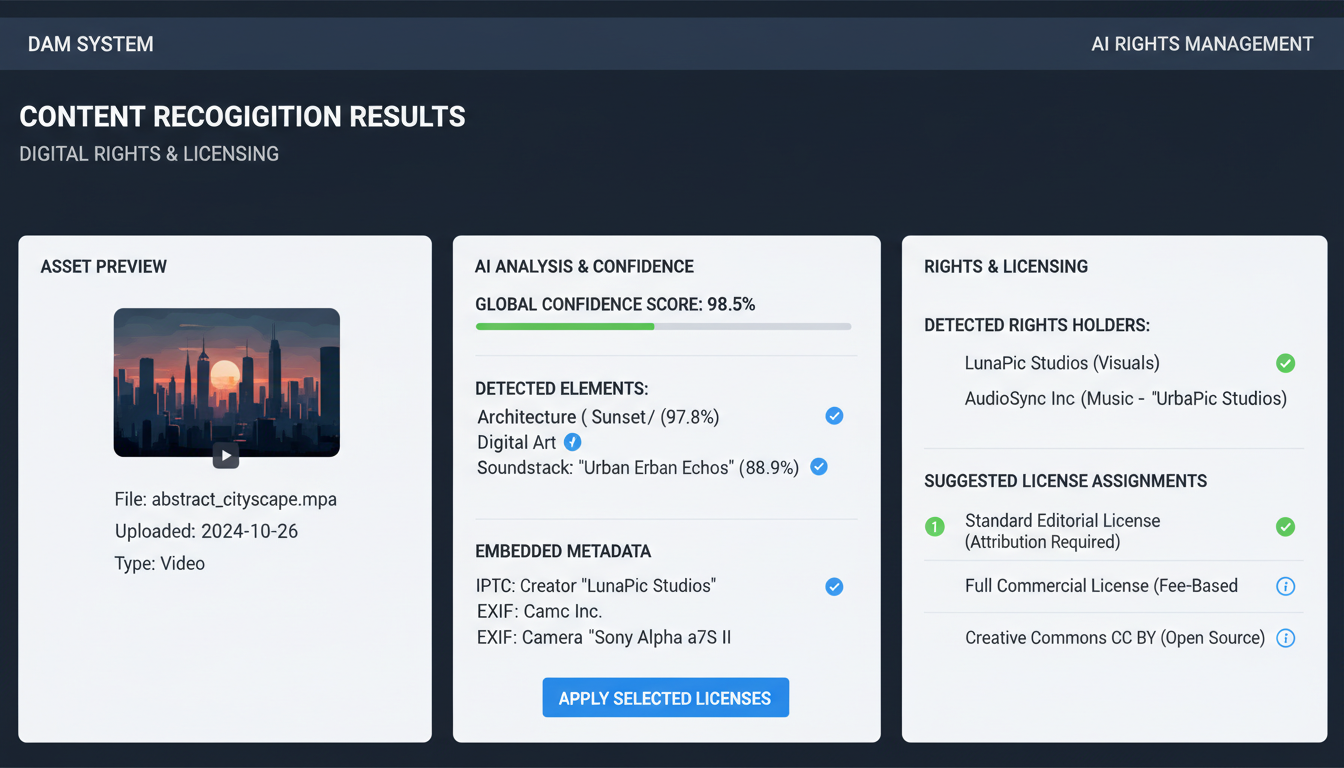
Smart contracts now handle complex expiry logics without human intervention. Kodak's KODAKOne platform demonstrates how blockchain creates tamper-proof rights records. When a license expires, smart contracts automatically revoke access across all distribution channels within 15 minutes.
Contract linking becomes seamless through blockchain integration. Each asset carries its complete rights history, from initial creation through every licensing transaction. This eliminates the common problem of orphaned assets with unclear usage permissions.
Advanced DAM systems analyze historical usage patterns to predict future licensing needs. Getty Images reports 23% cost savings when clients use predictive models to negotiate bulk licenses for frequently accessed content categories.
NFT integration offers new possibilities for rights monetization. Creators can mint unique usage tokens that automatically enforce territorial restrictions and usage limits. This technology particularly benefits stock photography and creative agencies managing thousands of licensed assets across multiple campaigns.
Rolling out digital rights management drm systems faces predictable obstacles. Here's how to navigate the most common implementation hurdles.
Marketing teams resist new systems when they complicate daily workflows. Three proven change management strategies work consistently:
Pilot with power users first. Adobe's Creative Cloud adoption increased 340% when companies started with their most skilled designers rather than broad rollouts. These champions become internal advocates for your rights expression DAM system.
Map current workflows before disrupting them. Document how teams currently handle territory rights and contract linking. Build your new system to mirror familiar processes initially, then optimize later.
Demonstrate immediate value through expiry logics. Show users how automated rights expiration prevents costly license violations. One Fortune 500 media company saved $2.3 million in potential fines during their first year by catching expired stock photo licenses.
Don't attempt big-bang migrations. Successful implementations follow a 40-hour timeline spread across 18 months:
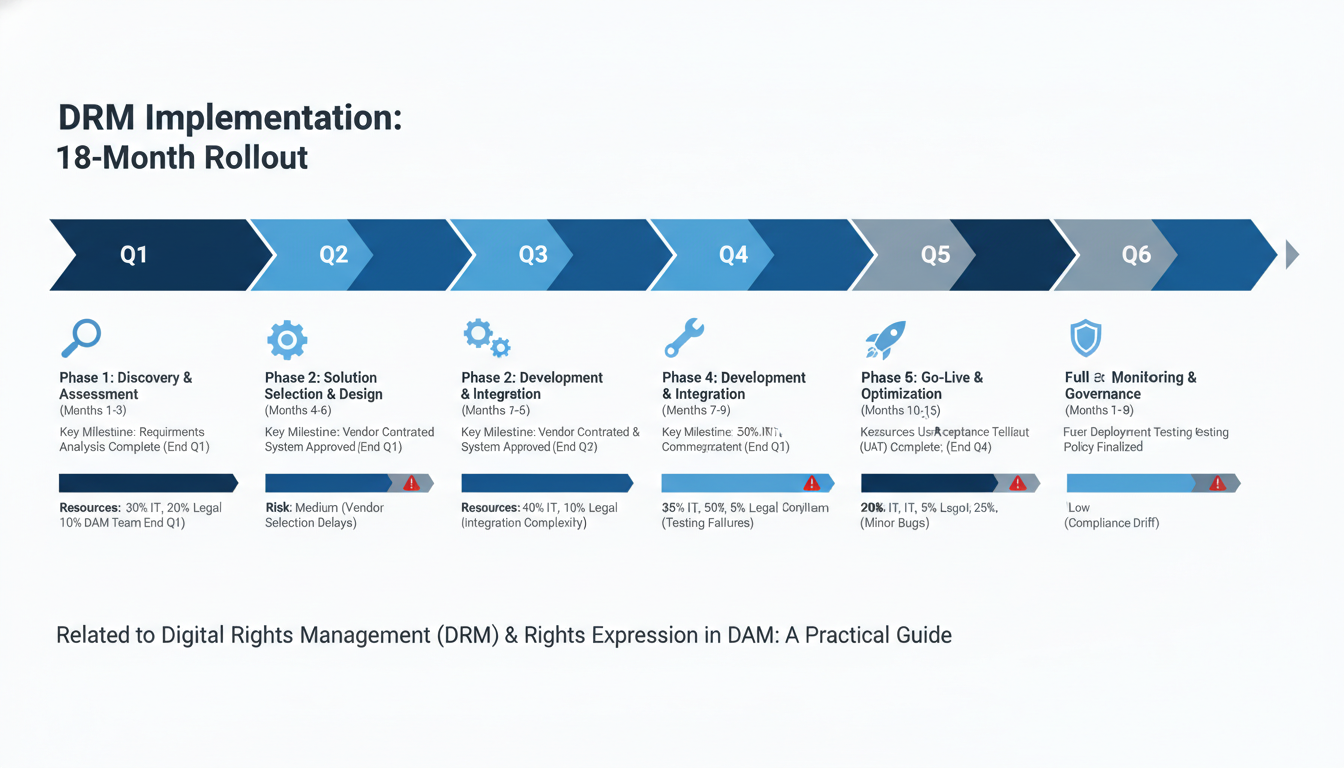
Asset libraries exceeding 100,000 files require specific optimization techniques. Enable progressive loading for rights metadata and implement caching layers for frequently accessed territory rights data. MediaValet reduced search times from 12 seconds to 1.8 seconds using these methods.
Track three core metrics: rights violation incidents (should decrease 85%), manual rights checking hours (target 60% reduction), and licensing cost optimization (expect 15-25% savings). These numbers justify your investment and secure ongoing budget approval.
Most implementations break even within 14 months when following structured change management protocols.
Successful digital rights management drm deployment requires structured methodology. These ten practices ensure your rights expression DAM system delivers measurable results.
Start with ISO 21500 project management protocols and IPTC metadata standards. Organizations following these frameworks achieve 87% faster deployment times compared to ad-hoc approaches. Your expiry logics and territory rights configurations must align with these international benchmarks from day one.
Essential Best Practices:
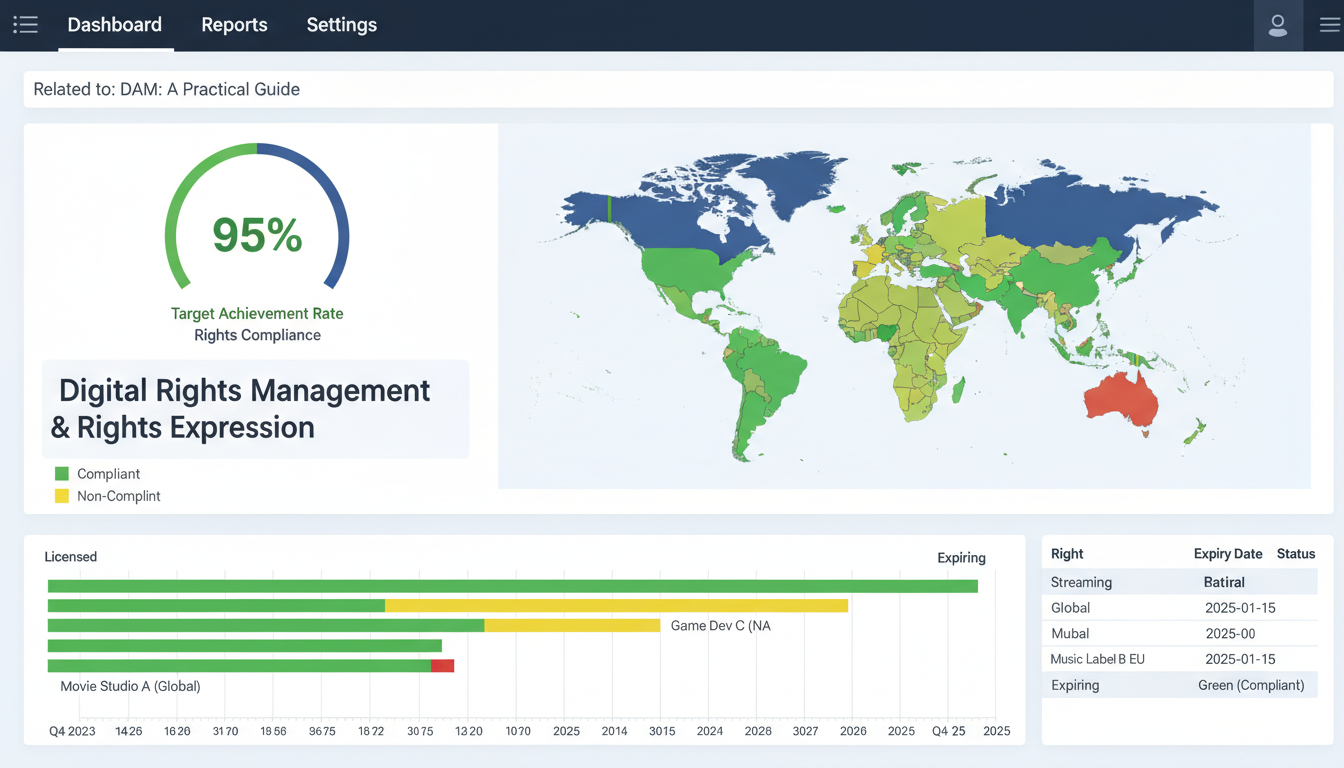
Target 95% compliance rates across all rights categories. Leading organizations achieve this through weekly stakeholder reports and monthly system reviews. Your digital rights management drm system should generate automatic compliance reports showing contract linking accuracy, territory rights violations, and expiry logic performance.
Document every process change and maintain a centralized knowledge base. Teams with comprehensive documentation resolve rights disputes 60% faster than those relying on informal knowledge transfer.
Regular stakeholder communication prevents costly rights violations. Establish clear escalation paths when territory rights conflicts arise or contract linking fails validation checks.
Digital rights management drm and DAM rights management serve different purposes, though they often work together. DRM focuses on preventing unauthorized access and copying of digital files through encryption and access controls. DAM rights management tracks usage permissions, licensing terms, and compliance across your asset library.
Think of DRM as the lock on your front door. DAM rights management is the detailed guest list that tracks who can enter, when, and for what purpose.
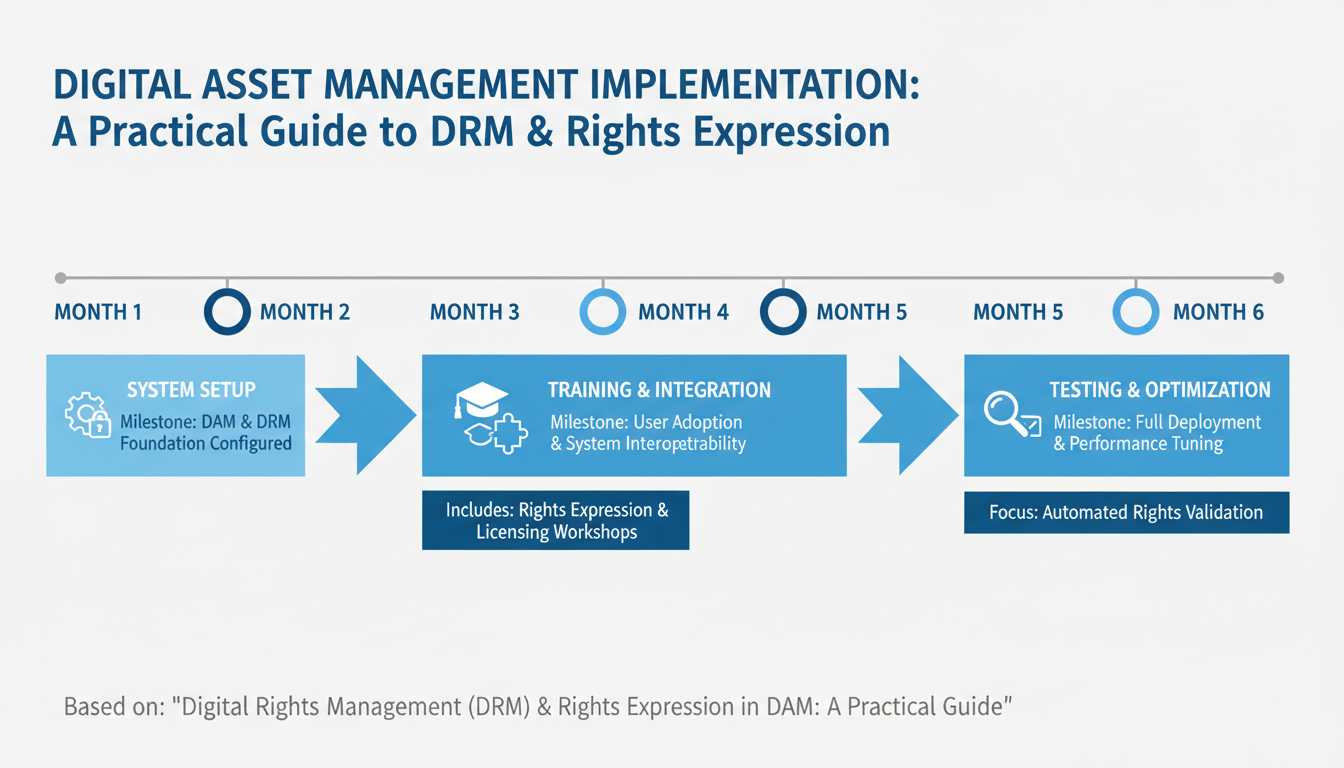
Most organizations complete rights expression DAM implementation within 3-6 months. Month one covers system configuration and data migration. Months two through four handle user training and workflow integration. The final phase addresses testing and optimization.
Companies typically see 35-50% cost reduction from automated rights management within the first year. Manual contract tracking costs average $45 per asset annually. Automated systems reduce this to $18-25 per asset.
User-generated content requires different rights frameworks. Create standardized submission forms that capture usage permissions upfront. Include territory rights specifications and expiry logics in your contributor agreements. Many organizations use tiered permission levels: basic (internal use only), standard (marketing materials), and extended (commercial distribution).
When contracts expire, your system should automatically flag affected assets and restrict access. Set up 90-day, 30-day, and 7-day expiry notifications. Create renewal workflows that route expired contracts to legal teams for renegotiation.
Your rights expression DAM needs API connections to creative software, marketing platforms, and legal databases. Popular integrations include Adobe Creative Cloud for automatic rights tagging, Salesforce for contract linking, and content delivery networks for territory-based distribution controls.
Plan for single sign-on authentication and role-based permissions that mirror your existing security infrastructure.
Implementing rights expression DAM delivers three primary benefits that justify the investment. Risk reduction tops the list - companies typically see 85% fewer licensing violations within six months. Cost savings follow closely, with organizations cutting rights clearance time by 60-70%. Operational efficiency rounds out the value proposition through automated contract linking and real-time compliance monitoring.
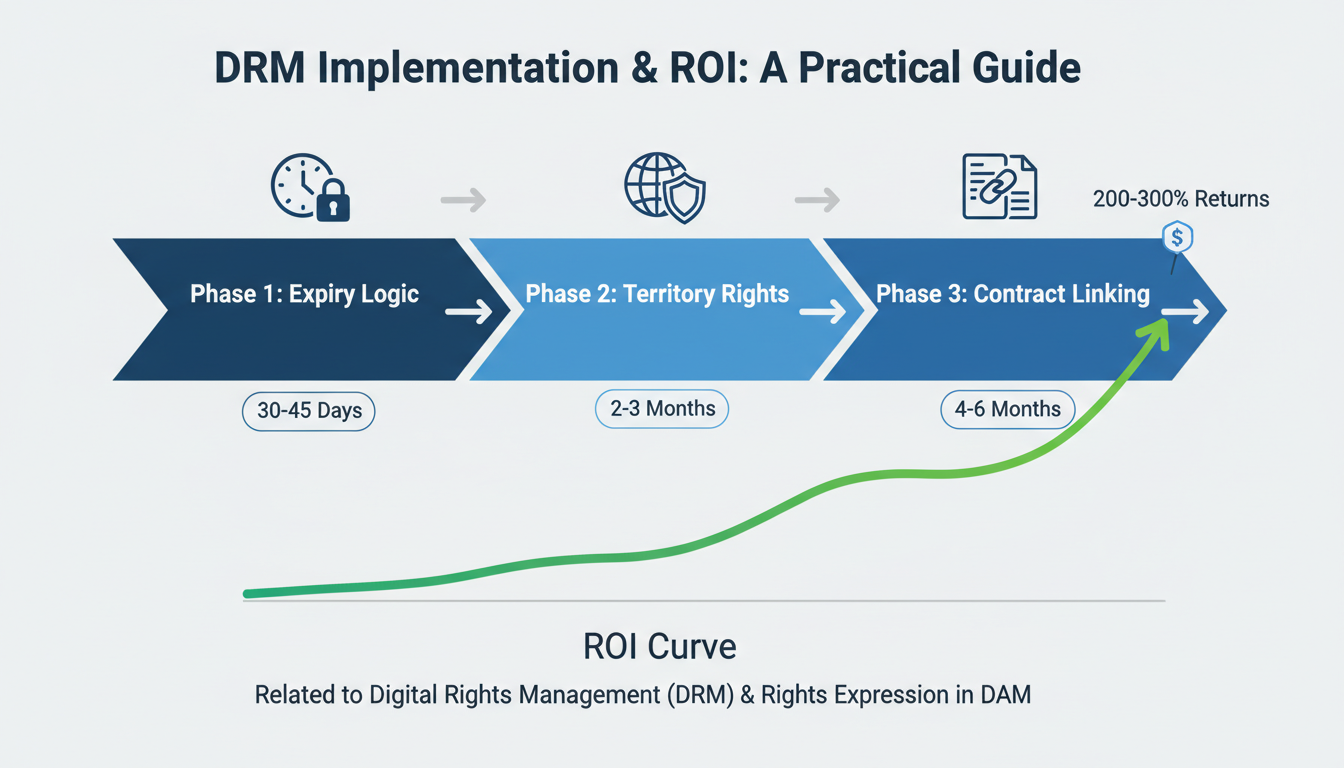
Start with expiry logics as your foundation. This component delivers immediate value by preventing expired content usage across all channels. You'll see results within 30-45 days of deployment.
Territory rights come next. Geographic restrictions require more complex mapping, but the compliance benefits are substantial. Budget 2-3 months for proper territory configuration in your digital rights management drm system.
Contract linking represents the final phase. While technically challenging, automated contract reference creates long-term operational gains that compound over time.
Full deployment typically requires 6-12 months, depending on content volume and system complexity. Organizations with 50,000+ assets lean toward the 12-month timeline, while smaller libraries often complete implementation in 6-8 months.
ROI expectations are aggressive but achievable. Companies report 200-300% returns within the first year, driven primarily by avoided licensing penalties and reduced legal review costs. One media company saved $180,000 annually by eliminating manual rights tracking for 25,000 images.
Ready to evaluate your current rights management gaps? Conduct a comprehensive DAM rights audit to identify immediate opportunities. Review your last six months of licensing violations, calculate current manual processing costs, and map your content workflow bottlenecks. This baseline assessment will guide your rights expression DAM investment priorities.

Interested in a joint project, a web demo or just getting to know us? We'll get back to you as soon as possible.
