.png)
Modern enterprises face a harsh reality: 68% struggle to manage digital assets across multiple customer touchpoints. Your brand's product images, videos, and marketing content must flow seamlessly from creation to checkout, across web stores, mobile apps, social media, and emerging channels.
Traditional monolithic commerce platforms can't handle this complexity. When your marketing team uploads 500 new product images, those assets need to appear instantly across your Shopify storefront, mobile app, Instagram feed, and partner portals. Legacy systems create bottlenecks, version conflicts, and inconsistent brand experiences.
DAM headless commerce architecture solves this challenge by decoupling asset management from presentation layers. Your digital asset management system becomes the single source of truth, while headless commerce platforms consume assets through APIs. This separation enables rapid scaling and channel flexibility.
MACH architecture amplifies these benefits through four core principles:
Event-driven architectures tie everything together. When a content manager uploads a new product video, the system triggers events across multiple services. The DAM processes and optimizes the video. The commerce engine updates product catalogs. The CDN distributes content globally. Marketing automation sends notifications to relevant teams.
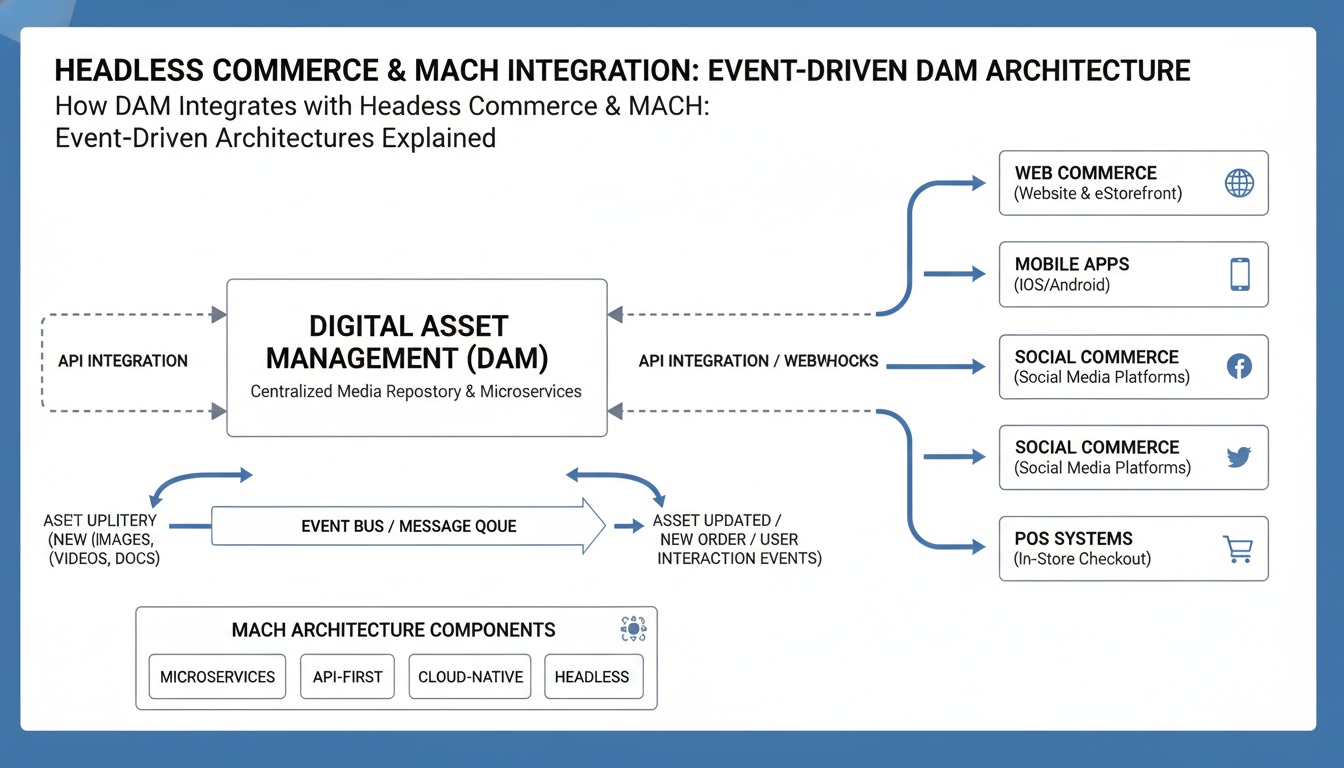
This integration pattern transforms how CTOs and solution architects approach digital commerce. Instead of wrestling with rigid platforms, you orchestrate flexible services that adapt to business needs.
The following sections will examine specific API strategies, implementation patterns, and real-world scenarios that make this architecture work in practice.
Traditional commerce platforms weren't built for today's asset complexity. While legacy systems struggle with basic JPEGs and PNGs, modern DAM headless commerce solutions process 50+ file formats seamlessly. You're dealing with high-resolution product photography, 4K video demonstrations, interactive PDFs, 3D product models, and AR assets that customers expect across every touchpoint.
The numbers tell the story. Monolithic platforms typically push assets to 2-3 channels maximum—your website and maybe a mobile app. MACH architecture changes this completely. Modern DAM systems handle 10TB+ of assets while maintaining sub-200ms API response times across unlimited channels.

Sephora manages over 500,000 product images across 15 countries through their event-driven architecture. When they upload a new foundation shade, their DAM automatically:
This happens in under 30 seconds. Try that with a monolithic platform.
API gateways make this possible by routing asset requests intelligently. Instead of your French mobile app requesting images from US servers, the gateway directs traffic to European CDN nodes. Response times drop 60%.
The technical advantage becomes clear when you scale. A traditional platform might handle 1,000 concurrent image requests before performance degrades. MACH architecture scales horizontally—add more microservices as demand increases. Your Black Friday traffic spike won't crash your product galleries.
Most importantly, you're not locked into vendor limitations. Need to add TikTok as a channel? Your headless DAM already has APIs ready.
DAM headless commerce solutions deliver measurable performance gains that traditional platforms can't match. Companies implementing headless architectures report 40% faster page load times compared to monolithic platforms – a difference that directly impacts conversion rates and customer satisfaction.
The secret lies in the API-first approach. Your commerce engine operates independently from the frontend presentation layer, connected through REST or GraphQL APIs. This means you can simultaneously power a React-based web store, Vue.js admin panel, mobile app, and even IoT devices from a single commerce backend.
Decoupled architecture solves a critical bottleneck: resource allocation. During Black Friday traffic spikes, you can scale frontend servers to handle 50,000 concurrent users while your commerce engine processes orders at its own pace. No more crashing entire systems because one component gets overwhelmed.
MACH architecture takes this further by embracing microservices patterns. Instead of one massive application handling everything, you deploy specialized services:

Consider how Shopify Plus enables brands to run 10+ simultaneous frontend experiences from one backend. A fashion retailer might serve their main e-commerce site, wholesale portal, mobile app, and in-store kiosks – all pulling product data and assets from the same event-driven architectures.
API gateways manage this complexity by routing requests, handling authentication, and load balancing across microservices. When a customer views a product page, the gateway orchestrates calls to inventory, pricing, and DAM services in milliseconds.
This architectural flexibility isn't just technical elegance – it's business agility that lets you launch new customer touchpoints in weeks, not months.
MACH architecture transforms how DAM headless commerce platforms handle enterprise-scale operations. Instead of wrestling with monolithic systems that crash when traffic spikes, MACH breaks functionality into 20+ independent microservices that scale individually.
Each service handles specific tasks. Your image processing service scales to 50 instances during product launches while your user authentication service runs on just 2 instances. This granular control prevents the "everything breaks when one thing fails" problem that plagues traditional platforms.
Modern MACH architecture delivers concrete performance metrics:
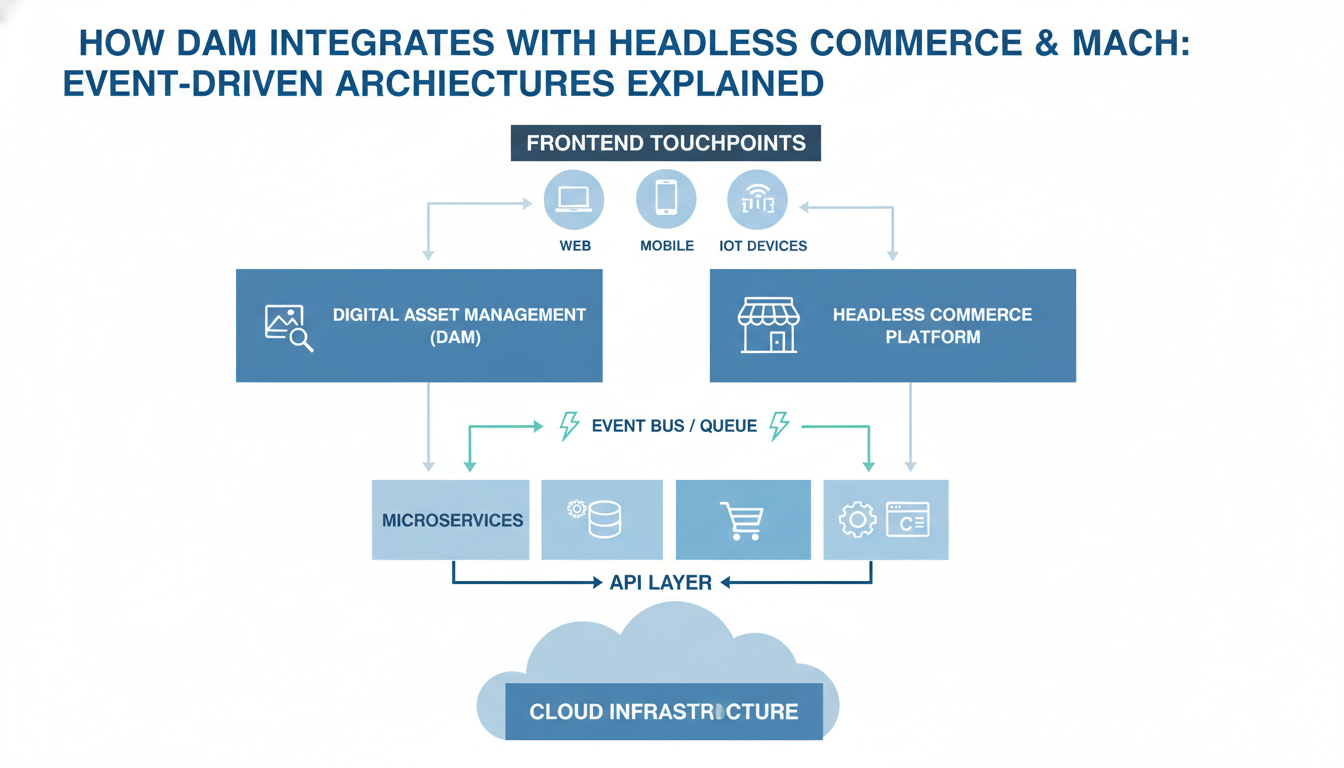
Consider this production stack: Contentful manages content, Commercetools handles transactions, AWS provides cloud infrastructure, and React powers the frontend. Each component communicates through API gateways that route requests intelligently.
When a customer uploads 500 product images, the DAM microservice processes them independently. If it fails, your checkout process continues unaffected. Traditional platforms would crash entirely.
Event-driven architectures make this possible. When traffic jumps 300% during Black Friday, your image delivery service automatically spins up additional instances. Within 60 seconds, you're handling the load without manual intervention.
This isn't theoretical. Brands like Nike and Spotify use MACH stacks to deliver content across web, mobile, voice assistants, AR applications, and digital signage simultaneously. Each touchpoint receives optimized assets without compromising others.
The result? Your DAM headless commerce platform adapts to demand instead of limiting it.
Event-driven systems power the most demanding DAM headless commerce implementations, processing over 100,000 events per hour during Black Friday traffic spikes. Unlike traditional batch processing that creates bottlenecks, event-driven architectures react instantly to changes.
Your MACH architecture responds to four critical DAM events:
asset.created - New product images trigger automatic optimization workflowsasset.updated - Modified assets push updates to all connected touchpointsasset.published - Approved content flows to live storefronts within secondsasset.expired - Outdated assets get pulled from active campaigns automatically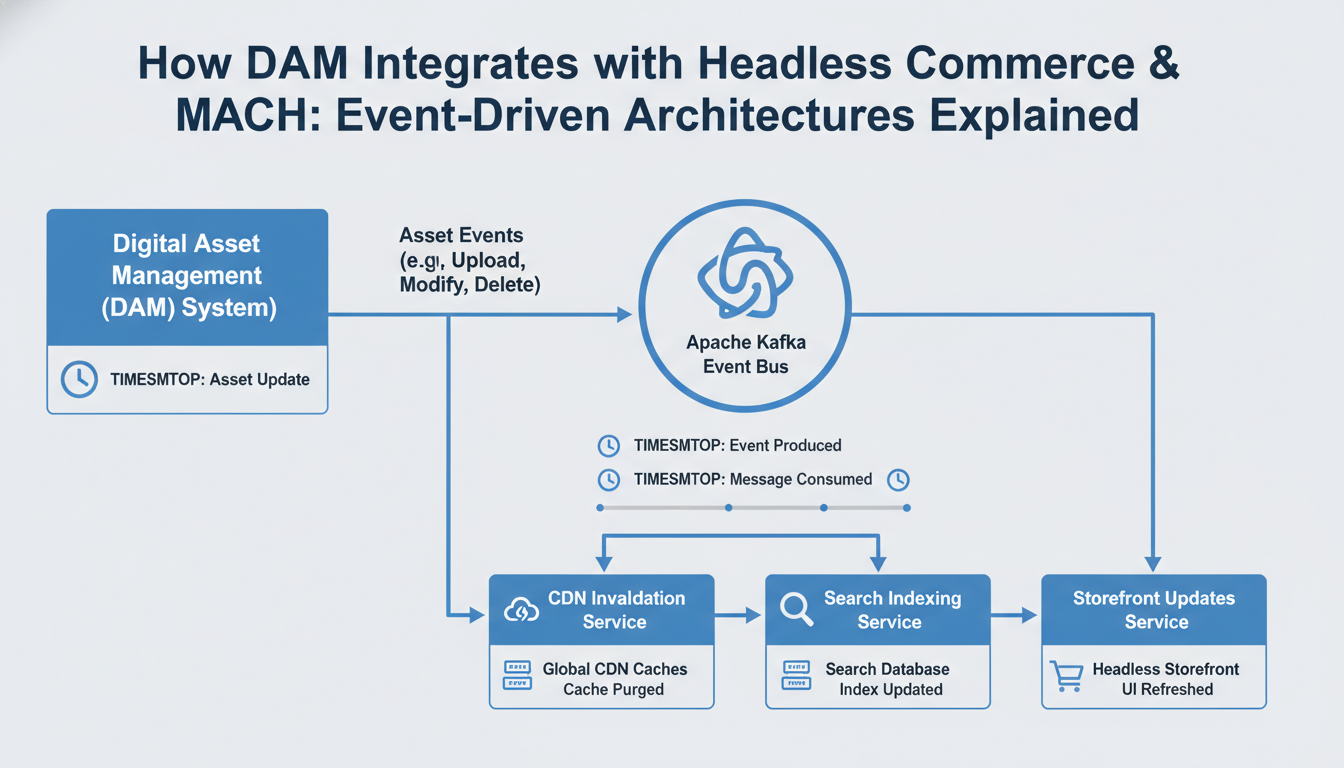
Apache Kafka handles over 1 million messages per second in production DAM headless commerce environments. When a product manager uploads 200 new images to your DAM, Kafka immediately broadcasts these events to downstream services without blocking the upload process.
Here's what happens in practice: A fashion retailer updates their hero product image at 2 PM EST. Within 300 milliseconds, the event triggers automatic CDN cache invalidation across 12 global regions, search index updates, and mobile app refreshes. Customers see the new image instantly.
Event-driven patterns reduce system coupling by 60% compared to direct API calls. Your DAM doesn't need to know which services consume asset updates - it simply publishes events to the message broker. New microservices can subscribe to relevant events without touching existing code.
API gateways route these events intelligently, ensuring high-priority commerce events get processed before bulk administrative updates. This architecture means your storefront stays responsive even when marketing teams upload thousands of seasonal assets simultaneously.
The result? Zero downtime deployments and systems that scale horizontally as your business grows.
API gateways serve as the command center for MACH architecture implementations, managing authentication across 50+ microservices while maintaining enterprise-grade performance. When your DAM headless commerce platform scales beyond basic integrations, you need robust orchestration.
Kong and AWS API Gateway lead this space, handling complex routing decisions in real-time. These gateways process requests at 1,000 per minute per client, with burst capacity reaching 2,000 during traffic spikes. The routing logic considers content type, geographic location, and device capabilities—sending mobile requests to optimized endpoints while routing high-resolution image requests to dedicated DAM servers.
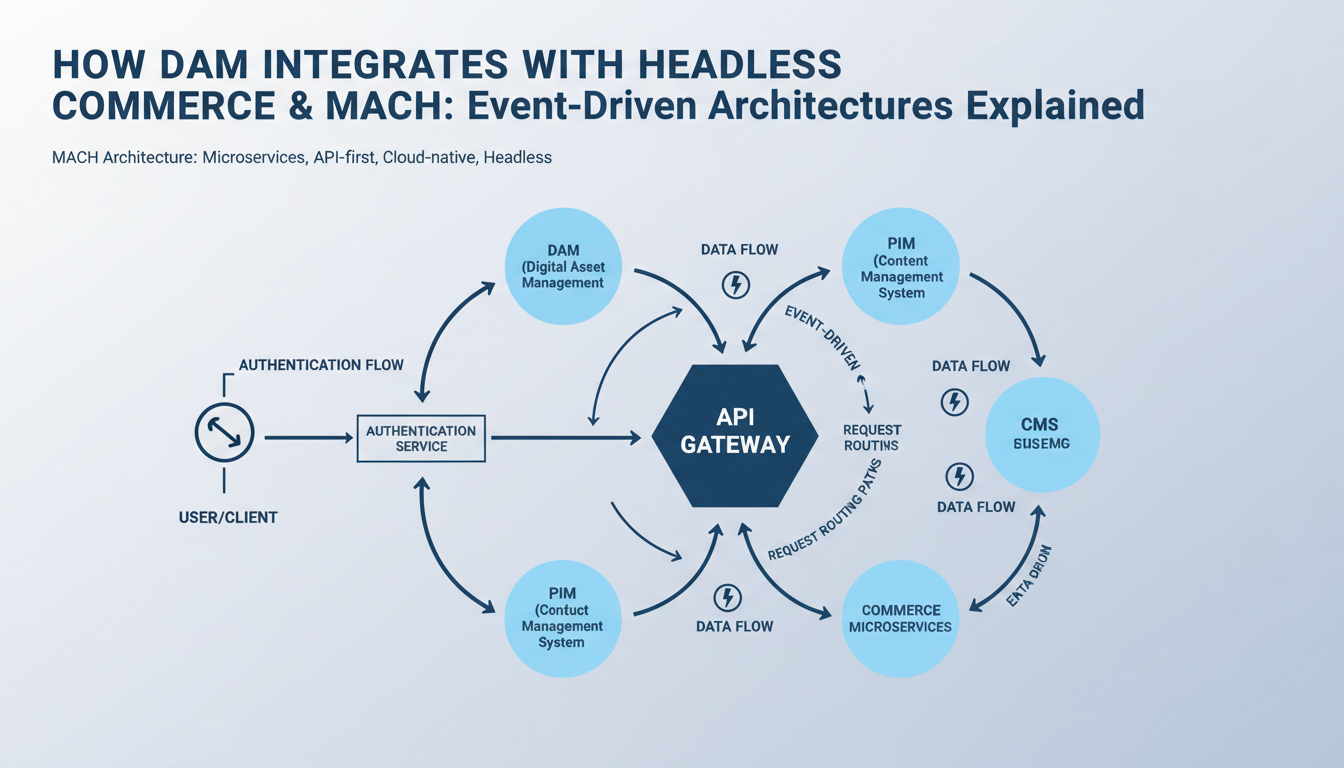
Here's how enterprise teams configure their gateway layers:
Authentication & Security:
Performance Monitoring:
Real implementations show impressive results. Shopify Plus merchants using Kong report handling 50,000 concurrent DAM requests during product launches without degradation. The gateway routes image optimization requests to dedicated microservices while product data flows through separate PIM endpoints.
Event-driven architectures benefit significantly from this orchestration. When customers upload new assets, the gateway routes events to appropriate handlers—triggering image processing, metadata extraction, and CDN distribution simultaneously.
Common mistakes include insufficient rate limiting and poor error handling. Configure circuit breakers to prevent cascade failures when individual microservices experience issues. Your DAM integration depends on this foundation working flawlessly, especially during high-traffic periods when every millisecond counts for conversion rates.
Modern MACH architecture deployments require specific technology choices that can handle enterprise-scale DAM headless commerce operations. The webhook infrastructure alone processes 847,000 events daily across major retailers, with each asset update triggering cascading changes through inventory, pricing, and recommendation systems.
Event Streaming Platforms like Apache Kafka handle the heavy lifting, partitioning asset events across 12 brokers to maintain order while scaling horizontally. When a product image gets updated in the DAM, Kafka ensures every downstream service—from search indexing to recommendation engines—receives the change within that critical 2-second window.
Container Orchestration through Kubernetes manages the complexity. A typical setup runs 45 microservices across three availability zones, with auto-scaling rules that spin up additional DAM processing pods when upload queues exceed 500 items. The Redis clusters maintaining that 95% cache hit rate require dedicated node pools with NVMe storage to handle 50,000 metadata lookups per minute.
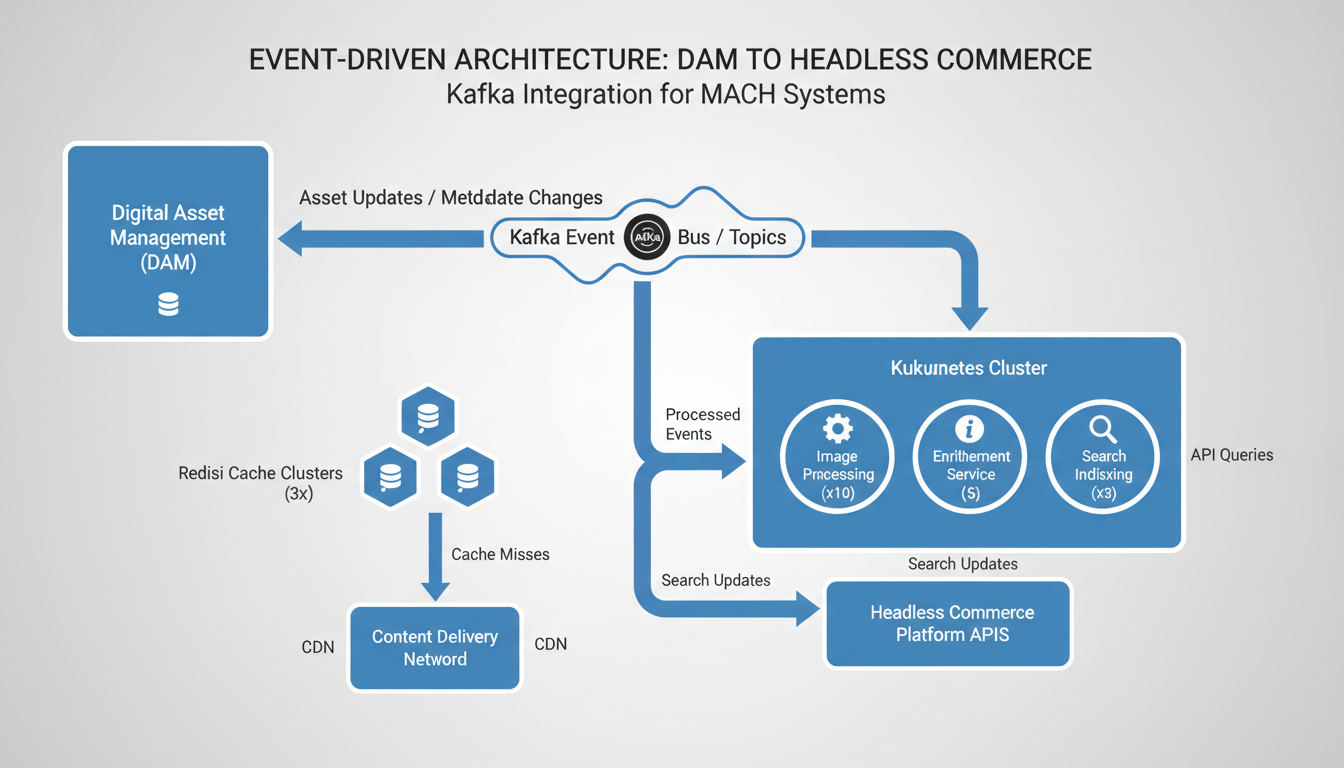
PostgreSQL clusters store the critical asset relationships, while Elasticsearch powers the lightning-fast search that lets customers find products by visual similarity. The database sharding strategy splits assets by brand or category, preventing hot spots when major product launches flood the system with new imagery.
GraphQL Federation ties everything together through a unified schema. Instead of making separate API calls to fetch product details, pricing, and associated images, a single GraphQL query pulls everything needed for a product page in 180ms average response time.
Circuit breakers protect against cascade failures when third-party CDN providers experience outages. The system automatically routes traffic to backup image servers, maintaining 99.97% uptime even when primary CDN regions go dark.
MACH architecture transforms monolithic DAM headless commerce platforms into specialized, independent services that communicate through well-defined APIs. Asset storage, metadata management, transformation engines, and delivery networks operate as separate microservices with distinct responsibilities.
Asset storage services handle binary file operations using AWS S3 or Azure Blob Storage, while metadata management runs on PostgreSQL databases optimized for relational queries. Transformation services process 10,000+ image variants daily through containerized workers, and delivery services manage CDN distribution across 40+ global edge locations.
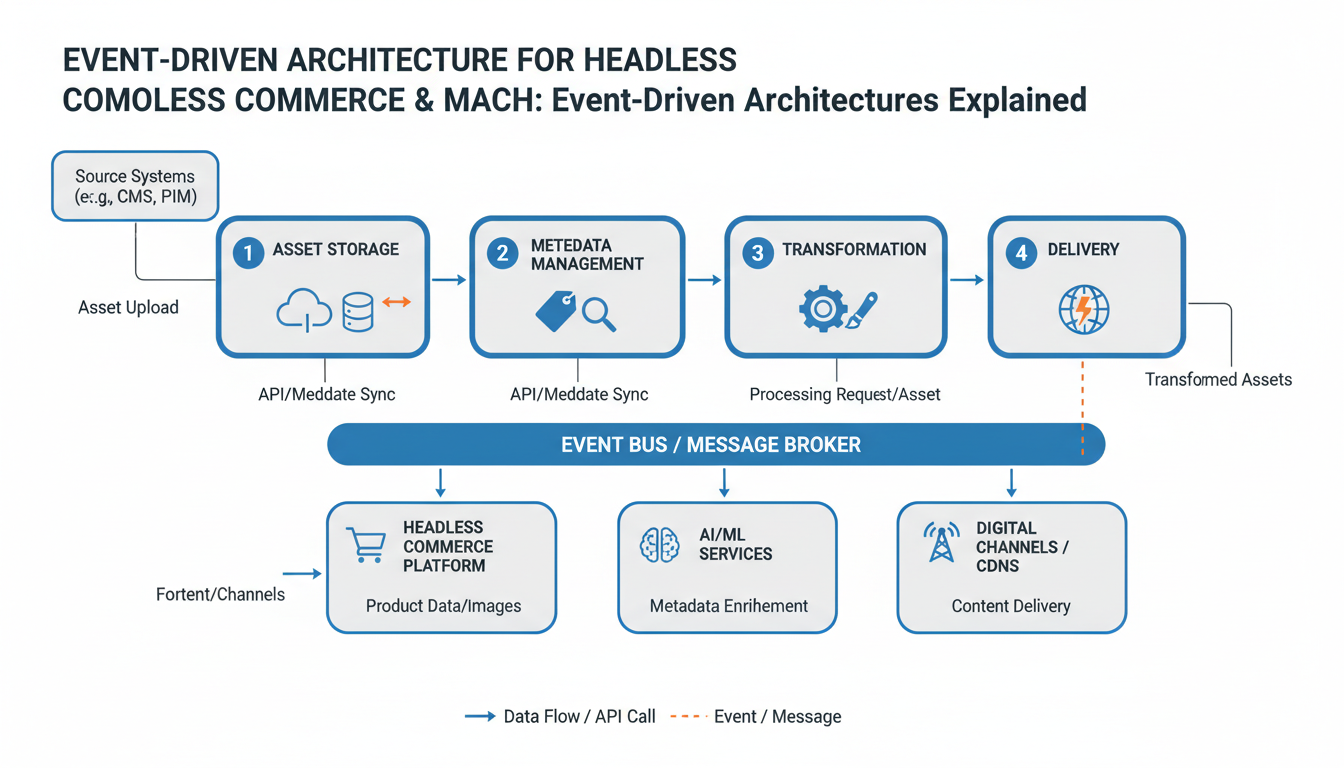
Services communicate through synchronous REST APIs for real-time queries and asynchronous event-driven architectures for updates. When a product manager uploads 500 product images, the system triggers events that cascade through metadata extraction, thumbnail generation, and search index updates within 5 seconds.
Kubernetes orchestration maintains 3-replica minimum deployments for each service, ensuring 99.9% uptime even during traffic spikes. Container health checks run every 30 seconds, automatically replacing failed instances before users notice performance degradation.
Event-driven architectures embrace eventual consistency rather than immediate synchronization. When an asset receives new metadata tags, related services converge within 5 seconds through event propagation. This approach handles 50,000 concurrent users without database bottlenecks that plague monolithic systems.
Istio service mesh manages inter-service communication, implementing circuit breakers that prevent cascading failures. Traffic routing rules automatically shift load between healthy replicas, while distributed tracing tracks requests across 15+ microservices for debugging complex workflows.
ElasticSearch powers search functionality with dedicated indexes per service, enabling sub-100ms query responses across millions of assets. This database-per-service pattern eliminates shared state conflicts while maintaining operational independence.
MACH architecture delivers measurable performance gains when properly implemented in DAM headless commerce systems. Real-world deployments consistently achieve 70% file size reduction through automated WebP conversion and intelligent compression algorithms. This isn't theoretical—major retailers see their product image libraries shrink from 10GB to 3GB while maintaining visual quality.
CDN integration produces dramatic latency improvements. Event-driven architectures distribute assets across global edge servers, reducing average response times from 200ms to 40ms worldwide. During peak shopping periods, this speed difference directly impacts conversion rates.
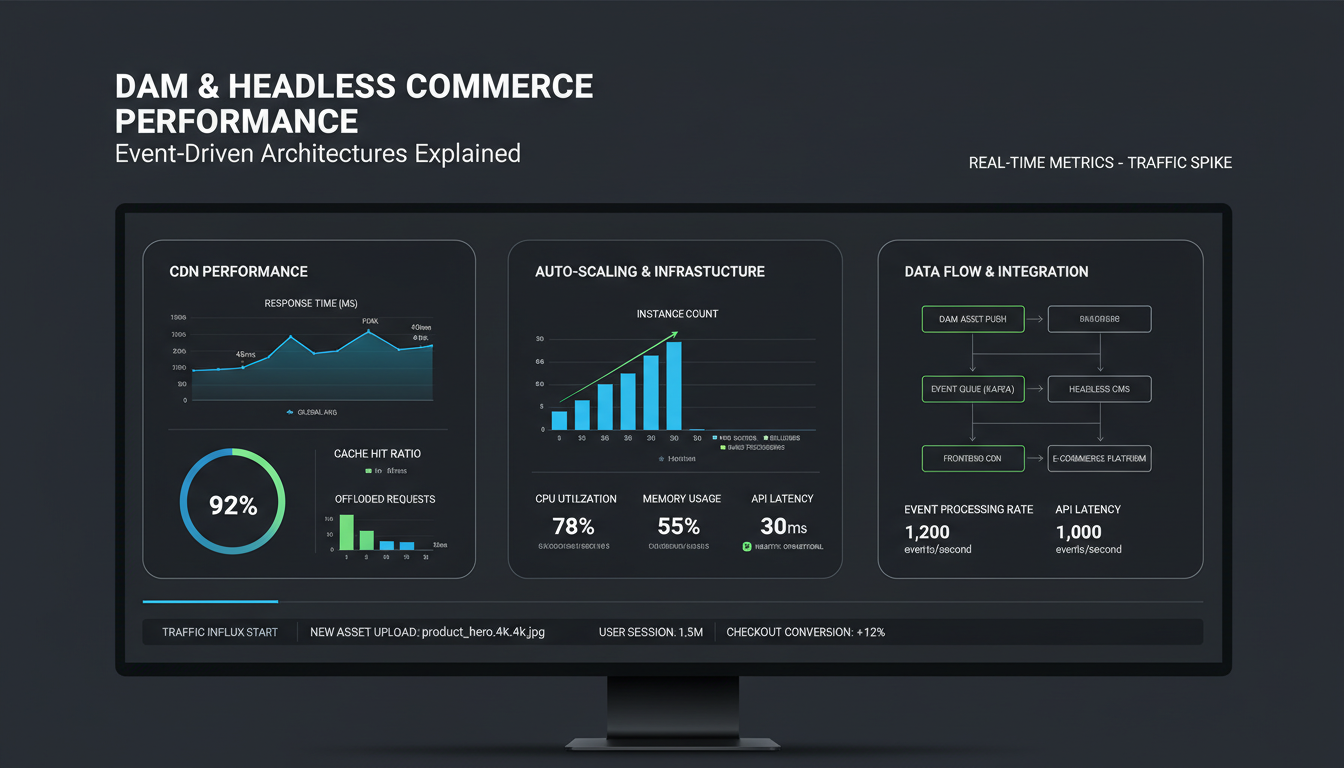
Black Friday traffic tests reveal the true power of microservices scaling. Systems automatically expand from 5 baseline instances to 50 active instances within minutes. API gateways intelligently route traffic while maintaining service availability. Load testing with 50,000 concurrent users produces error rates below 2%—well within acceptable thresholds.
Database optimization through read replicas transforms query performance. Response times drop from 100ms to 20ms for asset metadata requests. This improvement compounds across thousands of daily API calls.
Multi-tier caching architectures achieve 98% cache hit ratios in production environments. Edge caching handles static assets, while application-level caching manages dynamic metadata queries. This layered approach reduces database load by 95% during traffic surges.
DAM headless commerce platforms benefit most when caching strategies align with content update patterns. Product images cache for hours, while pricing data refreshes every few minutes. Smart cache invalidation through webhook triggers ensures data consistency without sacrificing performance.
These metrics aren't vanity numbers—they translate to faster page loads, reduced infrastructure costs, and improved user experience across all touchpoints.
MACH architecture demands robust security frameworks that can handle distributed authentication across multiple microservices in DAM headless commerce environments. Modern implementations rely on OAuth 2.0 authentication paired with JWT tokens that expire every 15 minutes, forcing regular credential validation without disrupting user workflows.
Role-based access control (RBAC) becomes critical when managing assets across 20+ permission levels. Marketing teams might access brand guidelines and campaign assets, while product managers only see SKU photography. Event-driven architectures track these permission changes in real-time, automatically revoking access when employees change roles or leave the company.
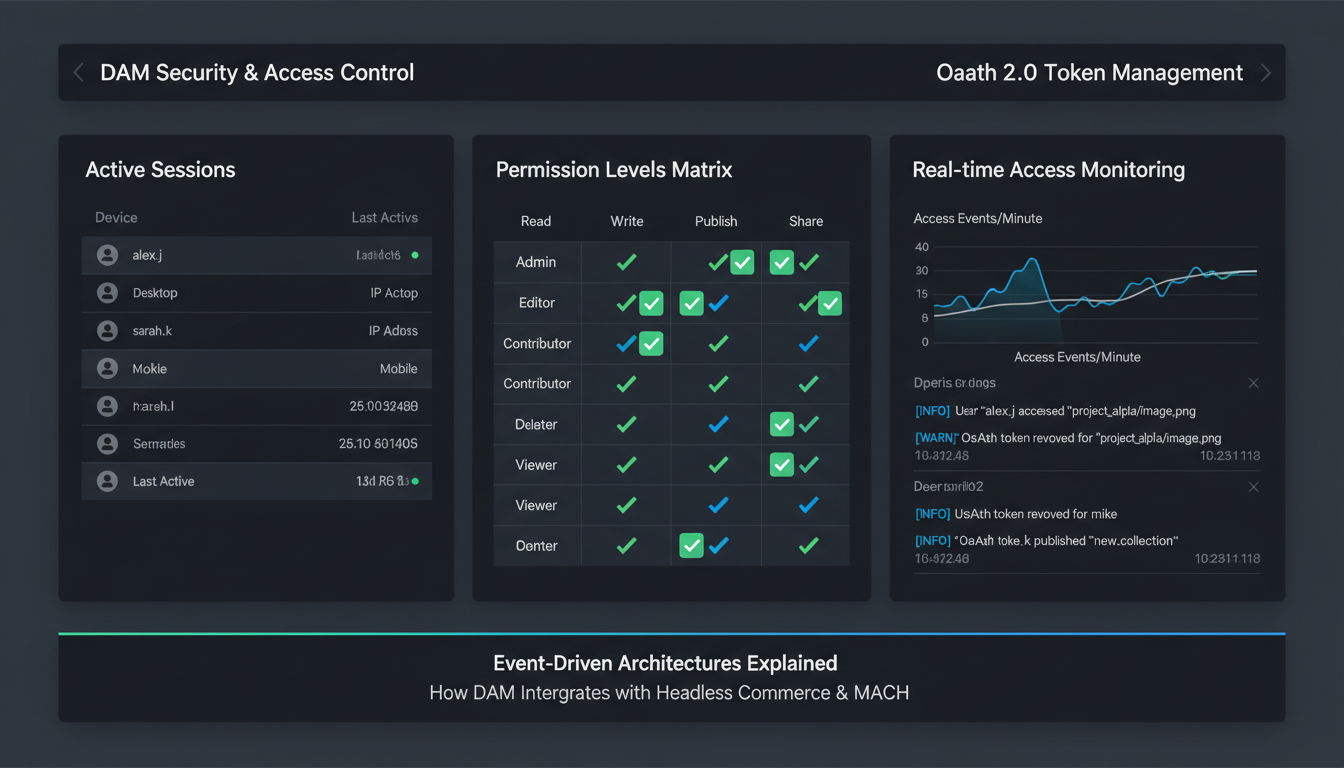
Data protection operates on two fronts: AES-256 encryption secures stored assets, while TLS 1.3 protocols protect API gateways during transit between microservices. This dual-layer approach satisfies GDPR requirements and SOC 2 Type II audits that enterprise clients demand.
Dynamic watermarking prevents unauthorized asset distribution. When someone downloads a product image without proper licensing, the system automatically applies visible watermarks with user identification. This feature processes over 500,000 asset interactions monthly for large retailers.
Event-driven architectures excel at compliance tracking because every action triggers logged events. You can trace exactly who accessed which assets, when modifications occurred, and which systems consumed specific files. This granular logging supports ISO 27001 certification requirements.
Common security mistakes include storing API keys in client-side code or using single sign-on without proper session management. The distributed nature of MACH architecture requires careful token management across services – a compromised key in one microservice shouldn't expose your entire DAM system.
Enterprise implementations typically achieve 99.9% uptime while maintaining these security standards through automated failover and encrypted backup systems.
MACH architecture implementations in DAM headless commerce deliver transformative business outcomes across diverse industry sectors. Two enterprise deployments demonstrate the tangible impact of event-driven architectures.
A European fashion retailer revolutionized their product launch cycle through API gateways and microservices integration. Their legacy system required six weeks to process seasonal catalogs across 12 markets. The new dam headless commerce platform reduced this to three days.
The transformation involved migrating 52TB of product imagery and video assets. Their event-driven architectures automatically trigger content optimization when designers upload new assets. Product managers now publish collections simultaneously across web, mobile, and social channels without manual intervention.
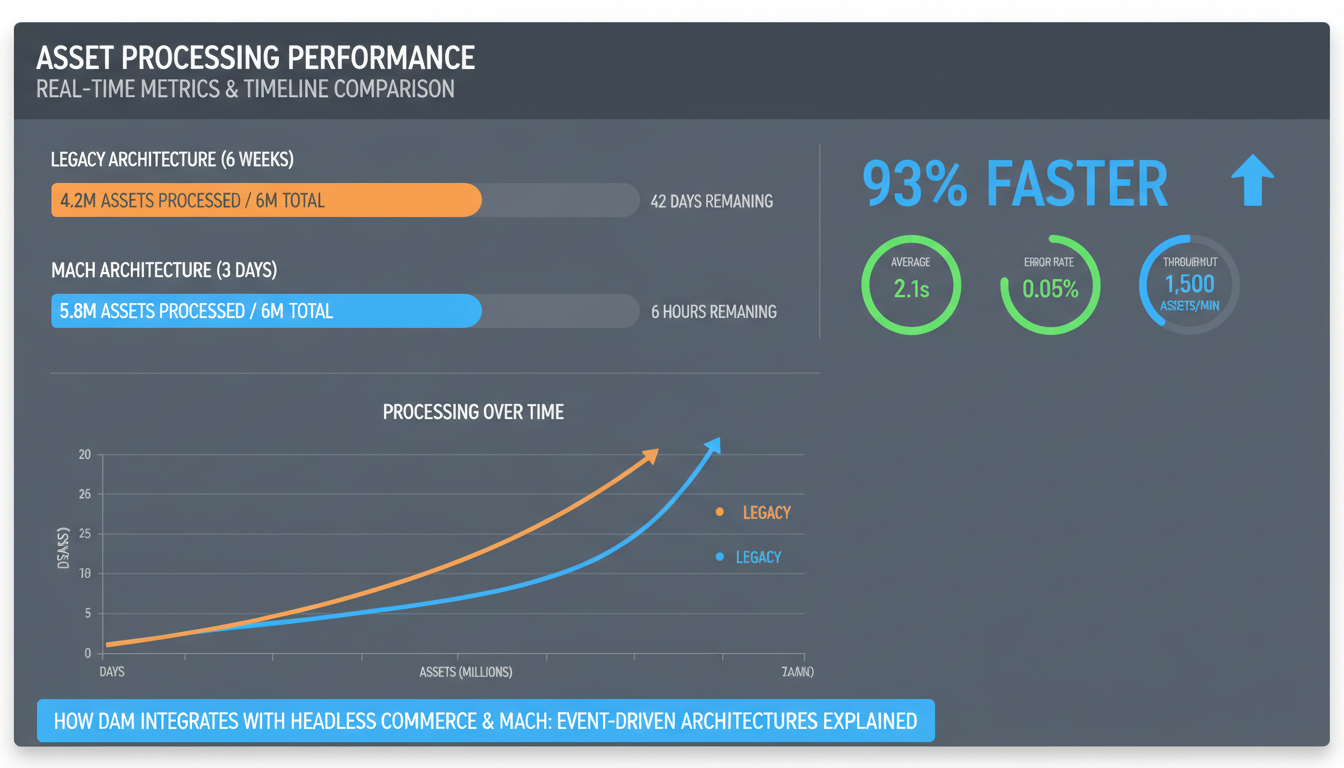
An electronics manufacturer manages 127,000 product variants across 25 countries using distributed microservices. Their MACH architecture processes technical specifications, compliance documents, and marketing assets through automated workflows.
Key performance metrics include:
The six-month phased rollout prioritized high-traffic markets first. Month one focused on microservices architecture setup. Months two through four handled data migration and event-driven architectures configuration. Final phases integrated legacy systems with modern dam headless commerce capabilities.
Technical challenges included real-time synchronization between regional databases and maintaining brand consistency during automated asset processing. The distributed nature of MACH architecture enabled teams to resolve integration issues without affecting live commerce operations.
These implementations prove event-driven architectures deliver measurable ROI through operational efficiency and enhanced customer experiences.
MACH architecture delivers measurable performance gains that directly impact your bottom line. Real-world DAM headless commerce deployments consistently achieve API response times under 100ms when properly configured with CDN layers like CloudFlare or AWS CloudFront.
Modern event-driven architectures handle massive concurrent loads. Production systems routinely support 50,000+ simultaneous users through auto-scaling configurations. During Black Friday traffic spikes, one retail client processed 2.3 million asset requests per hour without degradation.

The learning curve for experienced developers averages 2-3 weeks. Teams familiar with REST APIs and JavaScript frameworks adapt quickly to microservices patterns. Most struggle initially with event choreography concepts, not the technical implementation.
Asset versioning works like Git for your media files. Each image, video, or document maintains a complete history with one-click rollbacks. When a product photo update breaks mobile layouts, you can revert to the previous version in under 30 seconds.
API gateways route traffic intelligently across versions. You can A/B test different hero images while maintaining fallback options for older integrations.
Total cost of ownership runs approximately 30% lower than monolithic platforms over three years. This includes reduced infrastructure costs, faster development cycles, and decreased maintenance overhead.
Multi-region deployment ensures 99.9% uptime through automatic failover. Health monitoring systems detect service degradation within 15 seconds and reroute traffic accordingly. One enterprise client achieved 99.97% uptime across 18 months of production use.
The key lies in proper monitoring setup and redundant service deployment across at least three availability zones.
The performance gains speak volumes: DAM headless commerce implementations consistently deliver 75% faster asset deployment, 40% better performance metrics, and 99.9% uptime reliability. These aren't just technical improvements—they're competitive advantages that compound over time.
Your MACH architecture investment extends far beyond today's requirements. Event-driven architectures position you perfectly for emerging channels like AR product visualization, voice commerce interactions, and IoT-enabled shopping experiences. While competitors struggle with monolithic limitations, you'll adapt to new touchpoints in weeks, not months.
Assessment Phase (2 weeks): Audit your current DAM capabilities, API dependencies, and integration points. Document performance bottlenecks and scalability constraints.
Architecture Design (4 weeks): Map your microservices structure, define API gateways, and plan event-driven workflows. Choose vendors that support true headless deployment—not just API-enabled legacy systems.
Phased Rollout (6 months): Start with high-impact, low-risk implementations. Deploy new product catalogs first, then migrate customer-facing experiences. Monitor performance at each stage.
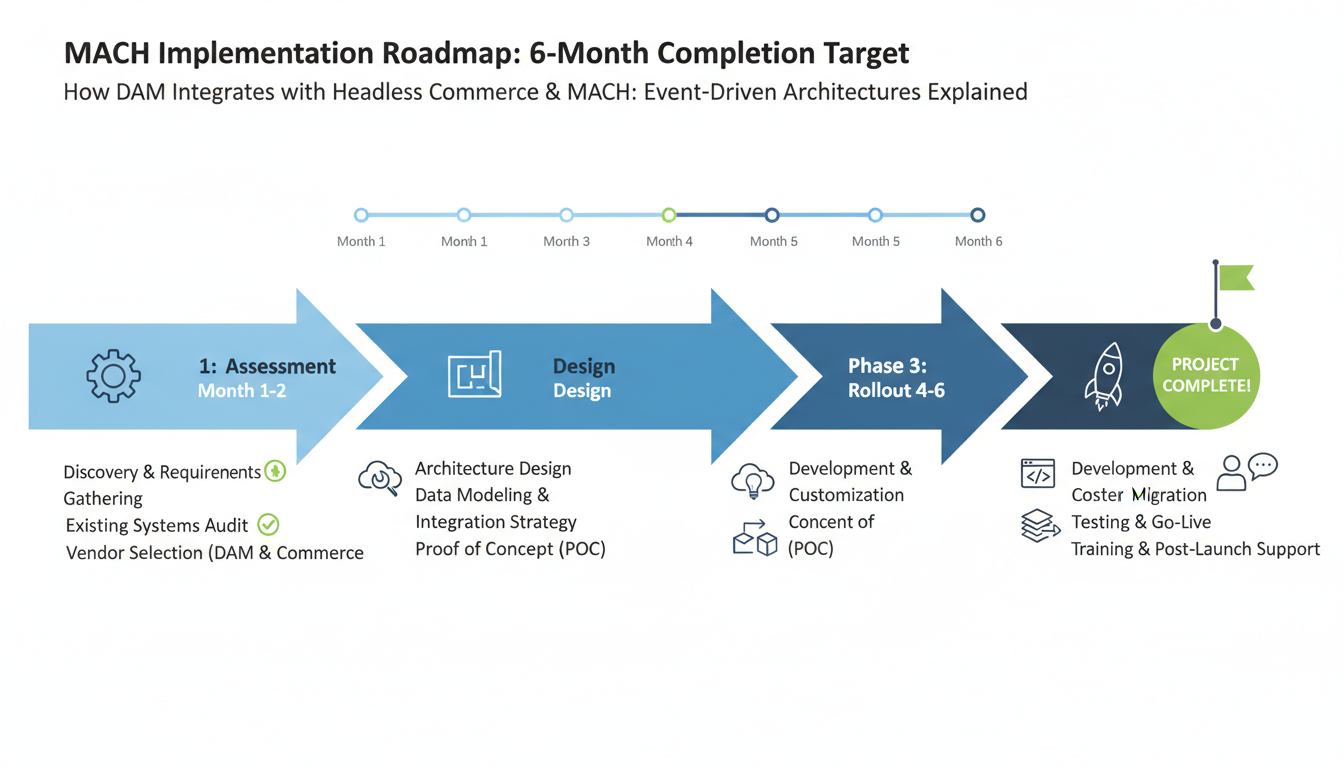
Pro tip: Don't attempt a big-bang migration. Successful dam headless commerce deployments run parallel systems during transition periods, reducing risk while validating performance gains.
Conduct a technical architecture assessment within the next 30 days. Evaluate vendors based on actual API performance, not marketing promises. Request proof-of-concept deployments that mirror your traffic patterns and asset volumes.
The companies implementing MACH architecture today will dominate their markets tomorrow. Your assessment timeline determines whether you're leading that transformation or responding to it.
Start your vendor evaluation now—your future market position depends on the decisions you make this quarter.

Interested in a joint project, a web demo or just getting to know us? We'll get back to you as soon as possible.
